 Blaine Siding
 Building Decks in Grandview: What the Climate Actually Demands
Grandview homes sit in one of the more exposed corners of Whatcom County. You get salt-laden air rolling in off the water, long stretches of driving rain through fall and winter, and a moss season that can stretch from October well into spring. None of that is unusual for Blaine — but it does mean a deck built the way you'd build one in a drier inland climate will fail here faster than it should. Fasteners corrode sooner. Framing that isn't protected from standing water rots from the inside out before the surface boards show any sign of trouble. Moss gets a foothold in shaded, north-facing corners and holds moisture against the decking long after the rain has stopped.
None of this means a deck can't last. It means the build has to account for these conditions from the footings up, not just at the surface. That's the difference between a deck that needs major repair in eight years and one that's still solid in twenty-five.
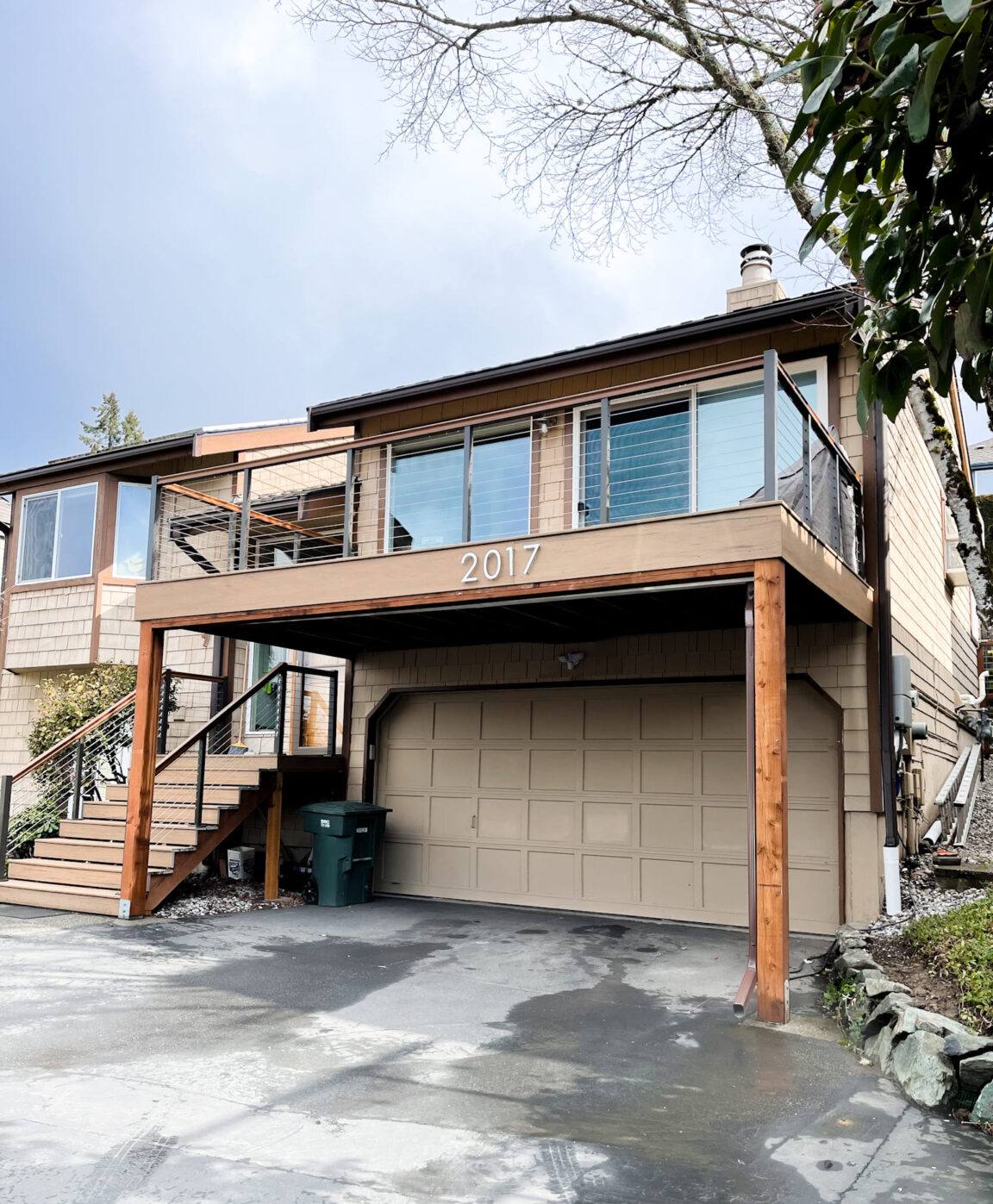
What a Correct Deck Build Involves
A deck is a structure first and a surface second. The parts nobody sees — footings, framing, ledger attachment, flashing — determine how long the parts you do see will last. In a marine climate like Blaine's, a few of these steps matter more than they would somewhere drier.
Footings and Frost Depth
Footings need to be sized and set to the depth required by local code, on undisturbed or properly compacted soil. Grandview's soil conditions can vary from lot to lot, so we check what we're building on rather than assuming. Undersized or shallow footings are one of the most common causes of a deck that starts to rock or sag within a few years.
Ledger Board Attachment and Flashing
Where a deck attaches to the house, the ledger board and its flashing are the single most important moisture detail on the entire project. Done wrong, water gets behind the ledger and works its way into the house's rim joist and framing — a repair that's far more expensive than the deck itself. Done right, flashing sheds water away from the house at every point, with proper gap and drainage behind the ledger so any moisture that does get in can escape.
Joist and Beam Protection
Untreated cut ends, fastener penetrations, and the tops of joists are where rot typically starts. Protective tape or coating on joist tops, sealed cut ends, and corrosion-resistant fasteners throughout are standard on any deck we build — not an upgrade.
Choosing Decking Material for Salt Air and Moss
There's no single "best" decking material — there's the right material for how a homeowner plans to use and maintain the deck. In Grandview's climate, the trade-offs are mostly about moisture behavior, maintenance tolerance, and how the surface handles algae and moss compared to how it handles fasteners and framing movement.
| Material | How It Handles Salt Air & Rain | Moss/Algae Resistance | Maintenance |
|---|---|---|---|
| Pressure-treated wood | Good if sealed and maintained; will absorb moisture at cut ends and fastener holes if not | Needs regular cleaning to prevent buildup in grain | Annual cleaning, periodic sealing/staining |
| Cedar | Naturally moisture- and insect-resistant, but still needs finish maintenance in wet climates | Better than treated pine but still needs cleaning | Sealing every 1–3 years to hold color and resist moisture |
| Composite decking | Doesn't absorb water or rot; performs well long-term in wet climates | Some capped composites resist algae staining well; uncapped or older composites can stain | Periodic washing; no sealing or staining needed |
| PVC decking | Fully moisture-proof; no organic material for rot to take hold in | Smooth, non-porous surface sheds moss and algae more easily than wood grain | Lowest maintenance; occasional washing |
We install all of these. Our job is to tell you honestly what each one asks of you over the next fifteen years — how much cleaning and sealing, how it holds up on a shaded north side of the house versus a sun-exposed deck, and what the fastening system needs to look like underneath it — rather than push whatever has the best margin.
Substructure and Moisture Management
The decking surface gets all the attention, but the framing underneath is what determines the deck's real lifespan. A few details we treat as non-negotiable on every build:
- Joist tape or a comparable protective barrier on all joist tops before decking goes down
- Stainless steel or otherwise corrosion-rated fasteners throughout — standard galvanized hardware corrodes faster in salt-air exposure
- Proper spacing between boards and beneath the deck for airflow, so moisture doesn't get trapped against framing
- Grading and drainage checked at the base of posts and footings so water doesn't pool against the structure
- Hidden fastening systems installed to manufacturer spec, not just "close enough" — gaps that are too tight trap moisture and debris; gaps too wide invite the same
Skipping any of these doesn't show up on day one. It shows up in year six or seven, usually as soft spots near the house or a deck surface that stays damp and mossy long after a dry afternoon.
Our Process, Start to Finish
We keep the process straightforward because most homeowners are doing this once and want to understand what they're paying for.
1. On-Site Assessment
We look at the site itself — sun exposure, drainage, soil, how the deck will tie into the house — before talking materials or price. A deck on a shaded, damp corner of a Grandview lot needs different decisions than one on an open, sun-exposed side.
2. Honest Estimate
You get a written estimate that spells out materials, structural specs, and scope — not just a single number. Deck projects in this area typically run from a modest budget for a smaller, simply-framed deck in pressure-treated lumber up to a considerably higher figure for a larger deck in composite or PVC with railing upgrades. Exact cost depends on size, height off grade, framing complexity, and material choice, which is why we walk the site before quoting rather than guessing over the phone.
3. Permitting
We handle the permit application and inspections required for the project rather than leaving that to you.
4. Construction
Footings, framing, flashing, and decking, in that order, with inspections at the stages that require them.
5. Walkthrough
Before we call it done, we walk the finished deck with you — fastening, railing, stairs, and drainage — so you know exactly what you have and what it needs going forward.
Moss, Mildew, and Long-Term Maintenance in a Marine Climate
Even a well-built deck needs some seasonal attention in a climate that stays damp as much of the year as this one does. The good news is that a properly built deck needs far less intervention than a poorly built one — good drainage and airflow underneath do most of the work of keeping moss from taking hold in the first place.
For homeowners, the practical maintenance list is short:
- Sweep debris (leaves, needles) off the deck regularly, especially in fall — trapped organic matter is what moss and algae feed on
- Clean the surface at least once a year with a deck-safe cleaner, more often on shaded sections
- Check that gaps between boards stay clear of debris so water keeps draining through
- For wood decks, reseal or restain on the schedule the product calls for — don't wait until the finish has already failed
- Have the substructure checked periodically, particularly near the ledger board and post bases, since that's where hidden moisture problems start
Permits and Code Considerations in Whatcom County
Most new decks in Blaine require a building permit, and the requirements cover things like footing depth, guardrail height for decks above a certain elevation, stair geometry, and ledger attachment method. These aren't paperwork for its own sake — they exist because the failure points they cover (guardrails, footings, ledger attachment) are exactly where decks become unsafe if they're built wrong. We pull the permit, coordinate inspections, and build to what's required rather than treating code minimums as optional.
Why Hire a Crew That Already Works in Grandview
A contractor who builds decks across a range of climates has to relearn the local conditions on every job. A crew that regularly works Grandview and the surrounding Blaine area already knows how the salt air and moisture patterns here behave, what soil and drainage tend to look like on lots in this area, and which construction details are worth being strict about versus which are less critical. That familiarity doesn't replace good workmanship, but it does mean fewer surprises mid-project and a deck that's specified correctly for where it's actually going to sit.
It also means someone local to call if a question comes up five or ten years down the road — about maintenance, about a repair, or about whether something you're seeing is normal wear or worth a closer look.
Is a New Deck Right for Your Home?
A few honest questions worth answering before committing to a project:
- Is your current deck (if you have one) failing at the structure level, or just cosmetically worn? These call for different fixes.
- How much sun exposure will the new deck get, and does that change which material makes sense?
- How much ongoing maintenance are you realistically willing to do — this should drive the material choice more than upfront cost alone
- Does the deck need to handle stairs, multiple levels, or a significant elevation change? These add engineering and cost.
- Is there an existing drainage issue on the lot that needs addressing before or during construction?
If you're weighing a new deck for a Grandview home, we're happy to come take a look, walk the site with you, and give you a straight answer on what it would take — no pressure, no obligation. Use the form below to request a free estimate.