 Blaine Siding
 Bellingham Homes Take a Different Kind of Beating Than Most
Bellingham sits on the Salish Sea in Whatcom County, and that location shapes everything about how a house ages here. You've got marine air rolling off Bellingham Bay, a wet season that can stretch from October well into spring, and enough tree cover in older neighborhoods that plenty of siding rarely gets a full day of direct sun. None of that is unusual for this part of Washington. But it does mean the siding on a Bellingham home is working harder than siding on a house fifty miles inland, and it shows up eventually as paint failure, soft trim, or panels that just don't look right anymore no matter how many times they've been painted.
We're a Blaine-based crew that works this stretch of Whatcom County regularly, and Bellingham siding replacement is a big part of what we do. We're not a national outfit dispatching a crew that's never seen a Pacific Northwest winter. We know what this climate does to a house because we see it on every job.
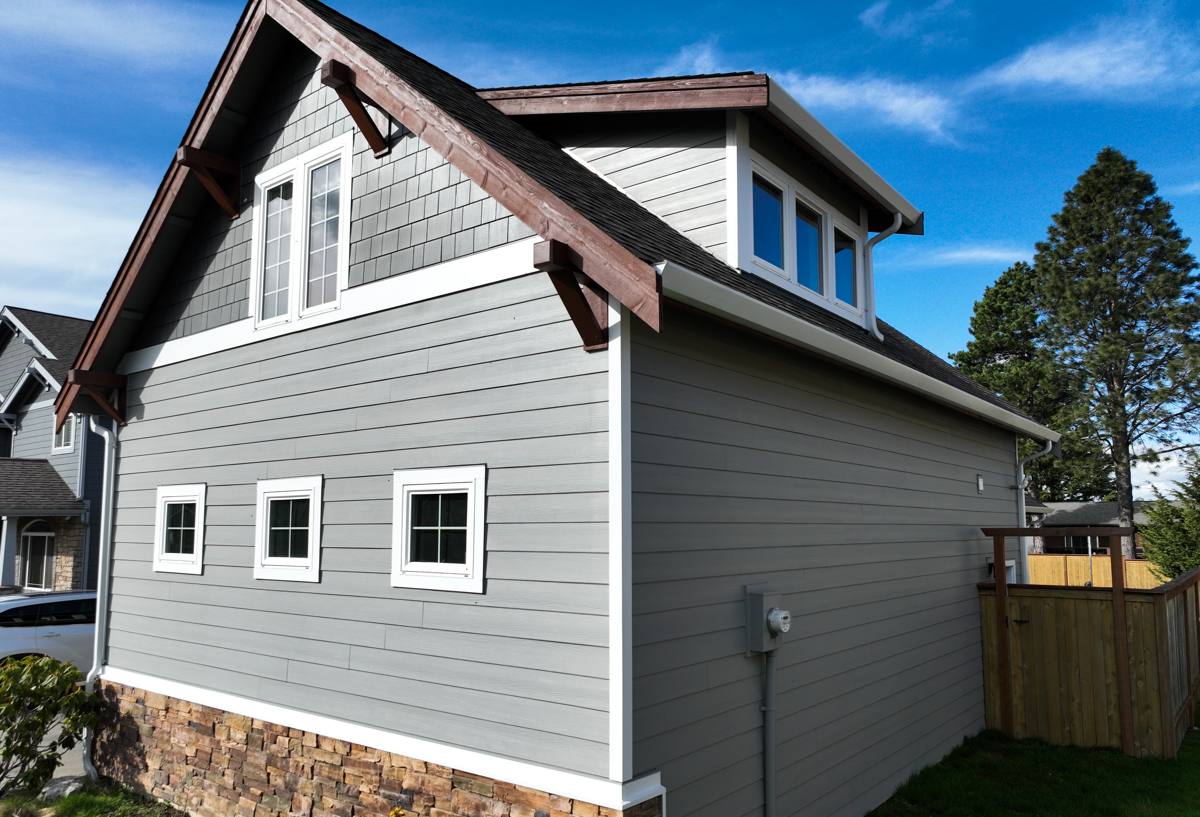
What the Marine Climate Actually Does to Exterior Siding
It helps to be specific about the mechanisms, because "wet climate" undersells what's actually happening to a wall over ten or twenty years.
Salt Air
Proximity to the bay means airborne salt is a real factor here, more so than most homeowners realize until they see it in the corrosion on fasteners, hardware, and unprotected metal trim. Salt-laden moisture accelerates the breakdown of materials that aren't built to handle it, and it's part of why we pay attention to the fastener and flashing details on every job, not just the siding panel itself.
Driving Rain
Wind-driven rain off the water doesn't just wet a wall — it pushes moisture sideways into laps, seams, and butt joints where standing water would otherwise just run off. Siding systems that weren't designed with this in mind can trap moisture behind the surface, where the real damage happens out of sight.
Moss and Prolonged Dampness
Whatcom County's long wet season and shaded lots are a good environment for moss and algae growth on north-facing walls and anywhere siding stays damp for extended stretches. Beyond the cosmetic issue, sustained moisture against a wall surface is exactly the condition that causes rot in wood-based products and coating failure in lower-grade composites.
Put those three together — salt exposure, driving rain, and a moss season that doesn't let up — and you understand why we standardized on one product instead of offering everything on the market.
Why We Only Install James Hardie Fiber Cement
We get asked fairly often why we don't offer vinyl, LP SmartSide, cedar, or other fiber cement brands like Cemplank or Allura. The honest answer is that after years of installing and repairing exteriors in this exact climate, we decided we'd rather stand behind one product we trust completely than offer a menu of options with different long-term outcomes.
Non-Combustible Material
James Hardie fiber cement is cement-based, not wood-based and not vinyl. It doesn't feed a fire the way wood siding can, and it doesn't soften, warp, or melt under heat exposure the way vinyl does. That's a meaningful difference in wildfire-adjacent regions of Washington, and it's simply a more stable material to have on a home long-term.
Built for This Specific Climate
Hardie engineers its HZ5 product line specifically for climates with significant moisture exposure and temperature swings — which describes Whatcom County well. The HZ5 formulation is designed to resist moisture-related damage in wetter regions, which is exactly the failure mode we see most often on siding that wasn't suited to this environment in the first place.
Factory-Applied ColorPlus Finish
Instead of a job-site paint job, Hardie's ColorPlus finish is baked on in a controlled factory process, which gives it better fade resistance and adhesion than field-applied paint. In a climate where UV exposure is inconsistent and moisture is constant, a factory finish holds up more evenly across the whole house than a coating applied outdoors between rain showers.
A Warranty You Can Actually Rely On
Hardie backs its products with a strong transferable warranty, which matters both for a homeowner planning to stay long-term and for resale value if they don't. A warranty is only as good as the product behind it, and we've seen enough of Hardie's track record in this region to trust it.
How Hardie Compares to the Alternatives
We don't think any of these products are junk — each has a place in the market. Here's the honest trade-off comparison that led us to standardize on one option.
| Material | Moisture Behavior in Wet Climates | Maintenance | Fire Resistance | Typical Longevity |
|---|---|---|---|---|
| Vinyl Siding | Sheds surface water well, but can trap moisture behind panels; softens and can warp in heat | Low, but color fades and can't be repainted easily | Softens/melts under heat exposure | 20-30 years, variable |
| LP SmartSide (engineered wood) | Wood-based; performs best when caulking and paint are maintained diligently | Moderate to high — coating maintenance is critical in wet regions | Combustible | 20-30 years with upkeep |
| Cedar / Primed Spruce | Natural wood movement; needs consistent sealing to resist rot in constant moisture | High — regular refinishing required | Combustible | Varies widely with maintenance |
| James Hardie Fiber Cement | Engineered for moisture resistance; HZ5 line built for wetter climates | Low — factory finish, no re-caulking cycle like wood | Non-combustible | Decades, per manufacturer warranty terms |
The pattern across the alternatives is consistent: they can perform well, but they ask more of the homeowner in ongoing maintenance to hold up in a climate like this one. Hardie was the product that let us stop worrying about that trade-off.
What a Bellingham Siding Replacement Looks Like With Our Crew
Every project starts with an honest look at what's actually happening behind the existing siding, not just what it looks like from the curb.
- On-site assessment. We check for moisture intrusion, soft sheathing, and flashing issues around windows, doors, and rooflines — problems that need to be addressed before new siding goes up, not after.
- Weather barrier and flashing detail. Given how much driving rain this area sees, correct water-resistive barrier installation and flashing at every penetration matters as much as the siding itself.
- Hardie installation to manufacturer spec. Proper fastening, clearances, and joint treatment are what make the difference between siding that performs for decades and siding that fails early — installation quality is where a lot of siding problems actually originate, regardless of product.
- Final detail work. Trim, caulking at appropriate joints, and a clean site when we're done.
Why It Matters That We're Based in Blaine, Not Somewhere Else
A crew that works Whatcom County regularly knows things that don't show up in a training manual: which sides of a house take the worst of the wind-driven rain, how much moss growth is normal versus a sign of a bigger moisture problem, and how the local building department and inspection process actually works. We're not learning this region on your project. When we're back in the area for a warranty check or a question six months after the job, we're not driving in from somewhere else — we're already local.
Roofing, Windows, and Decks Face the Same Climate
Siding isn't the only exterior surface fighting salt air, driving rain, and moss in this area — your roof, windows, and any deck take the same exposure. We handle all four because they're connected: a roof leak can show up as siding damage, a failing window can rot the wall cavity behind good siding, and a deck built without the right materials and fasteners will show corrosion and rot faster here than almost anywhere inland. If you're already planning a siding replacement, it's worth having a crew look at the whole exterior at once rather than treating each surface as an isolated project.
Signs Your Bellingham Home May Need Siding Replacement
- Paint that's peeling, bubbling, or needs repainting more often than every five to seven years
- Soft or spongy spots when you press on the siding, especially near the bottom edges or corners
- Persistent moss or algae growth that returns quickly after cleaning
- Visible warping, buckling, or gaps between panels
- Rising energy bills that suggest the wall assembly isn't insulating or sealing the way it should
- Corrosion staining around fasteners or metal trim
- Interior signs like musty smells or discoloration on walls that back up to exterior siding
What Affects the Cost of a Siding Replacement
| Factor | Why It Matters |
|---|---|
| Home size and wall complexity | More corners, gables, and trim detail mean more labor and material |
| Condition of existing sheathing | Rot or moisture damage found underneath the old siding needs repair before new siding goes on |
| Siding profile and trim selection | Lap width, board-and-batten, and trim choices affect material cost |
| Access and site conditions | Multi-story sections, tight lots, or landscaping can affect labor time |
| Whether flashing or window details need upgrading | Bringing water management details up to current standards protects the new siding investment |
We'd rather walk your specific house and give you real numbers than throw out a broad estimate that doesn't reflect your situation — every home in this area carries a slightly different history of exposure and prior work.
Ready When You Are
If your siding is showing its age, or you just want a second opinion on what's really going on behind it, we're happy to take a look. There's no pressure and no obligation — just a straightforward assessment from a crew that works this climate every day. Use the form below to request a free estimate for your Bellingham home.