 Blaine Siding
 Why Small Warning Signs Deserve Attention in Blaine
Siding almost never fails overnight. It fails in stages — a hairline crack that widens over a few winters, a corner that stays damp a little longer after every storm, a color that goes slightly chalky before anyone notices. Because the changes happen slowly, most homeowners don't catch them until the problem has already worked its way from the surface into the wall behind it. In Blaine, that timeline moves faster than it does in most of the country. This is a town that sits right where Semiahmoo Bay meets Drayton Harbor, a few minutes from the Peace Arch border crossing, with salt-laden air coming off the water, wind-driven rain that hits walls sideways rather than falling straight down, and a moss season that can run nearly year-round on shaded exposures. Materials that would show only minor wear after a decade in a drier inland climate can show real problems here in half that time, especially if the product wasn't suited to marine exposure or the installation wasn't done to spec.
This page walks through what failing siding actually looks like — from what you can see standing on the sidewalk to what only shows up once you get up close or step inside the house. The goal isn't to talk every homeowner into an early replacement. It's to help Whatcom County homeowners tell the difference between normal cosmetic aging and a problem that's actively letting water into the structure.
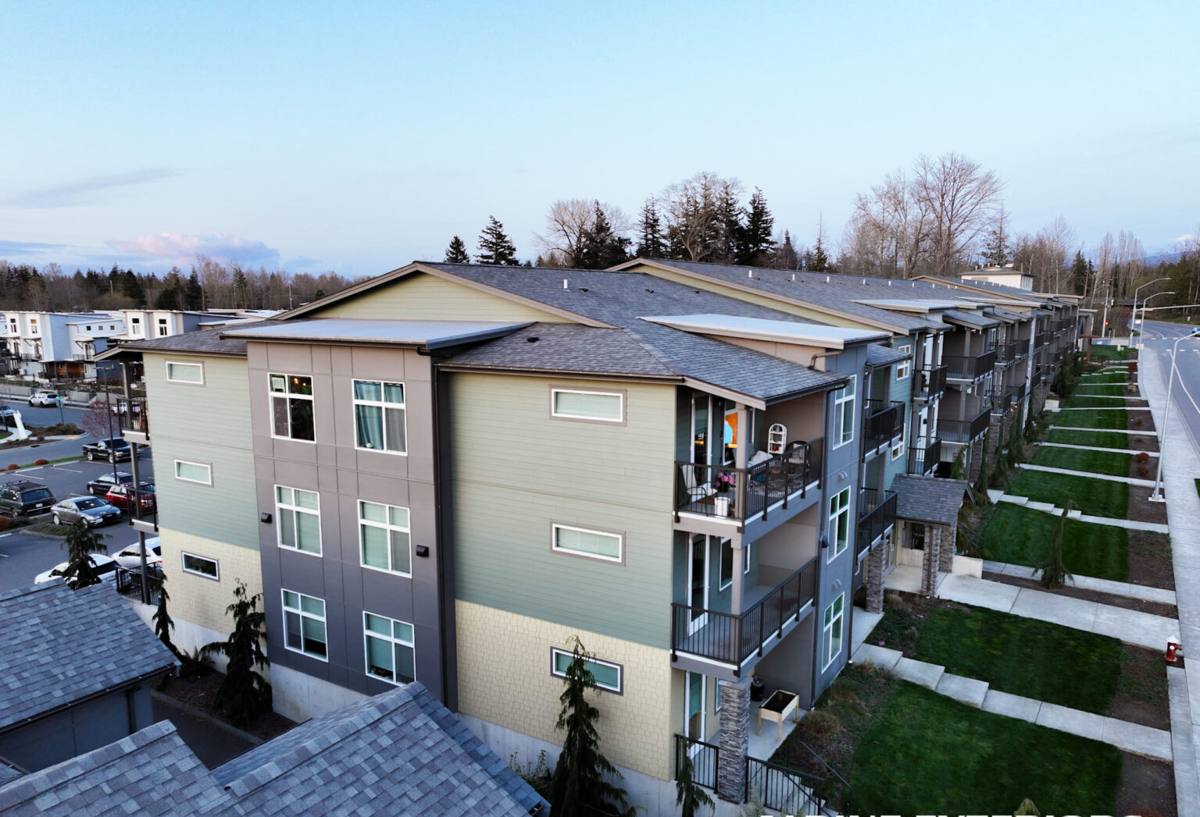
What Blaine's Climate Actually Does to Siding
Being this close to open water changes the math on how long siding lasts. Salt air is corrosive to fasteners, flashing, and lower-grade finishes in a way that inland Whatcom County towns simply don't deal with to the same degree. Wind off the Strait of Georgia doesn't just bring rain — it drives that rain sideways into seams, trim joints, and butt joints, which stresses siding differently than straight-down rainfall does. Layer on a moss season that can stretch from fall through spring on north-facing and shaded walls, and you have three separate stressors working on a home's exterior at once, year-round. A siding product and installation that would perform fine in a drier climate can start showing wear well ahead of schedule here, which is exactly why the signs below deserve to be checked regularly rather than only when something looks obviously wrong.
Warning Signs You Can Spot From the Curb
Warping, Bowing, or Buckling
Panels or boards that no longer sit flat against the wall — bulging, rippling, or bowing along a seam — are almost always reacting to moisture. Wood-based siding swells when it absorbs water and doesn't reliably return to its original shape once it dries, so repeated wet-dry cycles through a Blaine winter can leave visible distortion behind. Once siding is warped, it has usually stopped sealing the wall the way it was designed to, even before any cracking shows up.
Fading, Chalking, or Uneven Color Loss
Gradual fading over many years is normal weathering. A chalky residue that rubs off on your hand, or color loss that shows up in patches rather than evenly across a wall, is not. Chalking means the surface finish has broken down and stopped protecting the material underneath, which leaves the siding more exposed to moisture than it was ever designed to handle.
Visible Cracking or Splitting
Where a crack shows up matters as much as the crack itself. Cracks running along the length of a board often point to a material or moisture problem, while cracking concentrated around window and door corners more often points to flashing or settling issues. Either way, a crack is an opening for water, and water that gets behind siding usually doesn't announce itself again until real damage has already been done.
Warning Signs That Need a Closer, Hands-On Look
Soft or Spongy Spots
Press gently on the lower courses of siding, the areas near grade, and the trim around windows and doors. If the material gives more than it should, or feels spongy instead of solid, moisture has likely already saturated the siding or the sheathing behind it. This simple press test is one of the most reliable things a homeowner can do without any tools, and given how much moisture Blaine sees, it's worth doing at least once a year.
Gaps, Loose Panels, or Popped Fasteners
Wind off the water is a near-constant here, and sustained exposure works fasteners loose over time. Gaps opening between panels, boards that flex when pushed, or nail heads backing out are all signs the siding is no longer secured properly. A loose panel isn't just a cosmetic issue — it creates a direct path for wind-driven rain to get behind the water-resistive barrier.
Moss, Mildew, or Dark Staining That Keeps Coming Back
Some surface growth on shaded, north-facing walls is common in this climate and isn't automatically a red flag. But moss or mildew that returns quickly after cleaning, or dark staining that keeps spreading instead of staying contained, usually means the surface is holding moisture longer than it should. Porous or lower-grade materials are far more prone to this than a dense, factory-finished product, and once growth is established it tends to speed up whatever surface breakdown is already underway.
Interior Clues That Water Has Already Gotten In
By the time siding failure shows up inside the house, water has usually been finding its way into the wall assembly for a while. These signs deserve prompt attention rather than a wait-and-see approach:
- Peeling paint or bubbling drywall on interior walls, particularly on exterior-facing ones
- A musty smell along exterior walls that doesn't clear up with normal cleaning
- Visible mold or discoloration near baseboards, window trim, or where walls meet the floor
- Heating bills that climb without a clear explanation, which can mean saturated insulation has lost effectiveness
- Wall surfaces that feel cool, damp, or soft to the touch
None of these on its own proves siding failure, but combined with visible exterior wear, they're a strong signal that moisture has already moved past the cladding and into the structure.
How Common Siding Materials Hold Up Under Blaine's Conditions
| Material | Typical Early Failure Signs | How It Handles Salt Air and Wind-Driven Rain |
|---|---|---|
| James Hardie fiber cement | Rare when installed to spec; watch caulk joints and fastener lines over the years | Dimensionally stable; factory ColorPlus finish resists fading and chalking |
| Vinyl siding | Warping, cracking during cold snaps, seams separating | Can distort with heat and cold cycling; seams are a recurring weak point |
| LP SmartSide / engineered wood | Edge swelling, delamination at cut ends, soft spots near grade | Wood-based core absorbs moisture readily; cut edges need consistent sealing |
| Cedar / primed wood | Cupping, checking, finish breakdown, recurring moss and mildew | Takes on and releases moisture easily; needs regular refinishing in this much wet air |
This is part of why we install James Hardie fiber cement exclusively rather than offering a menu of siding brands. The other products all have a place in the broader market — but in a marine, high-moisture setting like Blaine's, we've consistently seen fiber cement hold up with fewer of the early warning signs covered above, and we'd rather stand behind one system fully than sell a homeowner a product that quietly shifts long-term maintenance risk onto them.
A Self-Inspection Checklist for Blaine Homeowners
Walk the exterior of your home once or twice a year — early spring and early fall work well in this climate — and check for the following:
- Press-test the bottom few courses of siding and anywhere near grade for soft or spongy spots
- Check south and west-facing walls for chalking, fading, or finish breakdown
- Look at north-facing and shaded walls for moss, mildew, or dark staining that returns after cleaning
- Inspect caulk lines and joints around windows, doors, and corner trim for cracking or gaps
- Look for panels that have separated, bowed, or show visible fastener pops
- Walk interior rooms along exterior walls and check for musty smells, staining, or soft drywall
- Confirm gutters and downspouts are moving water away from the siding instead of splashing back onto it
Telling Maintenance Apart From Replacement
Not every item on this page means a full re-side is needed. Isolated caulk cracking, a few popped fasteners, or surface staining on an otherwise sound wall are usually maintenance items that can be addressed directly. Widespread warping, soft sheathing behind multiple panels, recurring interior moisture signs, or a finish failing across large sections of the house point toward replacement being the more honest recommendation — patching a system that's already failing tends to buy a year or two at best rather than solving the underlying problem.
What Waiting Actually Costs
The real risk with failing siding isn't the siding itself — it's what happens to the wall assembly behind it while the problem goes unaddressed. Wet sheathing loses structural integrity over time, insulation stops performing once it's saturated, and framing exposed to sustained moisture can develop rot that costs considerably more to repair than the siding replacement would have. Catching failure signs early, while the damage is still limited to the cladding layer, is almost always less disruptive and less expensive than waiting until the problem has reached the framing underneath.
Getting a Straight Answer on Your Siding
If you're seeing any combination of the signs above, or you're just not sure whether what you're looking at is cosmetic wear or something more serious, an in-person look tells you more than any checklist can. We walk the exterior, check the spots that tend to fail first in a climate like Blaine's, and give you a straightforward read on what's maintenance, what's worth watching, and what actually needs to be addressed. If replacement does turn out to make sense, we can walk you through why James Hardie fiber cement is what we install and stand behind on homes in this area. Reach out below for a free, no-pressure estimate.