 Blaine Siding
 Exterior Work Built for Nooksack's Climate
Nooksack sits inland from Blaine, but it shares the same weather system that defines exterior work across Whatcom County: a long wet season, persistent low cloud cover, and moisture that doesn't let up for months at a stretch. Homes here don't take a direct hit of salt spray the way waterfront properties closer to Semiahmoo Bay do, but the marine air mass that moves across the county still carries humidity and rain inland, and it settles into siding, trim, roofing, and anything wood-adjacent just the same. The practical result is the same list of problems we see on exterior calls throughout the region: swelling and rot at butt joints, moss colonizing north-facing roof slopes and shaded siding, and paint film failing years before it should because the substrate underneath was never really dry.
We work Nooksack as part of our regular service area, alongside Blaine and the rest of Whatcom County. That matters more than it sounds like it should — a crew that only shows up once for a bid and never again doesn't build a feel for how a specific area's weather actually behaves. We do.
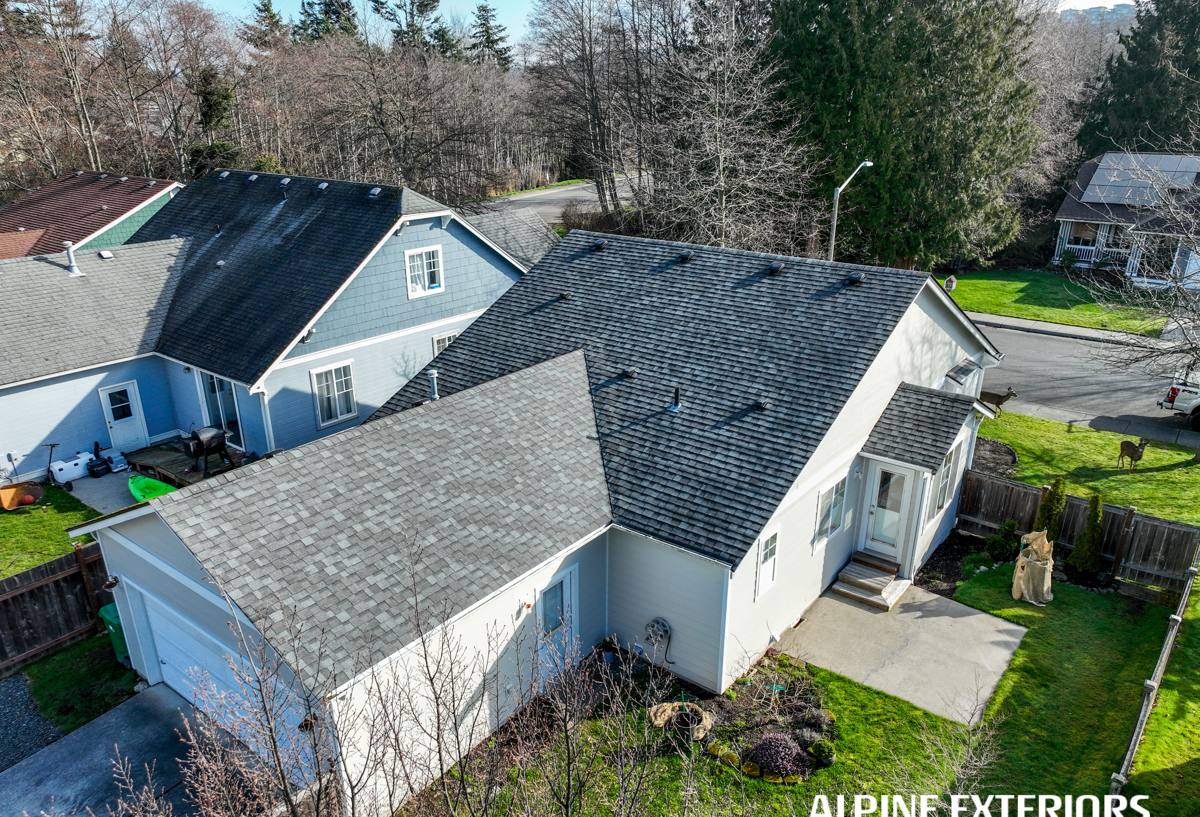
What the Local Climate Does to a House
Rain That Finds Every Gap
Whatcom County doesn't get the heaviest rainfall totals in the state, but it gets a lot of days of it — soft, sustained, driving rain that has time to work its way into any weak point in a building envelope. A house doesn't need a dramatic storm to develop water problems here. It needs one bad seam, one under-flashed window, or one section of caulk that failed three winters ago and was never noticed, and then years of ordinary rain does the rest.
Moss and Shade
Nooksack has plenty of tree cover and plenty of shaded north- and east-facing walls and roof planes that rarely see direct sun in the winter months. That's exactly where moss and algae take hold. Moss doesn't just look bad — it holds moisture against the surface underneath it, and on wood-based siding or aging roofing, that constant dampness accelerates rot and granule loss.
Temperature Swings and Material Movement
Whatcom County sees real freeze-thaw cycling in winter, plus warm, dry stretches in summer. Materials that absorb moisture expand and contract with those swings. Over years, that movement opens up joints, cracks paint film, and loosens fasteners — especially on siding products that weren't engineered with this kind of climate cycling in mind.
Siding: Why We Only Install James Hardie
We get asked why we don't offer vinyl, LP SmartSide, cedar, or the other fiber cement brands like Cemplank and Allura. The honest answer is that we made a decision years ago to standardize on one product line — James Hardie fiber cement — because it's the one we trust to perform in this climate without turning into a maintenance project for the homeowner.
- Vinyl is affordable and low-maintenance in a general sense, but it expands and contracts more than fiber cement across temperature swings, can warp or crack in impacts, and doesn't hold paint if a homeowner ever wants to change the color.
- LP SmartSide is an engineered wood product. It performs reasonably when installation and maintenance are followed to the letter, but it's still wood-based, which means edge and seam moisture management has to be nearly perfect over decades — in a climate this wet, that's a hard standard to guarantee.
- Cedar looks great when new but needs ongoing refinishing, and untreated moisture exposure over time leads to cupping, splitting, and rot, especially in shaded, damp locations like much of Nooksack.
- Cemplank and Allura are also fiber cement, and fiber cement as a category is the right call for this climate. Where they differ from what we install is factory finish process, product engineering for specific climate zones, and warranty structure — details covered in more depth below.
James Hardie fiber cement is non-combustible, dimensionally stable, and manufactured with a factory-applied ColorPlus finish that's baked on and warranted against fading and peeling — which matters in a region where a home's siding sits under fog, drizzle, and UV cycling for a decade at a stretch without ever fully drying out.
HZ5 and Climate-Engineered Product Lines
James Hardie engineers its siding in different formulations for different climate zones — HZ5 is the formulation built for the wetter, milder Pacific Northwest, versus a hot-dry or freeze-heavy formulation elsewhere in the country. That's not a marketing detail; it affects how the product handles moisture cycling over its lifespan, which is precisely the stress Whatcom County exterior work is up against.
Roofing for a Wet, Shaded Climate
Roofing failures in this area rarely show up as one dramatic leak. More often it's granule loss from age, moss lifting shingle edges, or flashing that was installed adequately but not built for decades of this much moisture cycling. We look at ventilation, underlayment, and flashing details as closely as the shingle itself, because in a climate like this, the roofing system underneath the visible layer is what actually determines how long a roof lasts.
Windows: Sealing Out Driving Rain
Old or poorly flashed windows are one of the most common sources of hidden water damage we find during siding tear-off. Wind-driven rain doesn't need a wide gap to get behind trim and start rotting the sheathing underneath — it just needs time, and this climate gives it plenty. When we replace siding around existing windows, we check flashing and sealant as a matter of course, and window replacement is something we handle directly rather than farming out, so the flashing and the siding integration are handled by one crew that's accountable for both.
Decks: Built to Handle Standing Moisture
A deck in Nooksack spends a good part of the year damp, especially where tree canopy keeps it shaded and slow to dry. Ledger board flashing, proper joist spacing, and material choice all matter more here than they would in a drier climate, because a deck built without moisture management in mind will show rot at the ledger and joists years before the surface boards look worn. We build and repair decks with drainage and ventilation as a starting assumption, not an afterthought.
Cost Factors to Expect
| Factor | Why It Matters Here |
|---|---|
| Existing moisture damage | Rot found during tear-off (common on older homes) adds sheathing repair before new siding goes on |
| Home size and wall complexity | More corners, gables, and trim details mean more labor and material |
| Siding product and finish | Fiber cement plank, panel, and shingle profiles vary in material cost and install time |
| Roof pitch and access | Steep or heavily treed lots require more setup time and safety equipment |
| Window count and condition | Old or failing windows replaced alongside siding add cost but avoid re-opening the wall later |
We give straight, itemized estimates rather than vague ranges, because every one of these factors changes the number and a homeowner deserves to know why.
What to Check Before Hiring an Exterior Contractor
- Washington state contractor license, current and in good standing
- Liability insurance and workers' compensation coverage
- A written scope that names the exact product, line, and finish being installed
- Manufacturer certification if the product line requires it
- A clear explanation of how the crew handles flashing, house wrap, and moisture barriers — not just the finish material
- References or a portfolio the contractor is willing to walk you through
A cheap bid that skips flashing detail or moisture barrier work will almost always cost more in the long run than a properly scoped one, especially in a climate that punishes shortcuts.
Why a Local Crew Matters in Nooksack
Exterior work here isn't generic. A crew that's worked Blaine, Nooksack, and the rest of Whatcom County knows which details of a build actually fail first in this climate — which corners take on moss, which flashing details tend to get skipped by out-of-area crews unfamiliar with the moisture load, and which materials hold up versus which ones just look good on install day. That local pattern recognition is worth more than it sounds like on paper, because it changes what gets extra attention before problems start rather than after.
If you're weighing options for siding, roofing, windows, or a deck on a Nooksack home, we're happy to walk the property and give you a straightforward, no-pressure estimate — just fill out the form below.