 Blaine Siding
 Exterior Work in a Waterfront Town
Blaine Harbor sits right where the Salish Sea meets Whatcom County, and that location shapes everything about how a house ages here. Homes near the water deal with a different set of pressures than a house fifteen miles inland: salt-laden air that never really stops moving, rain that comes in sideways off the water more often than it falls straight down, and long stretches of gray, damp weather that give moss and algae months at a time to get comfortable on a north-facing wall. None of this is exotic or unusual for the area — it's just the baseline. The homes that hold up well in Blaine Harbor are the ones where the exterior was built and maintained with that baseline in mind from the start.
We work on siding, roofing, windows, and decks throughout Blaine and the surrounding parts of Whatcom County, and Blaine Harbor is one of the areas where we see the clearest, fastest evidence of what marine exposure does to the wrong materials. This page walks through what that exposure actually does to a home's exterior, how we approach siding replacement in this kind of environment, and why we've standardized on one siding product instead of offering the full menu most contractors carry.
What Salt Air, Wind-Driven Rain, and Moss Actually Do
Each of these three factors stresses a different part of a home's exterior, and together they compound.
Salt Air
Airborne salt is corrosive to exposed metal fasteners, flashing, and trim, and it accelerates the breakdown of coatings and caulks that aren't rated for coastal exposure. On siding specifically, salt residue combines with moisture to create a film that holds dirt and encourages mildew growth, which is why homes close to the water often look dingy faster than homes just a short distance inland, even with the same paint job.
Wind-Driven Rain
Rain that's pushed sideways by wind off the harbor doesn't behave like rain falling straight down. It gets forced up under lap siding, around window and door trim, and into any gap in the weather barrier that would otherwise shed water on a calmer day. This is why flashing details, house wrap installation, and caulking at penetrations matter more here than they would in a more sheltered location — the margin for error is smaller.
Moss and Algae Season
Whatcom County's wet season runs long, and shaded, north- or west-facing walls in Blaine Harbor can stay damp for weeks at a stretch. That's exactly the environment moss, algae, and mildew need to establish themselves. On the wrong substrate, sustained moisture and organic growth don't stay cosmetic — they can work into seams, fastener holes, and any spot where the surface coating has started to fail.
Why We Install James Hardie Fiber Cement Here
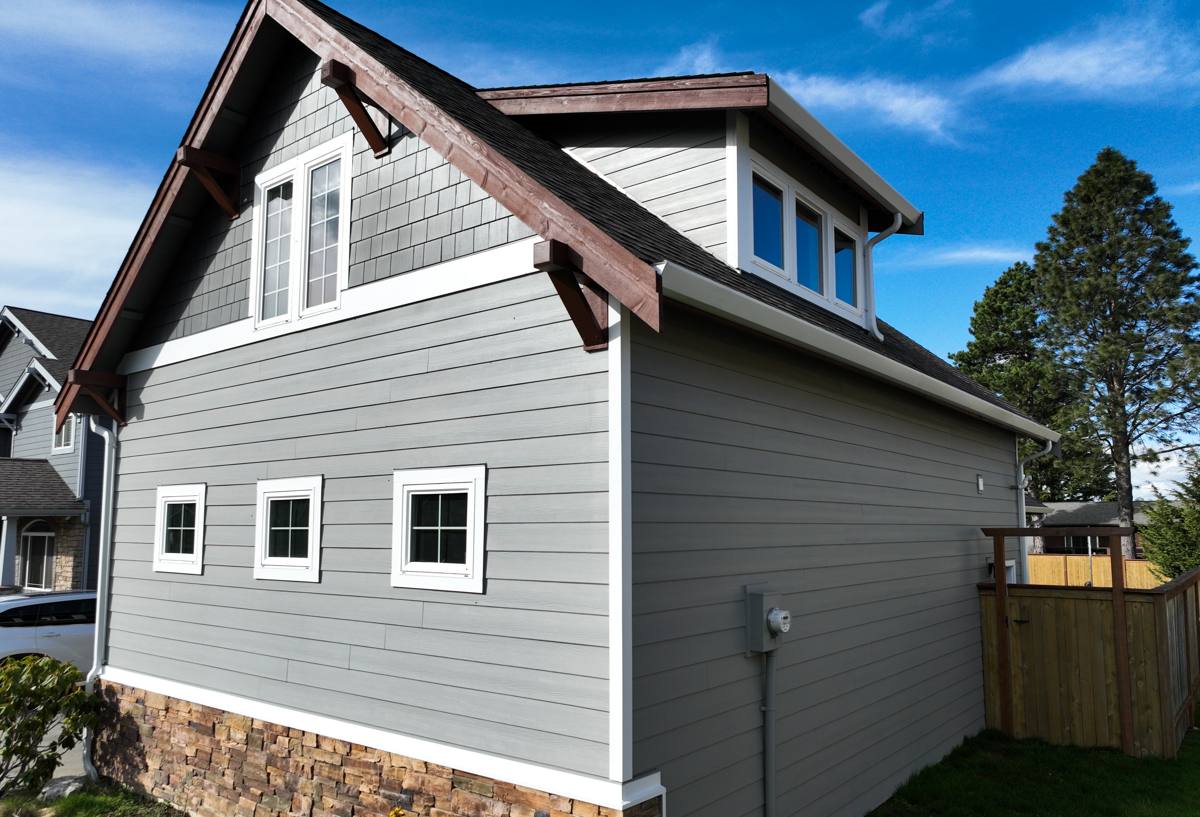
We install James Hardie fiber cement siding exclusively, and in a location like Blaine Harbor, that's not a marketing preference — it's a practical one. Fiber cement is non-combustible and dimensionally stable, meaning it doesn't swell, warp, or rot the way wood-based products can when they take on repeated moisture. Hardie's ColorPlus factory-applied finish is baked on under controlled conditions and holds up to UV and salt exposure noticeably better than field-applied paint, which matters on a coastline where recoating every few years isn't something most homeowners want to budget for.
Hardie also engineers specific product lines (the HZ5 designation, for example) for regions with more demanding moisture and temperature cycling, and Western Washington's coastal areas fall into that category. Combined with a strong transferable warranty, that engineering is a big part of why we don't hedge with multiple siding brands — we've chosen the one we believe holds up best to what Blaine Harbor actually throws at a house.
What We Don't Install, and Why That's Relevant Here
Most exterior contractors will sell you whatever siding you ask for. We don't, and it's worth explaining why, especially in a marine environment.
- Vinyl siding is affordable and low-maintenance in mild conditions, but it can become brittle over time with UV and temperature swings, and its seams and J-channels give wind-driven rain more opportunities to find a way behind the cladding.
- LP SmartSide and other engineered wood products perform well when installation and maintenance are followed precisely, but they're wood-based, and wood-based siding is inherently more vulnerable to sustained moisture exposure than fiber cement — a real consideration on a wall that stays wet for days after a harbor storm.
- Primed spruce and cedar can look excellent and have a long history in the Pacific Northwest, but both require an ongoing maintenance commitment — recoating, caulking, and moisture monitoring — that goes up, not down, this close to salt water.
None of these products are bad products used correctly in the right setting. They're just not what we're willing to put our name behind for a home that's going to spend decades absorbing salt air and driving rain. Fiber cement gives us a material where the maintenance burden and moisture risk are both lower, which is the trade-off that matters most in Blaine Harbor.
Comparing Siding Materials for Coastal Exposure
| Material | Moisture Behavior | Maintenance in Marine Air | Finish Durability |
|---|---|---|---|
| James Hardie Fiber Cement | Dimensionally stable, resists warping | Low — occasional wash | Factory ColorPlus finish, long UV/salt resistance |
| Vinyl | Sheds water but seams can allow intrusion | Low, but can become brittle over time | Field-limited color options, can fade |
| Engineered Wood (LP SmartSide) | Vulnerable if moisture reaches the substrate | Moderate — caulk and coating checks | Field or factory finish depending on product |
| Cedar / Primed Spruce | Absorbent; needs consistent sealing | High — recoating on a regular cycle | Depends entirely on maintenance schedule |
The Rest of the Exterior: Roofing, Windows, and Decks
Siding is only part of how a Blaine Harbor home stands up to the weather. We also handle roofing, windows, and decks, because a home's exterior works as one connected system — a roof that's shedding water improperly, or a window that isn't flashed correctly, can undermine even the best siding job.
Roofing
Roofs near the harbor take on wind-driven rain the same way walls do, and moss growth on shaded roof slopes is a routine maintenance issue in this part of Whatcom County. We look at flashing, ventilation, and moss prevention as part of any roofing conversation, not just the field material.
Windows
Window flashing and sealant are one of the most common places water finds its way into a wall assembly during a coastal storm. When we replace siding, we check window integration closely, since a siding job is also a good opportunity to correct flashing details that may have failed over the years.
Decks
Outdoor living space near the water deals with the same salt exposure and moisture cycling as the siding above it. Fastener selection, board spacing for drainage, and ledger flashing all matter more here than in a drier inland setting.
What a Local Crew Should Get Right
A crew that mainly works inland can do a technically fine installation and still miss details that matter specifically near the water. For Blaine Harbor, we pay close attention to:
- Fastener and flashing material chosen for corrosion resistance, not just cost
- House wrap and seam taping done to shed wind-driven rain, not just vertical rain
- Caulking and sealant products rated for sustained UV and salt exposure
- Ventilation behind the siding so moisture that does get in can dry out
- Extra attention on north- and west-facing walls where moss and algae take hold fastest
Signs Your Current Siding Needs a Closer Look
- Persistent moss or dark streaking that comes back shortly after cleaning
- Soft spots, bubbling, or visible warping, especially near the bottom courses
- Paint or coating that's peeling or chalking faster than expected
- Gaps or cracked caulking around windows, doors, or trim
- Visible rust bleeding from fasteners or flashing
Planning a Project in Blaine Harbor
Cost and timeline for a siding project depend on the size of the home, the condition of the existing wall assembly (whether we're dealing with hidden moisture damage), and how much of the trim, flashing, and window integration needs to be addressed along the way. A straightforward re-side on a well-maintained home is a very different project from one where years of moisture exposure have to be corrected first, and we'll always tell you honestly which situation you're in before work starts.
If you're noticing moss buildup, fading, or soft spots on your siding, or you're just planning ahead for a home this close to the harbor, we're happy to take a look. Reach out for a free, no-pressure estimate using the form below, and we'll walk the exterior with you and explain exactly what we see.