 Blaine Siding
 Reading the Signs on a Blaine Home
Every siding job we look at in Blaine starts with the same question from the homeowner: "Can this be patched, or do we need to talk about replacing the whole thing?" It's a fair question, and it deserves an honest answer rather than a sales pitch. Some damage really is a weekend fix. Other damage is a symptom of something bigger happening behind the siding, and patching it just buys you a year or two before the same problem reappears somewhere else on the wall.
This guide walks through how to tell the difference, what makes Blaine's climate a factor in that decision, and what actually goes into a legitimate repair versus a full re-side. Nothing here is meant to talk you into a bigger job than you need — plenty of Blaine homes get several more years out of their existing siding with the right spot repairs.
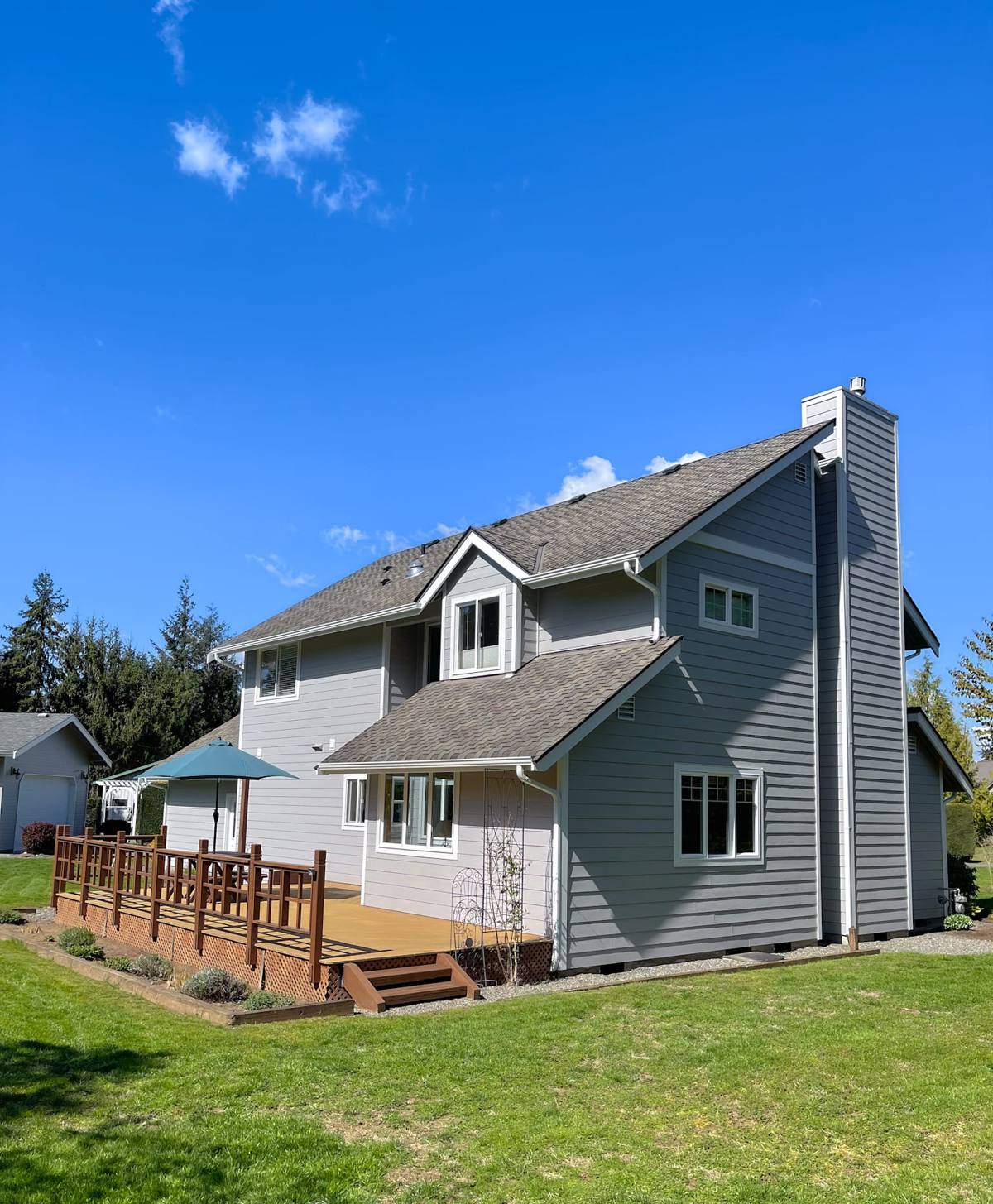
Why Blaine's Climate Speeds Up the Clock
Blaine sits right on Semiahmoo Bay and Drayton Harbor, which means salt-laden air is a constant here in a way it isn't for homes further inland in Whatcom County. Salt air accelerates corrosion on fasteners, trim flashing, and any exposed metal, and it works its way into porous siding materials faster than plain rain does. Add in the region's driving rain — wind-driven storms off the Strait of Georgia that push water sideways into wall assemblies rather than straight down — and you get moisture intrusion at seams and laps that a drier climate would never see.
Then there's moss season, which in this part of Whatcom County runs long — often eight months or more of damp, shaded conditions that let moss and algae colonize north-facing walls, fence lines, and anything shielded from direct sun. Moss holds moisture against the siding surface far longer than open exposure would, which matters most for materials that aren't dimensionally stable when wet.
None of this means Blaine siding is doomed — it means the inspection questions are different here than they'd be in a drier climate, and the repair-versus-replace math has to account for salt exposure, wind-driven rain, and sustained dampness, not just age.
What This Looks Like in Practice
A siding product that performs fine in a sheltered inland yard can struggle on a waterfront-facing wall two miles away in Blaine. That's why we look at orientation and exposure on every estimate — the ocean-facing and north walls of a home almost always show more wear than the walls tucked out of the weather.
Repair vs. Replace: The Core Decision Table
Most siding decisions come down to three things: how much of the wall is affected, what's happening underneath the surface, and how old the existing material already is relative to its expected service life. Here's a general framework we use when walking a property.
| Situation | Usually Repair | Usually Replace |
|---|---|---|
| Damage extent | Isolated to one or two boards/panels | Spread across multiple walls or elevations |
| Cause of damage | Impact damage, a single failed caulk joint, one cracked board | Systemic moisture intrusion, rot at multiple points, widespread warping |
| Age of siding | Well within its expected service life | At or past manufacturer's expected lifespan |
| Sheathing/framing | Solid, dry, no soft spots | Soft, spongy, or visibly rotted sheathing found on probing |
| Paint/finish condition | Localized peeling or fading | Finish failing broadly, chalking, or repeated repainting needed |
| Moss/algae staining | Surface staining, cleans off | Recurring growth tied to trapped moisture underneath |
No single row decides the outcome by itself — it's the combination that matters. A home with one cracked board and otherwise sound, dry sheathing is a repair. A home with staining, soft sheathing behind two or three boards, and siding already near the end of its rated life is telling you the whole wall system needs attention, not just the visible symptom.
Warning Signs That Usually Mean More Than a Patch
Some symptoms are reliable indicators that the problem goes deeper than what you can see from the ground. If you're noticing more than one or two of these, it's worth having someone actually probe behind the siding before committing to a repair.
- Soft or spongy spots when you press on the siding, especially near the bottom courses or window trim
- Bubbling or peeling paint that keeps coming back in the same spot after repainting
- Visible gaps or separation at seams, corners, or where siding meets trim
- Persistent moss or algae growth that returns within a season of cleaning
- A musty smell in an interior room that shares a wall with the affected siding
- Warping, cupping, or boards that no longer sit flat against the wall
- Nail heads popping or streaking rust down the face of the siding — a common salt-air symptom in Blaine
- Damage clustered on the same one or two walls, particularly ones facing the water or prevailing wind
What a Legitimate Repair Actually Involves
A proper spot repair isn't just swapping a damaged board for a new one and calling it done. It should include pulling the affected material far enough back to inspect the house wrap or building paper underneath, checking the sheathing for softness, and confirming flashing at any nearby windows, doors, or penetrations is doing its job. If the underlying structure is dry and sound, replacing the damaged pieces and re-sealing properly is a legitimate, cost-effective fix — there's no reason to replace an entire wall over a problem that's genuinely contained.
Where repairs get risky is when a contractor skips that inspection step and just caps the damage. In a climate like Blaine's, with sustained dampness and salt exposure, a repair that doesn't check what's behind the surface is a repair that's guessing.
Matching Materials on an Older Home
One practical wrinkle with repair-only jobs: older siding, especially anything with a factory finish or a specific board profile, can be hard to match exactly. A patch that's structurally fine but visibly mismatched in color or texture is a cosmetic trade-off worth discussing honestly before the work starts, not after.
When Replacement Is the Smarter Long-Term Move
Full replacement makes sense when the damage is widespread, when the sheathing underneath has been compromised in more than one location, or when the siding is old enough that you'd be repairing it again within a year or two regardless of what you fix now. It's also worth considering replacement proactively if you're already planning other exterior work — a re-roof, window replacement, or repaint — since bundling the siding into that project avoids paying for scaffolding, tear-out, and disposal twice.
There's also a straightforward math argument. If a home needs repairs on three or four separate walls, the labor and material cost of doing those repairs correctly, one at a time, can approach a meaningful fraction of a full re-side — without giving you a uniform, fully warrantied result at the end.
Cost Factors Worth Understanding
Every home is different, and we don't quote sight-unseen numbers on a page like this. But the factors that move a project's cost up or down are consistent, and knowing them helps you ask better questions when you're getting estimates.
| Factor | Why It Matters |
|---|---|
| Extent of hidden damage | Rot found in sheathing or framing adds tear-out and rebuild costs beyond the siding itself |
| Home height and access | Two-story walls, steep grades, and water-facing elevations often require more scaffolding or staging |
| Material choice | Product, profile, and finish all affect both material cost and long-term maintenance |
| Trim and detail work | Corner boards, window trim, and fascia detail add labor time beyond flat wall area |
| Repair vs. full tear-off | Partial repairs cost less up front but don't reset the clock on the rest of the wall |
What We Install When It's Time to Replace
When a Blaine home needs new siding rather than a repair, our recommendation is James Hardie fiber cement. It's a non-combustible material engineered to hold up to the specific conditions this stretch of Whatcom County deals with — driving rain, sustained dampness through moss season, and salt-laden air off the bay. Hardie's ColorPlus factory finish is baked on rather than field-applied, which matters in a climate where field-painted finishes tend to fail faster than they would inland, and the HZ product lines are engineered specifically for wet, marine-influenced climates like this one. It also carries a strong transferable warranty, which is worth something to anyone who might sell the home down the road.
We say this as a general recommendation, not a hard sell on every job — plenty of homes are genuinely better served by a well-executed repair. But when the wall assembly is telling you it's time for something new, fiber cement is what we put on homes in this area because it's what performs.
Getting an Honest Answer for Your Home
The only reliable way to know whether your siding needs a repair or a full replacement is to have someone actually get up close, probe the suspect areas, and check what's happening behind the surface — not just eyeball it from the driveway. If you're seeing any of the warning signs above, or you're just not sure which category your home falls into, we're happy to take a look and give you a straight answer either way. Reach out for a free, no-pressure estimate using the form below.