 Blaine Siding
 Why We Only Install One Siding Product
Most siding contractors carry a catalog: vinyl for budget jobs, LP SmartSide for a wood look at a lower price, fiber cement for the higher end. We don't. Every full siding job we install in Blaine and the surrounding Whatcom County towns goes up in James Hardie fiber cement. That's not a marketing angle — it's a decision we made after years of watching which products actually hold up against this specific stretch of coastline, and which ones create callbacks, maintenance headaches, or premature failure that the homeowner ends up paying for twice.
This page explains the reasoning in plain terms: what our climate does to a house, what James Hardie's system actually is, and why we'd rather turn away a job than install something we don't stand behind.
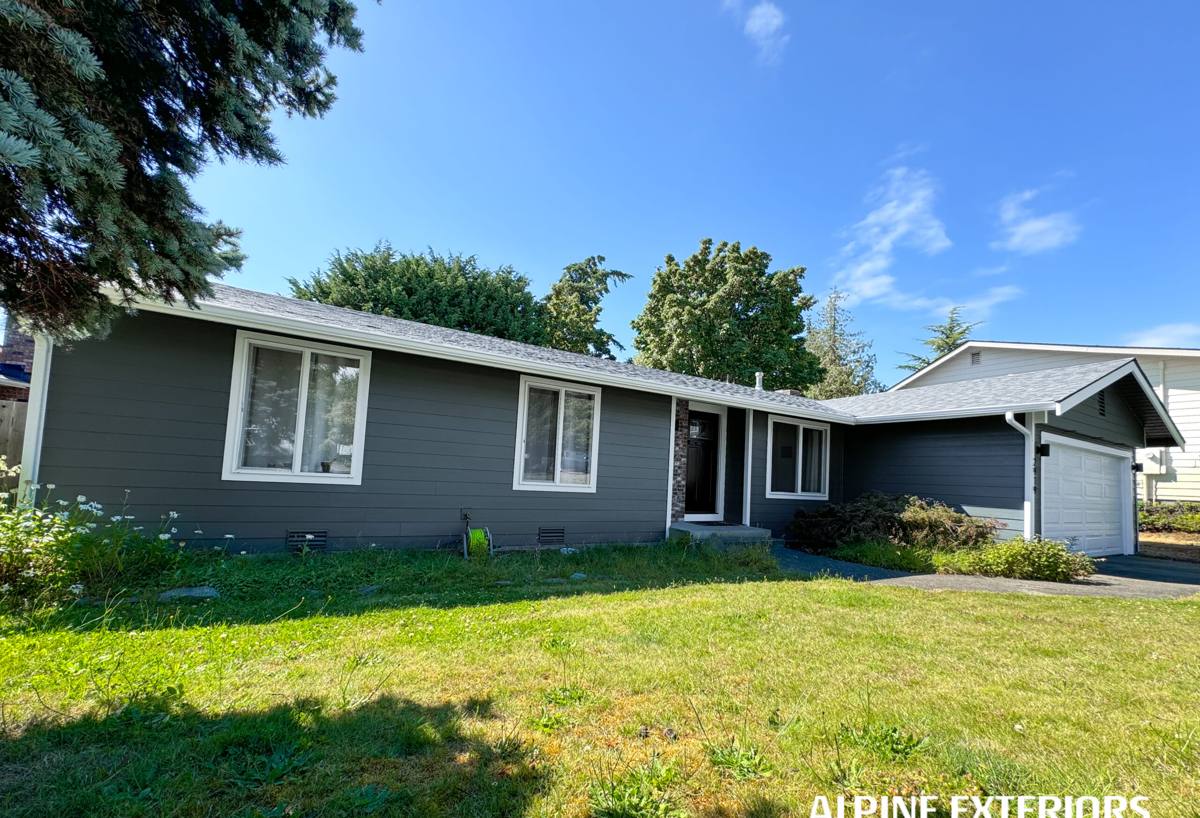
What Blaine's Climate Actually Does to a Wall
Blaine sits right on Semiahmoo Bay and Boundary Bay, which means salt-laden air is a constant, not an occasional weather event. Add Whatcom County's long wet season — driving rain off the Strait of Georgia, months of low-angle sun that doesn't dry surfaces quickly, and a mild, damp climate that's practically a greenhouse for moss and algae — and you get a set of conditions that punishes any siding material with a weak point.
Three things matter most for a wall assembly here:
- Moisture exposure duration. It's not just how much rain falls, it's how many days a surface stays wet. Whatcom County's cloud cover and marine humidity keep siding damp far longer than a drier climate would.
- Salt air corrosion and staining. Fasteners, trim, and finish coatings all take a beating close to saltwater. Cheap or poorly protected components fail faster here than fifty miles inland.
- Moss and algae growth. Shaded, north-facing, and tree-covered walls in this region grow moss aggressively. Some siding materials resist it well; others become a food source.
Every product decision on this page traces back to those three conditions.
What James Hardie Actually Is
James Hardie siding is fiber cement — a mix of Portland cement, sand, and cellulose fiber, cured and formed into planks, panels, and shingles. It's not plastic (vinyl) and it's not an engineered wood product (LP SmartSide, OSB-based siding). That composition is the whole reason it behaves differently in a wet, salty climate.
Product Lines We Install
James Hardie makes several product families, and we select based on the house, not on whatever happens to be cheapest that month:
- HardiePlank lap siding — the most common choice, available in several textures including smooth and Cedarmill (a wood-grain texture).
- HardiePanel vertical siding — used for board-and-batten looks and modern facades.
- HardieShingle siding — a shingle profile for accent gables, dormers, and Craftsman-style detailing.
- HardieTrim boards — fiber cement trim to match, so window and corner details don't become the weak point in an otherwise good installation.
HZ5 Engineering for This Climate
James Hardie engineers its products by climate zone under what it calls the HZ5 system, and the products specified for our zone are formulated for wet, freeze-prone Pacific Northwest conditions rather than a generic national spec. That distinction matters more here than in most parts of the country — a product engineered for a dry southern climate doesn't perform the same way against Whatcom County rain.
ColorPlus Factory Finish vs. Field-Painted Siding
One of the biggest practical differences between Hardie and most alternatives is the finish. ColorPlus is a factory-applied, baked-on finish applied under controlled conditions, not brushed or sprayed on-site in variable weather. For a homeowner, that translates to a few concrete advantages:
- More consistent coverage and color match than a field-applied paint job.
- Touch-up product matched to the factory finish for nail heads and cut edges.
- A finish warranty separate from the substrate warranty (see below), which most job-site paint simply doesn't carry.
Field-painted fiber cement is still a legitimate option and we install it when a homeowner wants a custom color, but ColorPlus is the lower-maintenance path, especially on a house exposed to salt air and constant damp.
Fire and Moisture Performance
Fiber cement is non-combustible. That's relevant everywhere, but it's a specific point of interest in Washington given wildfire seasons that have pushed smoke and ember exposure into areas that didn't used to worry about it. It's not the primary reason we chose Hardie for a coastal town like Blaine, but it's a real, meaningful difference from vinyl (which softens and deforms under heat) and from wood-based products.
On the moisture side, the advantage is different: fiber cement doesn't absorb and swell the way engineered wood siding can when a seam, cut edge, or fastener point isn't perfectly sealed. It doesn't rot. It won't support the kind of fungal growth that eventually compromises an OSB-core product. In a climate where siding stays wet for days at a stretch, that's the difference between a 30-year wall and a wall that starts showing edge swelling or delamination inside a decade.
The Warranty Difference
James Hardie backs its products with a long, transferable limited warranty on the substrate, plus a separate finish warranty on ColorPlus coatings. A few things are worth knowing about how that compares to typical alternatives:
| Factor | James Hardie (ColorPlus) | Typical Vinyl | Engineered Wood (LP-type) |
|---|---|---|---|
| Substrate warranty | Long-term, non-prorated, transferable | Varies widely by manufacturer, often prorated after early years | Typically shorter, with moisture-related exclusions |
| Finish warranty | Separate factory finish warranty | Color/fade warranty only, no separate coating | Field-paint warranty depends on painter, not manufacturer |
| Transferable to new owner | Yes, with registration | Sometimes, terms vary | Sometimes, often with reduced coverage |
| Installation-dependent | Yes — must follow Hardie's published install specs | Less installation-sensitive | Highly sensitive to sealing at seams and cuts |
That last row matters as much as any other. A warranty is only as good as the installation behind it, which is the next section.
What Correct Installation Actually Involves
Fiber cement is not a forgiving material to install badly, and a rushed crew can turn a 30-year product into a 10-year problem. When we install James Hardie siding, the details we hold to include:
- Proper clearance between the siding's bottom edge and roofing, decks, and grade — a gap James Hardie specifies precisely to prevent wicking.
- Correct fastener type, spacing, and depth — over-driven or under-driven nails are one of the most common causes of early failure.
- Factory or field-sealed cut edges on every piece that's trimmed on-site, since a raw cut edge is the one place the material can absorb water.
- Proper flashing and weather-resistive barrier behind the siding, integrated correctly at windows, doors, and penetrations.
- Correct panel and joint gapping to allow for expansion without caulking every seam shut.
- Matching HardieTrim or equivalent fiber cement trim rather than mixing in a softer wood trim that will fail faster than the field siding around it.
This is also why we don't subcontract Hardie installation out to whoever's available that week. Crews that install it regularly know where the mistakes happen.
Cost Factors Homeowners Should Understand
James Hardie costs more up front than vinyl and is competitive with or sometimes higher than engineered wood siding, depending on the product line and finish chosen. A few factors actually drive that number more than the material itself:
| Factor | Effect on Cost |
|---|---|
| Tear-off vs. install over existing siding | Full tear-off costs more but is usually the right call on an older Whatcom County home with hidden moisture damage |
| House complexity (gables, dormers, trim detail) | More cuts and trim transitions increase labor time regardless of material |
| ColorPlus vs. field-painted finish | ColorPlus adds some material cost but removes a paint job from the near-term budget |
| Product line (lap vs. panel vs. shingle accents) | Mixed profiles for architectural detail cost more than a single lap profile |
| Site access | Waterfront and hillside lots common around Blaine can add staging and material handling time |
We won't quote a number here since every house is different, but we'll walk through these factors specifically for your home during an estimate.
Why We Say No to the Alternatives
We get asked regularly why we won't quote vinyl, LP SmartSide, Cemplank, Allura, or bare cedar and primed spruce siding. None of these are bad products in the abstract — each has a legitimate use case somewhere. Our reasoning is specific to what we've seen happen to these materials on homes in this climate:
- Vinyl expands, contracts, and can warp in temperature swings, and it doesn't hold up structurally against wind-driven debris the way fiber cement does. It's also a poor match stylistically for the Craftsman and coastal Pacific Northwest architecture common here.
- LP SmartSide and other engineered wood products perform reasonably well when every seam and cut edge stays sealed for the life of the product, but that's a big ask over decades of constant Whatcom County moisture, and a single failure point can lead to swelling that spreads.
- Bare cedar and primed spruce are beautiful but require a maintenance commitment — recoating, caulking, moisture monitoring — that most homeowners underestimate, especially with the moss pressure this region puts on wood surfaces.
- Cemplank and Allura are also fiber cement and reasonable products, but we've standardized our crews, fasteners, and warranty process on one manufacturer's system so every job we do gets the same level of expertise, not a crew relearning specs for a different product each time.
Standardizing on one product also means our crews are genuinely expert in it, rather than reasonably competent across five different systems.
Is Full Siding Replacement Right for Your House?
Not every home needs a full tear-off. Signs it's time to seriously consider replacement rather than repair include soft spots or visible swelling in the existing siding, recurring paint failure despite repainting, moss buildup that keeps returning after cleaning, or visible gaps and warping at seams. If your siding is still sound, a repair or partial replacement may be the more honest recommendation, and we'll tell you that during an inspection rather than push a full job you don't need.
If you're weighing a siding project on a Blaine home — whether it's a full replacement or you just want a straight answer about what condition your current siding is in — we're happy to come take a look and give you a free, no-pressure estimate.