 Blaine Siding
 Grandview's Siding Problem Isn't Like Most of the Country's
Grandview sits close enough to the water and to the open weather patterns that roll through Whatcom County that siding here takes a different kind of beating than siding forty miles inland. It's not one big storm that does the damage — it's the accumulation. Salt-laden air moving off the water, long stretches of driving rain instead of gentle drizzle, and a shaded, damp moss season that can run most of the year in the wrong exposure. Any siding product will survive a few months of that. Whether it survives fifteen years without warping, staining, rotting at the bottom courses, or needing a full repaint is a different question entirely.
We install James Hardie fiber cement siding exclusively, and Grandview is a good example of why. This page isn't a generic pitch for Hardie — it's specifically about what this material needs to do differently on a Grandview home versus a home somewhere dry and inland, and what a correct installation looks like when the goal is decades of low-maintenance performance, not just a fresh look for a season or two.
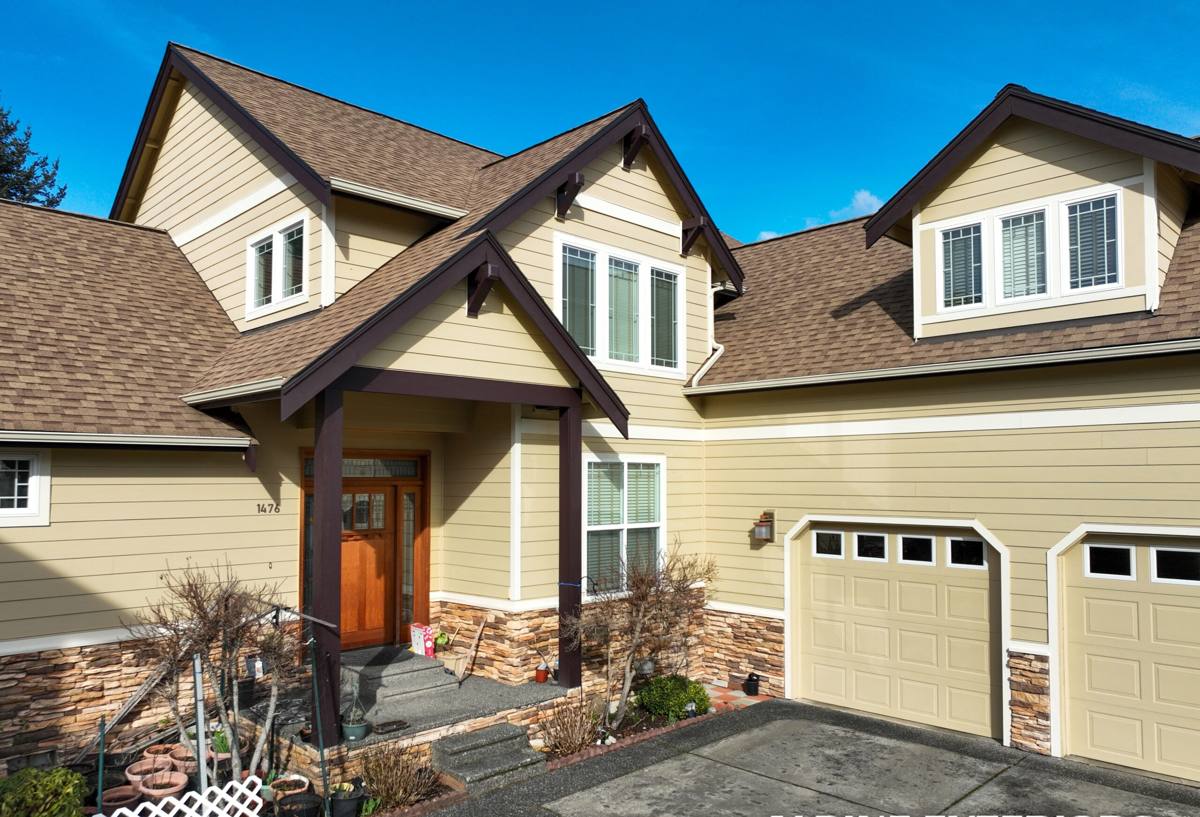
What Grandview's Climate Actually Does to Siding
Salt Air and Slow Corrosion
Homes with any real exposure to marine air deal with a slow, cumulative process: fine salt particles settle on exterior surfaces, hold moisture against the wall, and accelerate corrosion on anything metal — fasteners, flashing, trim edges. Painted wood and some engineered wood products can also see faster finish breakdown under this kind of exposure, because the salt film holds humidity against the surface longer than plain rainwater would.
Driving Rain, Not Just Rain
Whatcom County gets plenty of straight-down drizzle, but Grandview's exposure means wind-driven rain is a regular event too — water hitting the wall at an angle, working its way behind poorly lapped siding, finding gaps around trim and penetrations. A siding system that only handles vertical rainfall well isn't enough here. The water management behind the siding matters as much as the siding itself.
A Long Moss Season
Shaded north and east walls, tree cover, and the region's damp stretches add up to a moss and algae season that, on the wrong product, can run nearly year-round. Moss holds moisture against a wall surface constantly, which is a slow but real threat to anything that isn't dimensionally stable or properly finished.
None of these three factors is dramatic on its own. Together, over ten or fifteen years, they're what separates a home that still looks sharp from one that's chalking, staining, or showing soft spots at the bottom of the walls.
Why We Standardized on James Hardie for Homes Like This
James Hardie fiber cement is engineered specifically around moisture and climate performance, which is the exact problem Grandview presents. It's non-combustible, dimensionally stable in wet-dry cycling, and finished at the factory with ColorPlus Technology — a baked-on finish that holds color and resists the kind of fading and chalking that salt air and UV accelerate on field-painted products. Hardie also builds climate-specific HZ product lines engineered for exactly the wet, marine-influenced conditions found throughout the Pacific Northwest.
We don't install LP SmartSide, vinyl, Cemplank, Allura, primed spruce, or cedar, and the reasoning is consistent across all of them: each has a real strength somewhere, but each also has a moisture, maintenance, or longevity trade-off that we're not willing to put our name behind on a home in this climate. Vinyl can warp and doesn't hold up structurally the way fiber cement does. Wood and primed wood products need consistent repainting and are more vulnerable to rot at joints and bottom courses. Other fiber cement brands may be a reasonable product, but we've built our installation training, warranty relationships, and process entirely around Hardie's specific system — mixing brands mid-crew is how installation mistakes happen.
What a Correct James Hardie Installation Actually Involves
The siding board itself is only part of the system. Most siding failures we get called to look at — regardless of brand — trace back to installation shortcuts, not the material. In a climate like Grandview's, the installation details matter more than average.
Water Management Behind the Siding
Correct installation starts with a drainage plane and weather-resistive barrier installed to shed water downward and outward, not trap it against the sheathing. Where budget and wall assembly allow, a rainscreen gap gives wind-driven rain and any incidental moisture a place to drain and dry instead of sitting against the back of the siding.
Flashing and Penetrations
Every window, door, vent, and utility penetration is a potential entry point for driving rain. Proper flashing — installed in the right order, lapped correctly, and integrated with the weather barrier — is what actually keeps water out, far more than caulk alone.
Fastening and Clearances
Hardie specifies fastener type, spacing, and placement for a reason: get it wrong and you risk cracking, or you compromise the board's ability to move slightly with temperature and humidity changes. Ground clearance and clearance from decks, patios, and roof lines also need to follow spec — too little clearance is one of the most common ways moisture gets trapped at the bottom of a wall.
Caulking and Sealant Joints
Joint sealant needs to be applied at the right locations with the right product — not everywhere, and not as a substitute for proper flashing. Over-caulking can trap moisture just as easily as under-caulking lets it in.
Get all of this right and Hardie siding is genuinely low-maintenance for the long haul. Get any piece of it wrong and you can end up with moisture problems behind a product that, on paper, should have prevented them.
Our Process on a Grandview Home
- Walkthrough and assessment — we look at wall exposure, shade patterns, existing moisture or moss issues, and the current siding's condition before recommending anything.
- Prep and sheathing check — old siding comes off and we inspect the sheathing underneath for rot or damage before anything new goes up. This is where hidden problems from a prior installation usually show up.
- Weather barrier and drainage plane installation — done to spec, not skipped or rushed, since this layer does most of the real water-management work.
- Flashing at every penetration — windows, doors, vents, and any wall penetrations get flashed before siding closes over them.
- Hardie board installation — installed to manufacturer fastening, clearance, and joint specifications.
- Final inspection and cleanup — we walk the finished job checking clearances, caulk lines, and trim before we call it done.
Why a Crew That Already Works Grandview Matters
Siding installation isn't uniform across Whatcom County, and it shouldn't be. A crew that's worked on homes with similar exposure to Grandview's already knows where to expect wind-driven rain problems, which wall orientations need extra attention to moss and shade, and how local wall assemblies and older construction methods typically show wear. That's not something you can fully substitute with a generic installation manual — it's pattern recognition built from doing the work in this specific environment.
It also matters for smaller, practical things: knowing realistic timelines around the area's weather windows, understanding what permitting and inspection looks like for the jurisdiction, and having a track record of jobs in the same conditions the new one will face.
Comparing Siding Options for Grandview's Exposure
| Factor | James Hardie Fiber Cement | Vinyl | Wood / Primed Wood |
|---|---|---|---|
| Salt air / marine exposure | Engineered for it; factory finish resists fading and chalking | Can become brittle and discolored over time | Finish breaks down faster; needs more frequent repainting |
| Wind-driven rain performance | Excellent when installed with proper flashing and drainage | Prone to water intrusion at seams and gaps | Vulnerable at joints and end grain if not maintained |
| Moss / algae resistance | Dimensionally stable; doesn't feed moisture-related decay | Doesn't rot, but can trap moisture behind panels | Susceptible to rot where moss holds moisture |
| Fire resistance | Non-combustible | Combustible | Combustible |
| Maintenance over 15 years | Periodic washing; repaint interval much longer than field-painted products | Low maintenance but limited repair options if damaged | Regular repainting and caulking required |
This table reflects general product characteristics, not guaranteed outcomes — actual performance always depends on installation quality and ongoing upkeep.
Maintenance and Longevity for This Climate
Even the right product benefits from a little seasonal attention in a climate like this. A periodic gentle wash removes salt residue and surface grime before it has a chance to hold moisture against the wall. Keeping gutters clear and vegetation trimmed back from shaded walls helps limit moss growth. Because Hardie's ColorPlus finish is factory-applied and warranted separately from the board itself, homeowners aren't stuck on the same repaint cycle that field-finished wood or primed products require — that's a real, practical difference in a place where repainting season can be short and wet.
Signs Your Current Siding Is Struggling With This Climate
- Persistent moss or algae staining that returns quickly after cleaning
- Soft or spongy spots near the bottom of walls or below windows
- Visible warping, cupping, or gaps opening between boards
- Paint that's chalking, peeling, or fading unevenly by wall orientation
- Rust streaking from fasteners or trim
- Rising heating or cooling bills without another clear cause
Getting Started
If you're weighing a re-side in Grandview, we're glad to walk the property, look at your specific exposure and any existing issues, and give you a straight answer about what your home needs — no pressure, no upsell to a product we wouldn't put on our own homes. Use the form below to request a free estimate.