 Blaine Siding
 Peace Arch sits right up against the international border, close enough to the Salish Sea that homes here take a steady beating from marine air, wind-driven rain, and a moss season that runs longer than almost anywhere else in Whatcom County. A roof that would hold up fine forty miles inland can fail early here if it wasn't built with this specific environment in mind. This page covers what that means for a roof replacement in Peace Arch — what the climate actually does to roofing materials, what a correct installation involves, and what to expect if you're planning a replacement soon.
What the Peace Arch Climate Does to a Roof
Blaine's location puts Peace Arch roofs under three kinds of stress that don't let up for long: salt-laden air, sideways rain, and moss. Each one attacks a roof differently, and a replacement that only accounts for one or two of them tends to disappoint the homeowner within a few years.
Salt Air and Metal Fatigue
Homes close to the water pick up fine salt particles in the air, and those particles settle on every exposed metal surface on a roof — nails, flashing, vent caps, gutter hangers. Over time, salt accelerates corrosion on lower-grade or unprotected metal, which is why fastener and flashing quality matters more here than it does on a roof twenty miles inland.
Driving Rain
Storms coming off the water in this part of Whatcom County often bring rain at an angle, not straight down. Wind-driven rain finds its way under shingle tabs, into open valleys, and around poorly sealed roof penetrations in a way that vertical rain never would. A roof designed for calm weather elsewhere can leak here at exactly the seams that would never be tested somewhere drier or less exposed.
A Long Moss Season
Cool, damp, shaded conditions for much of the year give moss and algae a long runway to establish themselves on north-facing slopes and anywhere tree cover blocks the sun. Moss isn't just cosmetic — its root structure lifts shingle edges, holds moisture against the roof deck, and shortens the life of the material underneath it.
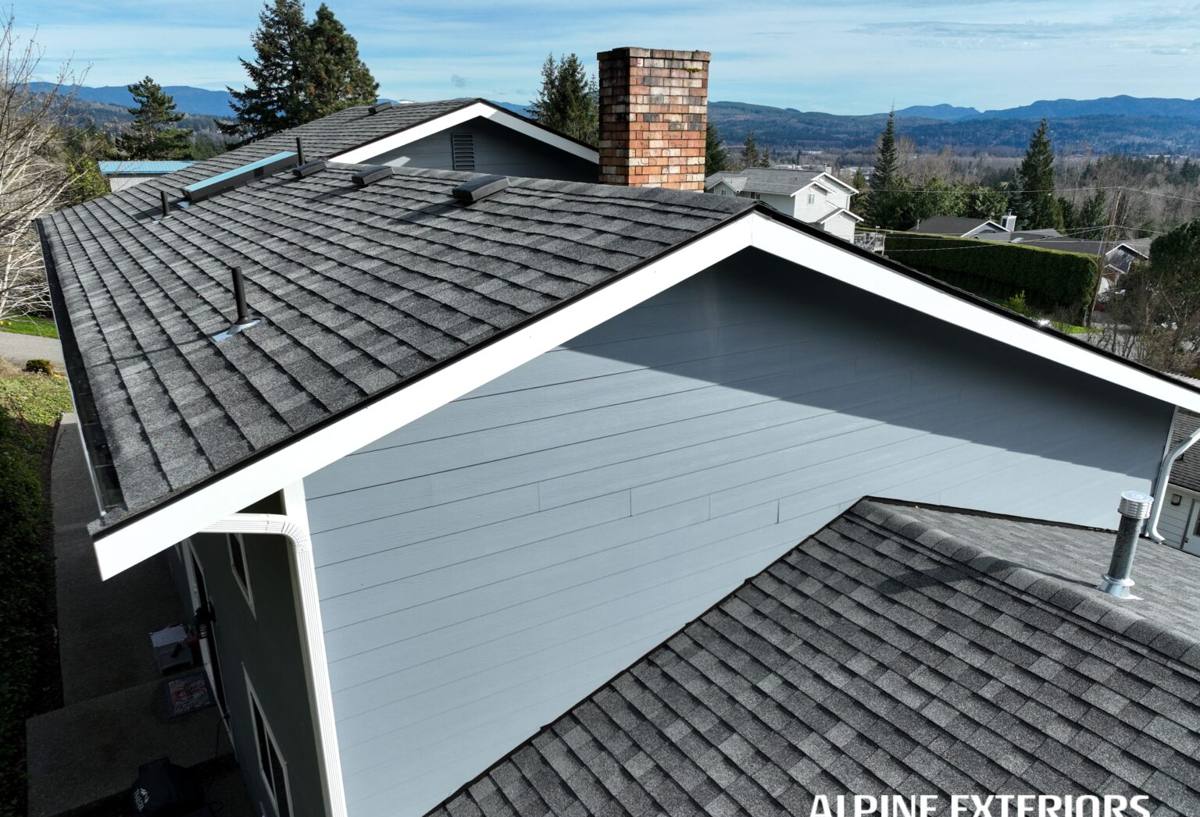
Warning Signs Peace Arch Homeowners Shouldn't Ignore
Because moisture damage in this climate tends to happen gradually and out of sight, many homeowners don't realize a roof needs replacing until there's already a leak. Watch for these signs before it gets to that point:
- Granules collecting in gutters or at downspout outlets
- Shingles that look cupped, curled, or have lifted edges
- Dark streaking or thick moss growth, especially on shaded slopes
- Soft or spongy spots when walking the roof (a sign the deck underneath is compromised)
- Daylight visible through the roof deck from inside the attic
- Rusted flashing around chimneys, vents, or skylights
- Interior ceiling stains that appear or worsen after wind-driven storms
Any one of these on its own isn't necessarily an emergency, but a combination usually means the roof is past the point where patching makes sense.
What a Correct Roof Replacement Involves
A roof replacement done right for this location isn't just about swapping old shingles for new ones. It's about addressing the specific ways salt air, rain, and moss attack a roof over time.
Full Tear-Off and Deck Inspection
We remove the existing roofing down to the deck rather than layering over it. This is the only way to actually see the plywood or OSB underneath, which is important here because trapped moisture from years of moss cover or minor leaks often causes rot that isn't visible from above. Any soft or damaged decking gets replaced before anything new goes down.
Underlayment and Flashing
Given how much wind-driven rain Peace Arch sees, we pay close attention to self-adhering ice-and-water membrane at eaves, valleys, and roof-to-wall transitions — the spots where sideways rain is most likely to find a gap. Flashing around chimneys, skylights, and vent pipes is replaced with corrosion-resistant material rather than reused, since salt air is exactly what shortens the life of older or lower-grade flashing.
Ventilation
A well-ventilated attic keeps moisture from condensing on the underside of the roof deck, which matters in a climate where the air outside is already damp for much of the year. We check that intake and exhaust venting are balanced, not just present, since mismatched venting is a common cause of premature deck rot.
Moss-Resistant Details
Where it makes sense for the home's exposure, we can include zinc or copper strips near the ridge, which release trace amounts of metal ions when it rains that inhibit moss and algae growth on the slopes below. It's not a substitute for regular maintenance, but it meaningfully slows regrowth on shaded roofs.
Choosing a Roofing Material for This Location
There isn't one "correct" material for every home in Peace Arch — the right choice depends on the home's exposure, budget, and how much maintenance the homeowner wants to take on. Here's how the common options compare for this specific environment:
| Material | Salt Air Resistance | Moss Resistance | Typical Lifespan | Maintenance Needs |
|---|---|---|---|---|
| Architectural asphalt shingle | Good, with quality flashing | Moderate — benefits from zinc strips | 25–30 years | Periodic moss treatment, gutter cleaning |
| Standing seam metal | Very good with coated/marine-grade panels | Excellent — sheds moss growth | 40–50+ years | Low; occasional fastener check |
| Synthetic/composite shingle | Good | Good | 30–50 years | Low to moderate |
| Cedar shake | Fair — needs consistent maintenance | Poor without treatment | 20–25 years in this climate | High; regular treatment required |
Metal roofing tends to perform best against this specific combination of salt and moss, but it comes at a higher upfront cost. Architectural asphalt shingle remains the most common choice in the neighborhood because it balances cost, appearance, and durability reasonably well when installed with the flashing and ventilation details this climate calls for. We'll walk through the honest trade-offs of each option based on your home's actual exposure rather than pushing one product across the board.
Our Roof Replacement Process in Peace Arch
1. Inspection and Estimate
We start with a full roof and attic inspection — checking the deck, ventilation, flashing, and the condition of the current roofing — and give you a written estimate that spells out material options and what's actually driving the cost.
2. Site Protection
Before tear-off begins, we protect landscaping, siding, and gutters, and stage material delivery so the job site stays workable for the length of the project.
3. Tear-Off and Deck Repair
Old roofing comes off down to the deck. Any rotted or damaged sheathing is identified and replaced before we move forward — we won't install new roofing over a compromised deck.
4. Underlayment, Flashing, and Roofing Installation
Ice-and-water membrane goes down at vulnerable areas first, followed by underlayment across the full roof, new flashing, and then the roofing material itself, installed to the manufacturer's specifications for proper wind and water resistance.
5. Cleanup and Final Walkthrough
We do a full site cleanup, including a magnetic sweep for stray nails, and walk the finished roof with you so you can see the work and ask questions before we consider the job done.
What Affects the Cost of a Roof Replacement
Every roof is priced based on its own specifics, but the main factors that move the number up or down are consistent across most Peace Arch homes:
| Factor | Why It Matters |
|---|---|
| Roof size and pitch | More surface area and steeper slopes take more material and labor time |
| Number of layers to remove | Multiple existing layers add to tear-off and disposal costs |
| Deck condition | Rotted or soft sheathing found during tear-off requires replacement before installation |
| Material choice | Asphalt shingle, metal, and composite options carry different material and labor costs |
| Roof complexity | Valleys, dormers, chimneys, and skylights each add flashing detail and time |
| Access | Tree cover, tight lot lines, or limited driveway access can affect staging and labor time |
We won't know your exact numbers until we've inspected the roof and deck in person, but this table gives you a realistic sense of what actually drives price up or down before you get a quote.
Why Local Experience in Peace Arch Matters
A roofing crew that regularly works this part of Blaine already knows which slopes in a given neighborhood tend to hold moss longest, which roof lines take the worst of the wind-driven rain, and which flashing details fail first in salt air — because they've seen it repeatedly, not because it's in a manual. That translates into fewer surprises during tear-off and a finished roof that's built for the conditions it will actually face, not generic conditions from a different climate zone.
Local experience also means familiarity with Blaine and Whatcom County permitting requirements, so the paperwork side of a replacement doesn't become a separate headache on top of the construction itself.
Caring for Your New Roof
A correctly installed roof still benefits from basic upkeep, especially in a climate that favors moss and holds moisture:
- Clear gutters and downspouts at least twice a year so water isn't backing up under the roof edge
- Have moss treated or gently removed before it establishes a heavy root structure, rather than after
- Trim back overhanging branches to reduce shade and debris buildup on north-facing slopes
- Schedule a walk-through inspection every couple of years, or after any major windstorm
- Address small flashing or sealant issues promptly — they're inexpensive to fix early and expensive to ignore
None of this requires much time or money, but it's the difference between a roof that reaches the top end of its expected lifespan and one that falls short of it.
If your roof in Peace Arch is showing its age or you just want an honest read on its condition, we're happy to take a look. Use the form below to request a free, no-pressure estimate — we'll tell you what we actually see, not just what sells a job.