 Blaine Siding
 Roofing in Dakota Creek Has Its Own Set of Problems
Dakota Creek sits close enough to the water that homes here take on a different kind of weather than roofs just a few miles inland. Salt-laden air off the Strait, driving rain that comes in sideways during winter storms, and a moss season that seems to stretch longer every year all put real, cumulative stress on a roof system. Asphalt shingle roofing is still one of the most practical, cost-effective choices for this area — but only when it's installed with this specific climate in mind, not treated the same way you'd roof a house in a dry inland county.
We work on homes throughout Blaine and Whatcom County, and Dakota Creek roofs consistently show the same wear patterns: moss establishing itself in shaded, north-facing slopes; granule loss accelerated by salt exposure; and flashing and underlayment failures where wind-driven rain finds the smallest gap. None of that is unusual for this part of Washington. It's just what happens when a roof isn't built or maintained for the environment it's actually in.
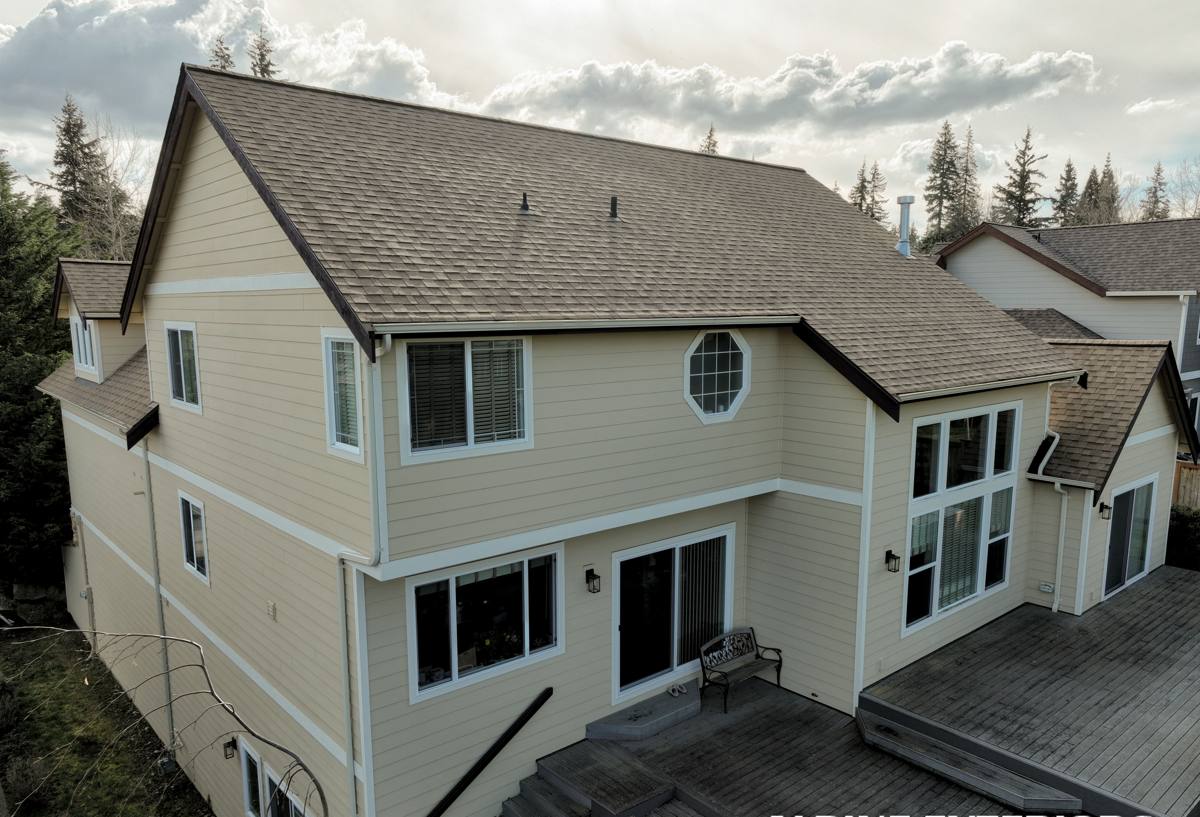
What Salt Air, Driving Rain, and Moss Actually Do to a Shingle Roof
Salt Air
Airborne salt doesn't rot shingles the way it corrodes metal, but it does accelerate the breakdown of the asphalt's protective granules over time and speeds corrosion on exposed fasteners, flashing, and vent components if they aren't rated for coastal exposure. A roof that would hold up for decades inland can show premature granule loss and metal fatigue closer to the water.
Driving Rain
Rain that comes in at an angle instead of straight down behaves differently on a roof. It can work its way under shingle tabs, around chimney and skylight flashing, and into valleys if the underlayment and flashing details weren't built for wind-driven moisture. A roof that would be watertight in calm rain can leak in a Dakota Creek storm if those details were cut short.
Moss
Shaded slopes, tree cover, and persistent damp conditions make Whatcom County moss country, and Dakota Creek is no exception. Moss holds moisture against the shingle surface longer than it would otherwise sit, and as it spreads it can lift shingle edges, trap debris, and slowly work its way under the roofing layer. Left unchecked for a few seasons, moss growth shortens the usable life of an otherwise sound roof.
What a Correctly Installed Roof Needs Here
A shingle roof built for Dakota Creek's climate isn't just "shingles nailed to plywood." The system underneath and around the shingles matters as much as the shingles themselves.
- Ice-and-water shield at vulnerable points — valleys, eaves, and around penetrations, where wind-driven rain is most likely to find a way in.
- A full synthetic underlayment across the deck, not just felt paper, as a second line of defense against wind-driven moisture.
- Properly detailed flashing at chimneys, skylights, walls, and valleys — this is where the majority of coastal leaks actually start.
- Corrosion-resistant fasteners and metal components suited to salt-air exposure rather than standard-grade hardware.
- Balanced attic ventilation so moisture doesn't get trapped underneath the roof deck, which both shortens shingle life and feeds moss and mold growth.
- Algae-resistant shingle products where appropriate, to slow the staining and growth cycle that's common on shaded, damp roof slopes.
Skip any one of these and the roof may still look fine from the ground for a year or two — the problems that show up in this climate are usually the slow kind, not the obvious kind.
Signs a Dakota Creek Roof Needs Attention
Because coastal wear is gradual, homeowners often don't notice a problem until it's already inside the attic. Watch for:
- Moss or dark streaking on north-facing or shaded slopes
- Granules collecting in gutters or downspouts
- Shingle edges that look curled, cupped, or lifted
- Soft spots or sagging when walked on (a job for a professional, not a DIY roof walk)
- Water stains on interior ceilings, especially after a windy rainstorm
- Rusting or deteriorating flashing around chimneys and vents
- Daylight visible through the attic roof deck
Any one of these on its own may be minor. Several together usually mean the roof system has been letting moisture in for a while.
Choosing the Right Shingle for This Climate
Not every asphalt shingle product is a good fit for a coastal, moss-prone, high-wind-driven-rain area. The table below is a general guide to how common shingle tiers hold up here — actual performance always depends on installation quality and site conditions.
| Shingle Type | Typical Wind Rating | Algae Resistance | Best Fit for Dakota Creek |
|---|---|---|---|
| Standard 3-tab | Lower | Usually none | Budget projects on well-ventilated, sun-exposed roofs only |
| Architectural / laminated | Moderate to high | Often available as an upgrade | Good general-purpose choice for most Dakota Creek homes |
| Premium/designer laminated | High | Typically standard | Best for shaded, moss-prone, or highly exposed slopes |
| Impact-resistant options | High | Varies by product | Worth discussing for exposed or storm-prone lots |
We don't push one manufacturer or product line as a blanket answer. The right choice depends on the roof's exposure, pitch, shading, and your budget — a conversation we have on-site, not from a price sheet.
Our Process
- On-site assessment — we look at the current roof, deck condition, ventilation, and specific exposure of your Dakota Creek property (shading, wind direction, proximity to water).
- Straightforward proposal — materials, scope, and pricing explained in plain terms, with options if there's a decision to make on shingle tier or added protection.
- Tear-off and deck inspection — old roofing removed and the deck checked for rot or soft spots before anything new goes down.
- Underlayment and flashing installation — ice-and-water shield, synthetic underlayment, and properly detailed flashing at every vulnerable point.
- Shingle installation — installed to manufacturer spec, including nailing pattern and exposure, which directly affects wind performance.
- Ventilation check — confirming intake and exhaust airflow is balanced for the attic space.
- Final walkthrough — cleanup, debris check (including magnetic sweep for stray fasteners), and a review of the finished work with you.
Maintenance in a Moss-Prone, Salt-Air Environment
A well-installed roof still needs periodic attention in this climate. A short annual checklist goes a long way:
- Clear gutters and downspouts of debris and granules before fall rains
- Remove moss growth using methods appropriate for shingles (not pressure washing, which can strip granules)
- Trim overhanging branches to reduce shading and debris buildup on north-facing slopes
- Check flashing around chimneys and vents for early signs of corrosion or lifting
- Have the attic checked periodically for adequate airflow and any sign of trapped moisture
- Schedule a professional inspection every couple of years, or after any major windstorm
None of this requires much time or money if it's done consistently. It's almost always cheaper than the repair bill that follows a roof that was left alone for a decade.
What Roof Work Typically Costs Here
Every roof is different, but the factors below are what actually move the price on a Dakota Creek asphalt shingle project.
| Factor | Why It Matters |
|---|---|
| Roof size and pitch | More square footage and steeper slopes mean more material and labor time |
| Number of layers to remove | Tear-off of existing layers adds labor and disposal cost |
| Deck condition | Rotted or soft decking found during tear-off requires repair before shingles go on |
| Shingle tier selected | Standard, architectural, and premium products carry different material costs |
| Flashing and ventilation upgrades | Bringing older detailing up to current standards adds cost but reduces future leak risk |
| Roof complexity | Valleys, dormers, skylights, and multiple penetrations increase labor and detail work |
We'll always give you a clear number for your specific roof after an on-site look — not a rough estimate based on square footage alone, which tends to miss the details that actually drive cost.
Why Local Experience in Dakota Creek Matters
A crew that already works this part of Blaine and Whatcom County knows which slopes on which lots tend to hold moss, which flashing details actually stand up to driving rain off the water, and which shortcuts show up as leaks two winters later instead of two months later. That's not something you get from a general contractor passing through the area once. It comes from doing this work, on these kinds of roofs, in this specific climate, repeatedly.
If you're weighing a repair, a full replacement, or just want an honest read on how much life your current roof has left, we're happy to take a look. Reach out for a free, no-pressure estimate — use the form below to get started.