 Blaine Siding
 Siding Replacement in Birch Point: A Waterfront Corner of Blaine's Coastline
Birch Point is a small waterfront community near Blaine, close enough to open water that homes here take on a heavier, steadier dose of coastal weather than houses set further back from the shoreline. It's a corner of Whatcom County we work regularly, and siding replacement is one of the most common calls we get out here — not new construction, but full removal and replacement of siding that's been fighting salt air, driving rain, and moss for years and has finally lost that fight.
This page is specifically about siding replacement for Birch Point homes: tearing off old, failing siding and installing a new system correctly, rather than patching or repairing what's already there. We install James Hardie fiber cement exclusively, and everything below is written around that system, since it's the only one we put on homes in this area.
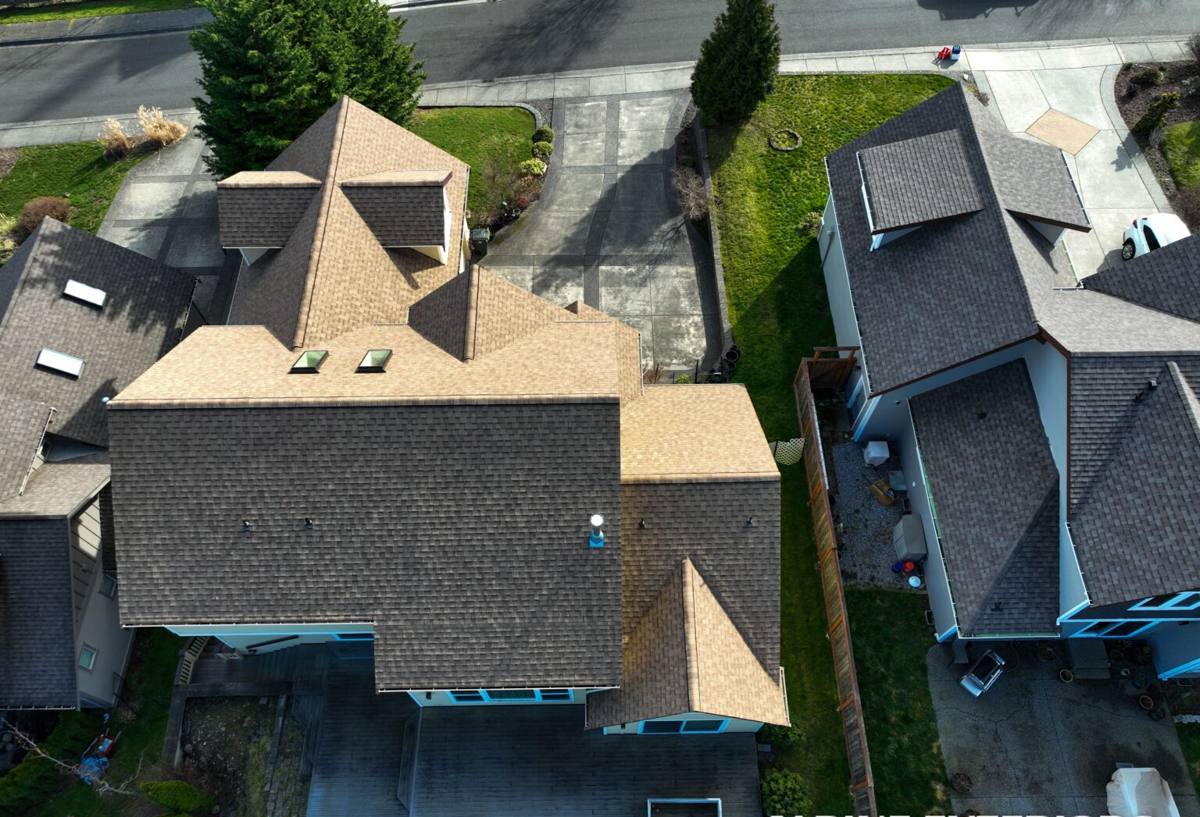
What the Climate at Birch Point Does to Existing Siding
Salt Air and Its Long-Term Toll
Homes this close to open water take on salt-laden air as a constant condition rather than an occasional one. Over years, that salt exposure accelerates corrosion on fasteners, flashing, and any exposed trim hardware, and it breaks down lower-grade paint and coatings faster than a drier, more inland climate would. On an older home, this is often the first thing we find once old siding comes off — corroded fasteners and trim that were doing far less holding than they looked like from the outside.
Driving Rain and Wind Exposure
Storms moving across open water don't drop rain straight down on a Birch Point house — wind pushes it sideways into siding joints, window flashing, and the seams where trim meets the field. That wind-driven pattern is harder on a wall assembly than the same rainfall would be somewhere sheltered, and it's exactly the kind of moisture that finds its way behind siding that's aging, cracked, or was never flashed correctly to begin with.
A Moss Season That Rarely Lets Up
Mild temperatures and near-constant moisture give moss a growing season that runs most of the year on shaded or north-facing walls. Older siding with any surface porosity or hairline cracking becomes a growth surface, and moss that keeps a wall damp longer accelerates whatever decay is already underway underneath it. By the time moss is visibly established, it's usually been holding moisture against that wall for a while already.
Signs Your Birch Point Home Needs Siding Replacement, Not Just Repair
Not every siding problem calls for a full tear-off. But in a climate this demanding, a few signs usually mean the underlying material and installation have reached the end of their useful life rather than needing a patch:
- Soft, spongy, or crumbling siding across more than one wall or a large section of a single wall
- Persistent moss or dark staining that returns quickly after cleaning, especially on shaded faces
- Cupping, warping, or visible gaps between boards or panels
- Paint that's peeling or failing across broad areas rather than one isolated spot
- Rust streaking below fasteners or trim, a sign hardware is corroding faster than expected this close to the water
- Rot or soft sheathing discovered at a window, corner, or bottom course during a smaller repair
- A siding system nearing or past its expected service life, regardless of how it looks from the street
Why Full Replacement Beats Patch Repair on an Aging Home
Patch repairs have a real place — a single damaged board or a localized impact doesn't justify tearing off an otherwise sound wall. But once damage is spread across multiple walls, or once we find rot or corrosion in more than one spot during an inspection, patching stops being a repair and starts being a series of short-term fixes on a system that's already failing. Full replacement lets us inspect and address the sheathing and water-resistive barrier underneath — the parts of the wall assembly that actually determine how the house holds up long-term — instead of installing new material over problems that are still there. On a Birch Point home taking this much salt air and wind-driven rain, that underlying inspection is often more important than the new siding itself.
Why We Replace Old Siding With James Hardie Fiber Cement, and Nothing Else
We used to install a wider range of siding products. We narrowed to James Hardie fiber cement exclusively after seeing, repeatedly, how different materials actually held up in salt-air, high-moisture towns like Blaine — not because of a supplier arrangement or a marketing push.
- Non-combustible core: Fiber cement doesn't feed a fire the way wood-based products can, which matters for both safety and insurance considerations.
- Factory-applied ColorPlus finish: The color is baked on under controlled factory conditions instead of brushed on in the field, so it holds up longer against fading, chalking, and moisture than a field-applied finish.
- Climate-engineered HZ5 formulation: Hardie's HZ5 product line is built for regions with sustained moisture and freeze-thaw cycling, which describes coastal Whatcom County well.
- Dimensional stability: Fiber cement doesn't swell, cup, or warp the way some engineered wood products can after years of wet-weather exposure off the water.
- Strong transferable warranty: Hardie backs the product with one of the stronger warranty structures in the industry, provided the installation follows their published spec.
We don't install LP SmartSide, vinyl siding, Cemplank, Allura, primed spruce, or cedar. Each has a place in the broader market, and plenty of homeowners are satisfied with them elsewhere. But on a waterfront property like a Birch Point home, we've made a professional call to stand fully behind one system rather than offer something cheaper that quietly shifts maintenance risk back onto the homeowner a few years down the road.
What a Correct Replacement Involves at Birch Point
Tear-Off and Sheathing Inspection
Old siding comes off completely, and the sheathing underneath gets inspected before anything new goes up. This is the step that gets skipped on a rushed job, and it's the one that matters most — installing new siding over rotted or damp sheathing just buries the problem behind a fresh surface for a few more years.
Weather-Resistive Barrier and Flashing
A new water-resistive barrier goes on with proper overlap and sealed seams at every penetration, then flashing is integrated at windows, doors, and any wall penetration before siding covers it. This hidden layer does most of the actual work of keeping wind-driven rain out of the wall assembly once the new siding is up.
Fastening and Clearance to Spec
James Hardie publishes exact fastener type, spacing, and clearance requirements, including minimum clearance between the bottom of the siding and grade, decks, and roofing. Those clearances exist to keep the lowest courses of siding out of standing water and splash-back, a common failure point on older homes where landscaping or a deck was added after the original siding went in. Corrosion-resistant fasteners aren't optional this close to the water — standard-grade hardware shows rust streaking and loosening well ahead of schedule.
Our Siding Replacement Process, Step by Step
- Site and exposure walk: We look at how each wall of the house is exposed to wind and salt air off the water, and where existing moss, staining, or damage suggests a chronic moisture issue rather than a one-time problem.
- Full tear-off: Old siding comes off completely so the sheathing and framing underneath can be honestly assessed, not guessed at.
- Sheathing repair: Any rot or soft spots found get addressed before new material goes up, even when it adds a step to the schedule.
- Weather barrier and flashing: A new barrier is installed with proper laps and sealed seams, with flashing integrated at every window, door, and penetration.
- James Hardie installation to spec: Panels go up following Hardie's fastening, spacing, and clearance requirements as the baseline for every home, not an upgrade option.
- Final walkthrough: We walk the finished job with the homeowner and go over basic maintenance for a home this close to the water.
Cost Factors for a Birch Point Siding Replacement
| Factor | Why It Matters |
|---|---|
| Home size and number of stories | More wall area and height mean more labor and, on taller homes, more staging and access equipment |
| Condition of sheathing underneath old siding | Rot or water damage found during tear-off adds repair scope before new siding can go on |
| Trim and window complexity | More openings, corners, and roofline transitions mean more flashing and cutting work |
| Exposure to wind and open water | Water-facing walls typically warrant closer attention to flashing, fasteners, and drainage detail |
| James Hardie product line and finish | Panel style, texture, and ColorPlus color selection affect material cost |
These are general drivers, not a quote. Every Birch Point property sits at a slightly different distance from the water and under different tree cover, so we walk the house and pull a section of old siding when needed before putting a real number on the work. That's also why we're cautious about estimates given over the phone or online without ever seeing the house — what's underneath the old siding often changes the scope more than anything visible from the street.
Timing a Replacement Around Local Weather
Whatcom County's wettest, windiest stretch generally runs from late fall through winter, and Birch Point's open exposure makes that stretch harder on both the house and the work itself than it is in more sheltered parts of the county. Spring and summer offer the most stable conditions for tear-off and installation, since fiber cement, sheathing repairs, and the weather barrier all perform better when they can be installed and set up under dry conditions rather than between storm systems. That said, a home actively taking on water shouldn't wait for the ideal season just to hold out for better scheduling.
Why a Crew That Already Works Birch Point Matters
A crew that replaces siding across Whatcom County's coastal towns regularly develops a feel for how salt air, driving rain, and moss actually behave on real homes over a full year, not just how a product performs on a spec sheet. That shows up in practical decisions on tear-off day: which walls have been silently taking on water the longest, where extra flashing attention is worth the time, and which fastener and clearance details genuinely can't be shortcut on a property this exposed. Birch Point's waterfront position isn't identical to more sheltered inland areas of the county, and a crew that already works out here builds accordingly instead of applying a one-size-fits-all approach learned somewhere else.
If your Birch Point home has siding that's showing its age, we're glad to come take a look and give you a straightforward, honest read on whether it needs replacement, repair, or a few more good years. Reach out using the form below to schedule a free, no-pressure estimate.