 Blaine Siding
 Board & Batten Siding, Built for Birch Bay's Waterfront Climate
Birch Bay sits right on the water, and that changes what siding has to deal with compared to a home even a few miles inland in Whatcom County. Salt-laden air off the bay, wind-driven rain that hits walls sideways instead of straight down, and a moss season that can stretch most of the year on shaded or north-facing elevations all put real stress on exterior cladding. Board and batten is a popular choice out here because of its clean, vertical look and the strong shadow lines it throws on beach cottages and newer builds alike — but that look only holds up if the material underneath and the installation details are right for this specific environment.
We install board and batten in James Hardie fiber cement exclusively. This page walks through what Birch Bay's climate actually does to this siding style, what a correct installation looks like, and why the details matter more here than they would somewhere drier and further from the water.
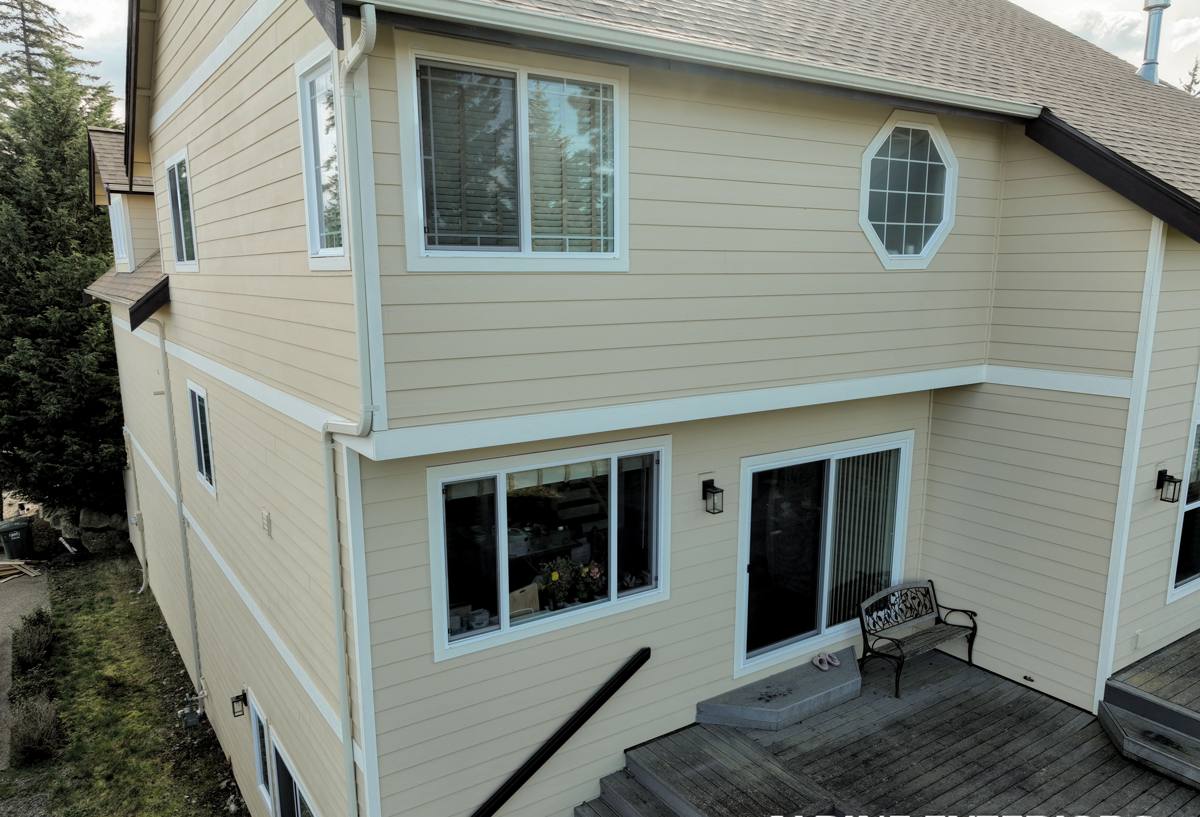
What Birch Bay's Climate Does to Vertical Siding
Board and batten relies on vertical boards with a raised batten strip covering each seam. Every one of those seams is a potential water entry point, and in a coastal Whatcom County location like Birch Bay, three things work against them constantly:
- Salt air: Airborne salt accelerates corrosion on fasteners and metal flashing, and it degrades paint and caulk faster than it does inland. Anything installed with the wrong fastener or a thin factory finish shows its age early.
- Driving rain: Storms coming off the water push rain horizontally into walls rather than letting it run straight down and off. That means water gets forced into gaps and laps that would stay dry in a calmer climate, so drainage behind the siding matters as much as the caulk joint in front of it.
- Long moss season: Cool, damp, and often shaded conditions on north- and west-facing walls let moss and algae take hold for much of the year. Moss holds moisture against the surface long after a storm passes, which is hard on any material that isn't dimensionally stable or properly finished.
None of this makes board and batten a bad choice for Birch Bay — it just means the product and the installation have to be matched to the exposure, not treated the same way they'd be treated on a sheltered lot.
Why We Only Install Board & Batten in James Hardie Fiber Cement
Board and batten is available in several materials, and we get asked why we don't offer it in wood, vinyl, or engineered wood products. Our answer isn't that those products are junk — it's that we've standardized on what holds up best, with the least maintenance burden, in exactly the kind of exposure Birch Bay sees.
| Material | How it handles salt air & moisture | Long-term maintenance in Birch Bay conditions |
|---|---|---|
| James Hardie fiber cement (our standard) | Non-combustible, dimensionally stable, factory ColorPlus finish resists fading and doesn't rely on field-applied paint for its primary protection | Occasional wash-down; caulk joints inspected on our schedule, not constant repainting |
| Primed wood or cedar | Absorbs moisture at end grain and seams; swells and shrinks with wet/dry cycles common near the water | Regular repainting or re-staining, higher risk of rot at battens and bottom edges |
| Vinyl | Can warp or become brittle with UV and temperature swings; seams and battens are often just overlapped, not sealed | Low maintenance but limited repair options and shorter realistic lifespan in exposed coastal spots |
| Engineered wood (LP-type products) | Performs reasonably when installation is flawless, but is more sensitive to moisture intrusion at cut edges and fastener points than fiber cement | Manufacturer maintenance requirements are stricter to keep warranty coverage intact |
James Hardie's HZ10 climate designation, which is what we use in this region, is engineered specifically for the moisture and temperature patterns of the Pacific Northwest coast. Combined with the factory-applied ColorPlus finish, it gives us a board that doesn't depend on a homeowner staying on top of repainting to keep water out.
Two Ways We Build Board & Batten in Hardie
There are two common approaches, and which one fits depends on the home:
- HardiePanel vertical siding with HardieTrim battens: Large-format panels installed vertically with trim boards covering the seams — a straightforward, cost-effective way to get the board and batten look with fewer total joints.
- Hardie Artisan Board & Batten collection: A more refined, deeper-profile product designed to replicate traditional board and batten more closely, with a heavier presence and finer detailing — usually chosen for homes where the architectural style calls for it.
What a Correct Board & Batten Installation Actually Involves
The visible boards and battens are the easy part to picture. What determines whether this siding lasts on a Birch Bay home is what happens behind and beneath them.
Drainage Plane and Rainscreen Gap
Given how much wind-driven rain this area sees, we install board and batten over a proper water-resistive barrier with a drainage gap (a rainscreen) rather than nailing it flat against the sheathing. That gap lets any moisture that does get past the surface drain and dry out instead of sitting against the back of the board — which matters enormously in a climate with a moss season this long.
Fastening
Salt air is hard on fasteners. We use corrosion-resistant fasteners rated for coastal exposure and follow James Hardie's fastening specifications for pattern and embedment, because under-driven or over-driven nails are one of the most common causes of early failure at board edges.
Joint and Penetration Detailing
Every seam, corner, and penetration (hose bibs, light fixtures, vents) is a place water can try to get in. Correct flashing at window and door heads, proper caulking at boards and trim, and attention to the bottom termination of the siding above grade all matter more here than in a drier climate, because there's simply more water trying to find a way in over the course of a year.
Spacing for Movement
Fiber cement expands and contracts with temperature and moisture. Battens and board ends are gapped correctly per manufacturer spec so the material can move without cracking caulk joints or buckling — a detail that's easy to skip and hard to notice until a few winters have gone by.
Board & Batten Cost Factors for a Birch Bay Home
Every home is different, but the same handful of factors tend to drive cost up or down on board and batten projects in this area:
| Factor | Why it matters here |
|---|---|
| Wall exposure to wind and salt spray | Waterfront-facing walls may need extra attention to flashing and drainage detailing |
| Existing siding removal | Tear-off of old wood or vinyl adds labor and may reveal sheathing repairs needed before new siding goes on |
| Product choice (HardiePanel + battens vs. Hardie Artisan) | Artisan's deeper profile and detailing cost more than the panel-and-trim approach |
| Number of corners, penetrations, and trim details | More cuts and joints mean more flashing and caulking work, which is where most water problems start if rushed |
| Color and finish | Factory ColorPlus finishes vary slightly in cost by color line but eliminate an initial paint job |
How Our Process Works
For a Birch Bay project, our process generally runs:
- On-site walkthrough to assess current siding condition, wall exposure to wind and salt spray, and any moisture or moss issues already present.
- Honest recommendation between HardiePanel-and-batten or Hardie Artisan based on the home's style and budget — we won't upsell a product the house doesn't call for.
- Written estimate covering material, tear-off if needed, and any sheathing or moisture-barrier repair the walk-through turned up.
- Installation following James Hardie's fastening, gapping, and flashing specifications, with a rainscreen drainage gap built in.
- Final walkthrough so you know what to expect from the finish over time and what (if anything) needs periodic attention.
Living With Board & Batten in a Salt Air, Moss-Prone Climate
One reason we like recommending fiber cement for this area is how little ongoing work it asks for compared to wood. That said, no siding is entirely maintenance-free on the water. A few things worth knowing:
- Rinse off accumulated salt spray and grime periodically, especially on wind-facing walls — a garden hose is usually enough.
- Check caulk joints at trim and penetrations every couple of years; caulk is the one component that wears out before the siding itself does.
- Keep vegetation and sprinklers from holding moisture against the wall, which slows drying and encourages moss on shaded elevations.
- If moss does establish on a wall, a gentle wash rather than pressure-washing protects the factory finish.
Why a Local Blaine Crew Matters for This Job
Board and batten forgives almost nothing when the details are wrong, and the details that matter change with exposure. A crew that installs siding across Blaine and Whatcom County regularly has already seen how wind off the water behaves on Birch Bay's waterfront lots, which walls tend to hold moss longest, and where flashing tends to get skipped by installers used to calmer inland conditions. That local pattern recognition is part of what keeps a board and batten job performing for decades instead of needing early rework.
If you're considering board and batten siding for a home in Birch Bay, we're happy to walk the property, look at your current siding condition, and put together a straightforward, no-pressure estimate — use the form below to get started.