 Blaine Siding
 Roofing for a Wet, Salty, Shaded Corner of Whatcom County
California Creek sits close enough to saltwater that homes here deal with a different mix of weather than roofs just a few miles inland. You've got salt-laden air rolling off the water, long stretches of driving rain that comes in sideways more than it falls straight down, and tree cover along the creek corridor that keeps roofs shaded and damp well after a storm has passed. None of that is unusual for Whatcom County, but it adds up differently on a roof than it does on siding or gutters, and it's why asphalt shingle roofing here needs to be installed and maintained with that specific combination in mind.
A shingle roof that would hold up fine in a drier, more open part of the state can start showing problems years early out here — granule loss from constant moisture cycling, soft spots where moss has been sitting against the shingle mat, or corrosion on fasteners that weren't rated for a coastal environment. We work on roofs in this exact setting regularly, and this page covers what actually matters for a California Creek home: material choice, installation details, moss management, and the kind of upkeep that keeps a roof performing for its full service life instead of quietly failing underneath.
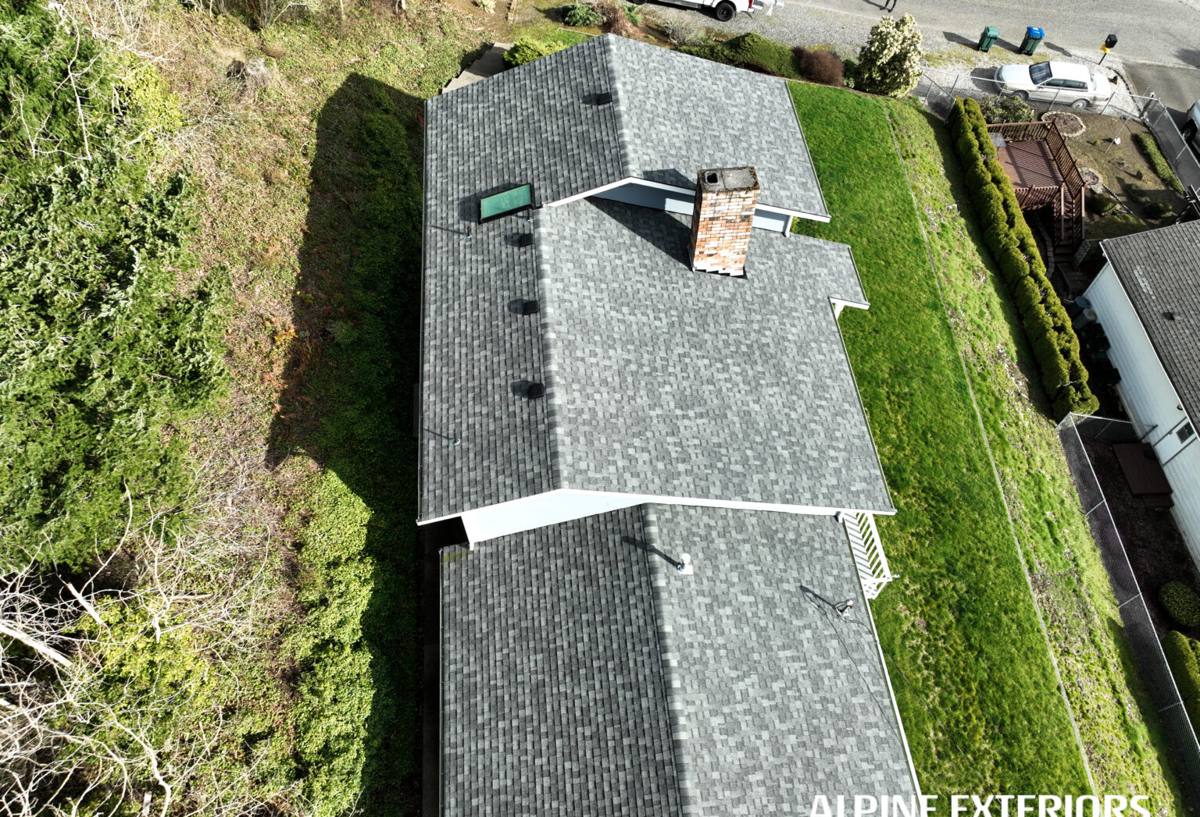
What This Climate Actually Does to a Shingle Roof
Salt air and metal fasteners
Homes within a few miles of saltwater see accelerated corrosion on any exposed or lightly protected metal — nail heads, flashing edges, vent boots with metal collars. On a roof, that shows up first at the flashing and fastener level long before the shingles themselves look worn. Using corrosion-resistant fasteners and flashing metals isn't an upsell out here; it's a baseline requirement for the environment.
Driving rain and wind-driven water intrusion
Rain that comes in at an angle behaves differently than rain that falls straight down. It gets pushed up under shingle tabs, into exposed nail heads, and along valleys and roof-to-wall transitions where a marginal seal will eventually leak. This is a wind-exposure problem as much as a rainfall-volume problem, and it's the reason underlayment coverage and flashing detail matter more here than the shingle brand printed on the wrapper.
Shade, moisture retention, and moss
Tree cover near the creek keeps parts of many roofs from ever fully drying out between storms. Moss and lichen take hold in exactly those conditions — north-facing slopes, areas under overhanging branches, and valleys where debris collects. Left alone, moss holds moisture directly against the shingle surface, which shortens the life of the mat and can lift shingle edges enough to let water underneath.
What a Correctly Installed Shingle Roof Includes Here
A shingle roof is a system, not just a layer of shingles nailed to plywood. In a climate like this one, every layer of that system earns its keep:
- Ice-and-water shield or self-adhering membrane at eaves, valleys, and roof-to-wall transitions, where wind-driven rain is most likely to find a way in
- Synthetic underlayment across the full deck, properly lapped and fastened, as the backup layer beneath the shingles
- Corrosion-resistant fasteners driven at the correct depth and pattern, not overdriven or underdriven
- Step flashing and counterflashing at every wall intersection, rather than relying on caulk or roof cement alone
- Balanced intake and exhaust ventilation, so the attic can actually dry out between wet spells instead of trapping moisture under the deck
- Shingles rated for algae resistance, which matters more here than the color or style differences between product lines
Skip any one of these and the roof may still look fine for a year or two. The failures that show up in this area almost always trace back to a shortcut in one of these details, not a defect in the shingle itself.
Choosing a Shingle for Salt Air, Rain, and Moss
Most manufacturers offer three general tiers of asphalt shingle, and the differences matter more in a coastal, shaded climate than they would somewhere drier. Algae-resistant (AR) shingles, which use copper- or zinc-infused granules to slow moss and algae growth, are worth the modest upcharge on nearly every California Creek roof we look at.
| Shingle Tier | Typical Lifespan Here | Moss/Algae Resistance | Best Fit |
|---|---|---|---|
| 3-Tab (economy) | 15–20 years | Limited unless AR-rated | Budget-driven projects, secondary structures |
| Architectural / Dimensional | 25–30 years | Good, especially with AR granules | Most primary homes in this area |
| Premium / Designer | 30+ years | Very good with AR granules | Steep or highly visible rooflines, longer-term hold |
Wind rating is worth checking too. Coastal and near-coastal properties benefit from shingles rated for higher wind speeds, particularly on exposed roof planes facing open water or cleared land. We'll walk through the specific product lines and ratings available at the time of your estimate rather than pushing one brand as the only option — the right shingle depends on your roof's exposure, slope, and how long you plan to stay in the home.
Moss and Debris: The Ongoing Reality, Not a One-Time Fix
Because of the shade and moisture around California Creek, moss control here is maintenance, not a single treatment. A new roof with AR shingles will still need periodic attention, especially on north-facing or heavily shaded slopes.
What actually helps:
- Keeping overhanging branches trimmed back so roof surfaces get more light and airflow
- Clearing needles, leaves, and debris from valleys and gutters before they compost in place
- Gentle, low-pressure moss removal rather than pressure washing, which can strip granules and shorten shingle life
- Periodic zinc or copper strip installation near the ridge on problem slopes, which lets rain carry moss-inhibiting minerals down the roof over time
- Catching small moss patches early, before they mat down and start holding water against the shingle
We're upfront that no shingle roof in this kind of shaded, damp setting is entirely maintenance-free. The goal is a roof and a maintenance rhythm that keeps moss from ever becoming a structural issue, not a one-time spray that gets forgotten.
How We Approach a California Creek Roofing Project
Inspection and honest scoping
We start on the roof, not just with a drive-by look. That means checking the deck condition, flashing points, ventilation, and how much of the current problem is shingle wear versus a moisture or moss issue that's been left unaddressed. You get a straight answer about whether you need a full replacement, a targeted repair, or something in between.
A written estimate you can actually compare
Our estimates spell out the shingle product, underlayment and ice-and-water shield coverage, flashing scope, and ventilation work — so you're comparing apples to apples if you're getting more than one quote.
Tear-off, deck check, and installation
Full tear-off lets us actually see the deck and fix any soft or damaged sheathing before new material goes down — a step that matters more here, given how often shaded, damp roofs hide moisture problems under the old shingles. Installation follows manufacturer specs for nailing pattern, exposure, and flashing detail, not shortcuts to save an hour on the job.
Cleanup and walkthrough
We clear the site of old material and debris, do a magnetic sweep for stray fasteners, and walk the finished roof with you so you know what was done and what to expect going forward, including any moss-maintenance recommendations specific to your lot.
Repair or Replace? How to Tell
Not every roofing problem near California Creek means a full replacement. Age, extent of damage, and how the roof was originally installed all factor into that decision. As a general guide:
- Isolated leaks near a single flashing point or vent, on a roof under 15 years old — usually a repair
- Granule loss concentrated in one area, with the rest of the roof intact — often a repair or partial re-roof
- Widespread moss with soft or spongy decking underneath — typically points toward replacement
- Shingles curling, cracking, or losing tabs across multiple slopes — a sign the roof is at or near end of life
- A roof original to a home more than 20–25 years old, even if it "looks okay" from the ground — worth a full inspection before deciding
We'll tell you plainly when a repair is the right call and won't push a full replacement a roof doesn't need yet.
Why Local Experience in This Area Matters
A crew that regularly works properties near California Creek already knows how the salt air, wind exposure, and shade patterns in this part of Blaine tend to play out on a roof — which slopes hold moisture longest, where moss shows up first, and which flashing details tend to fail if they're not done right the first time. That's the kind of knowledge that comes from working this specific stretch of Whatcom County, not from a general roofing checklist. It also means we're familiar with local permitting requirements and the practical realities of getting equipment and material to properties in this area.
We're not asking you to take our word for the condition of your roof. We'll show you what we find, explain the reasoning behind our recommendation, and give you a clear estimate before any work starts.
Get a Free Estimate for Your California Creek Roof
If your roof is showing moss buildup, granule loss, or you're just not sure how much life it has left, we're glad to take a look. The estimate is free, there's no pressure to book anything on the spot, and you'll walk away with a clear, honest picture of what your roof actually needs. Use the form below to get started.