 Blaine Siding
 Why California Creek Homes Need a Different Approach to Siding
California Creek sits close enough to the water that homes here deal with a mix of conditions that inland Whatcom County properties simply don't face in the same combination: salt-laden air moving off the coastline, driving rain that hits siding at an angle rather than falling straight down, and a long, damp shoulder season that keeps north-facing walls and shaded siding runs wet enough, long enough, for moss and algae to take hold. Any one of these on its own is manageable. Together, over years, they expose the weak points in a siding job fast — usually at the seams, the fastener points, and wherever the original installer cut corners on flashing.
We install siding throughout Blaine and the surrounding areas of Whatcom County, and California Creek is one of the neighborhoods where we see the clearest difference between a siding job that was installed to spec and one that wasn't. It's not usually the siding material itself failing — it's water finding a path in through a gap, lap, or penetration that wasn't detailed correctly for this specific exposure.
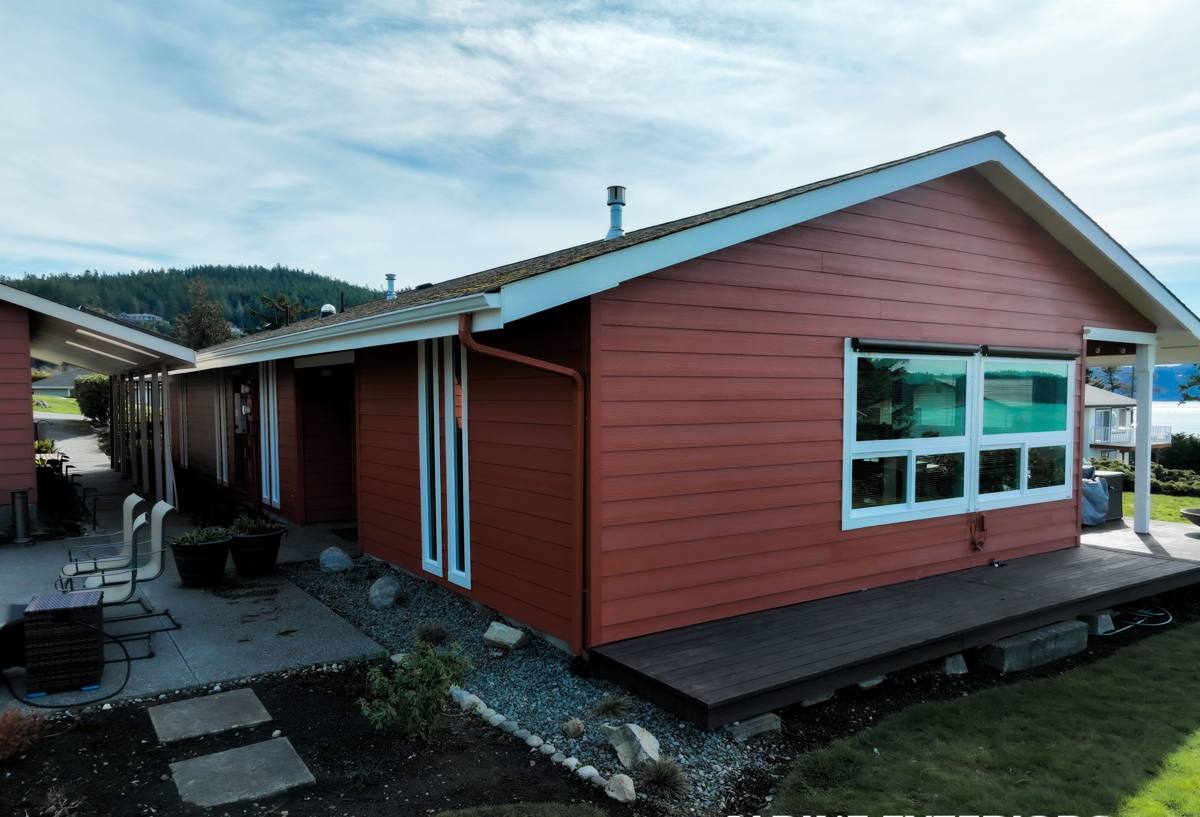
What the Local Climate Actually Does to Siding
Salt Air and Fastener Corrosion
Homes near the water don't just get "some" salt exposure — airborne salt settles on every exterior surface, including fasteners, flashing, and any exposed metal trim. Over time, ordinary fasteners can corrode, staining the siding around them and eventually weakening their hold. This is why fastener selection matters more here than it does a few miles inland: stainless steel or hot-dip galvanized fasteners rated for coastal exposure aren't an upgrade in California Creek, they're the baseline.
Driving Rain and Wind-Driven Moisture
Storms coming off the water don't just drop rain straight down — wind pushes it sideways and upward into laps, corners, and trim joints that would stay dry in a calmer climate. If a siding installation relies on caulk alone to keep water out of a joint, that joint is a future failure point. Correct lap spacing, properly integrated flashing, and a real drainage plane behind the siding are what actually keep wind-driven rain from becoming a moisture problem inside the wall.
Moss, Algae, and the Long Damp Season
Shaded walls, north exposures, and anywhere tree cover keeps siding from drying out fully between storms are prone to moss and algae growth for a good stretch of the year. Beyond the cosmetic issue, sustained moisture sitting against a siding surface accelerates any existing weakness — cracked caulk, an open seam, an unsealed cut edge — turning a minor gap into a path for water intrusion.
What a Correct Siding Installation Involves Here
A siding job built for California Creek's exposure isn't dramatically different in materials from siding installed elsewhere in Blaine, but the details get less forgiving. The things that matter most:
- A continuous, correctly lapped weather-resistive barrier behind the siding, with no gaps at seams or penetrations
- Flashing integrated at every window, door, deck ledger, and roof-to-wall intersection — not just caulked over
- Correct fastener type, spacing, and penetration depth, sized for coastal-exposure conditions
- Proper clearance between the bottom of the siding and grade, decks, patios, and roof lines to avoid standing moisture and splash-back
- Factory-finished panels and trim installed per the manufacturer's specifications, so the finish warranty stays intact
- Attention to shaded, low-airflow wall sections where moss and algae are most likely to establish
Skipping any one of these doesn't usually cause an immediate problem. It shows up two, five, or ten years later as a soft spot, a stain, or a section that's holding moisture nobody would guess is there just by looking at it.
Why We Install Only James Hardie Fiber Cement Siding
We don't install vinyl, LP SmartSide, Cemplank, Allura, or bare cedar and primed spruce siding. That's a deliberate standard, not a limitation in what we're capable of installing. In a climate like California Creek's — salt air, driving rain, extended damp periods — the material itself has to hold up to conditions that punish anything with a weak moisture tolerance or an unstable finish.
James Hardie fiber cement is non-combustible, dimensionally stable in wet-dry cycling, and comes with a factory-applied ColorPlus finish that's engineered to resist fading and hold up against UV and moisture exposure far better than field-applied paint. Hardie also engineers specific product lines (their HZ5 line, for example) for harsher climate zones, which matters in a coastal exposure like this one. The company backs installations with a strong transferable warranty — but that warranty is only as good as the installation behind it, which is why correct detailing at every seam and penetration matters as much as the product choice itself.
We go into more detail on the trade-offs of other siding materials on our other pages, but the short version for California Creek: this is not a climate where you want to gamble on a product that's sensitive to moisture, prone to fading, or dependent on perfect field-applied paint to perform over the long run.
Our Installation Process for California Creek Homes
1. On-Site Assessment
We start by walking the property and looking specifically at exposure — which walls face the water and prevailing wind, which sections stay shaded and damp, where the existing siding (if any) is already showing moisture or moss issues, and where flashing and drainage details need the most attention.
2. Removal and Substrate Check
Once old siding comes off, we check the sheathing and framing underneath for any moisture damage that was hidden. This is often the point where a homeowner learns whether their old siding was actually doing its job — and it's much cheaper to address a wet stud bay now than after new siding is already up.
3. Weather Barrier and Flashing
We install a continuous weather-resistive barrier and integrate flashing at every window, door, and penetration before a single piece of siding goes up. This step is the one most often shortcut on lower-quality jobs, and it's the one that matters most in this climate.
4. Siding Installation to Manufacturer Spec
Hardie panels and trim go up per manufacturer fastening and clearance requirements, with corrosion-resistant fasteners throughout and careful attention to lap spacing and joint treatment.
5. Final Walkthrough
We walk the finished job with the homeowner, covering what was done, what to expect from the finish over time, and any basic maintenance that helps the siding perform well through the local wet season.
Cost Factors for a California Creek Siding Installation
Every home is different, but the factors that move the price on a siding installation in this area tend to be consistent. We give exact numbers only after seeing the property, but here's what typically drives the estimate:
| Factor | Why It Matters Here |
|---|---|
| Home size and wall complexity | More corners, dormers, and trim details mean more flashing and cutting work |
| Exposure level | Walls facing the water or prevailing wind need more careful detailing than sheltered walls |
| Existing substrate condition | Hidden moisture damage found during tear-off can add repair scope |
| Siding profile and trim selection | Lap width, panel style, and trim options affect material cost |
| Access and site conditions | Slopes, tight lot lines, or landscaping near the walls affect labor time |
Because California Creek homes often have higher exposure on at least one side of the house, we generally recommend budgeting for full flashing and drainage-plane work rather than a bare minimum install — it's a smaller cost difference up front than the cost of a moisture repair later.
Signs Your Current Siding Isn't Holding Up
If you're not sure whether your home's siding needs attention, a few signs are worth checking for, particularly on walls that face the water or stay shaded:
- Persistent moss or algae growth that returns soon after cleaning
- Visible staining running down from fasteners or trim joints
- Soft or spongy spots when pressed, especially near the base of walls or under windows
- Cracked, gapped, or missing caulk at seams and trim
- Peeling or fading paint on painted wood siding, or chalking on older vinyl
- Any interior signs of moisture near exterior walls, like musty smells or discoloration
None of these automatically mean a full siding replacement is needed, but they're worth having looked at before they get worse — especially heading into another wet season.
Why Local Installation Experience Matters
Siding installation isn't a one-size-fits-all trade. A crew that mostly works drier, inland projects can install a technically fine job that still underperforms on a coastal-exposure property, simply because the detailing habits that work fine elsewhere aren't strict enough for what California Creek sees every winter. Working regularly in Blaine and this part of Whatcom County means knowing which walls need extra flashing attention before it's asked for, which fastener spec actually holds up to the salt air, and what a home in this specific setting needs to perform for decades rather than years.
If you're considering new siding for a home in California Creek, we're happy to take a look and walk you through what your specific property needs — no pressure, no obligation. Reach out using the form below to schedule a free estimate.