 Blaine Siding
 Custer's Climate Is Hard on Roofs — Metal Handles It Differently Than Shingles
Custer sits close enough to the water and to Drayton Harbor's marine air that homes here deal with a combination most inland Whatcom County properties don't: salt-laden air, long stretches of driving rain off the Strait, and a moss season that can run most of the year in shaded, north-facing spots. Asphalt shingles absorb that moisture, hold onto organic growth, and slowly break down from the freeze-thaw cycling and UV exposure that come with our weather pattern. Metal roofing responds to all three of those stressors better, but only when it's specified and installed correctly for a coastal Whatcom County property. That last part matters — metal roofing done wrong in a salt-air environment fails in ways that are expensive to fix, from premature fastener corrosion to trapped moisture under poorly flashed panels.
This page covers what a correct metal roof installation looks like specifically for Custer homes, what we do differently because of the local climate, and what to expect if you're considering the switch from shingles or replacing an aging metal roof.
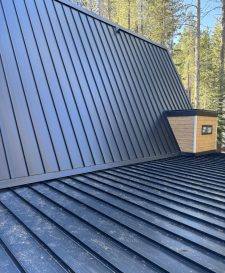
What a Correct Metal Roofing Job Involves
Metal roofing isn't just panels laid over the old roof deck. A roof that's going to hold up against Custer's rain and salt air needs the full system done right, starting underneath the panels themselves.
The Layers That Matter
- Roof deck inspection and repair — any soft, rotted, or water-stained sheathing gets replaced before anything goes on top of it. Installing over a compromised deck just hides the problem.
- Underlayment — we use a high-temperature synthetic or self-adhered underlayment rated for metal roofing, not the felt paper sometimes used under shingles. Metal panels expand and contract more with temperature swings, and the underlayment has to move with that without tearing.
- Ice and water barrier at vulnerable points — eaves, valleys, and any low-slope transitions get a self-sealing membrane. Custer's driving rain can push water uphill under panels during a strong southwesterly, and this is the backup layer that keeps it out of the house.
- Flashing at every penetration and transition — chimneys, vents, skylights, and roof-to-wall intersections are where the vast majority of metal roof leaks actually originate, not the panel field itself.
- Fastener selection matched to the panel and to salt exposure — more on this below, since it's one of the details homeowners rarely get told about until something rusts.
Panel Types We Install
Not every metal roofing product is right for every home, and the coastal setting narrows the field somewhat. Here's how the two main options compare for a Custer property:
| Panel Type | How It's Fastened | Best Fit For | Coastal Considerations |
|---|---|---|---|
| Standing Seam | Concealed clips, no exposed fasteners through the panel face | Most Custer homes, especially anything with a simple gable or hip roofline | No exposed screw heads means fewer long-term points for salt corrosion and gasket failure |
| Exposed Fastener (5V, corrugated, ribbed) | Screws driven directly through the panel, with rubber washers | Outbuildings, shops, budget-conscious projects | Washers degrade faster in salt air and UV; requires more frequent inspection and occasional re-torquing |
We'll walk through both options honestly during an estimate. Exposed-fastener panels cost less up front and are a legitimate choice for a barn or shop, but for a primary residence this close to the water, we generally steer homeowners toward standing seam because the maintenance burden over 20-30 years is lower.
Moss and Algae: Custer's Longest-Running Roofing Problem
Whatcom County's wet season stretches long, and Custer's tree cover and marine humidity give moss and algae plenty of time to establish on north- and east-facing roof slopes. On shingles, moss roots into the granule surface and lifts tabs, which is how a lot of shingle roofs actually start leaking. Metal roofing doesn't give moss anything to root into, and a properly sloped, well-fastened metal roof sheds water fast enough that standing moisture — the thing moss and algae actually need to establish — doesn't have time to sit. That doesn't mean metal is maintenance-free; debris still needs to be kept off valleys and gutters need to stay clear so water keeps moving. But you won't be dealing with the same moss removal and treatment cycle that shingle roofs in shaded Custer lots typically need every couple of years.
Salt Air and Corrosion: What It Means for Material Choice
This is the detail that separates a roof that looks right on installation day from one that still looks right in fifteen years. Salt air accelerates corrosion on any exposed metal, and that includes fasteners, flashing, and the panel coating itself.
What We Pay Attention To
- Panel coating — we specify coatings rated for coastal exposure rather than a base-grade finish, since UV and salt both attack paint systems over time.
- Fastener material — stainless or coated fasteners matched to the panel metal, not mismatched metals that can set off galvanic corrosion between the fastener and the panel.
- Flashing material consistency — flashing, panels, and fasteners should all be compatible metals. Mixing metals without accounting for galvanic reaction is a common shortcut that shows up as staining and pitting years later.
- Cut edges — every field-cut panel edge gets treated or protected, since a raw cut edge is where coating failure and rust typically start first.
None of this is exotic or unusual — it's standard coastal-installation practice. But it's also the kind of detail that gets skipped by crews who mostly work drier, inland jobs and don't adjust their material specs for a property near the water.
Our Process, Start to Finish
- On-site assessment — we look at your existing roof, deck condition, roofline complexity, and any problem areas (valleys, chimneys, low-slope sections) before quoting anything.
- Written estimate — panel type, coating, underlayment spec, and a clear price, so you know exactly what you're paying for and why.
- Scheduling — we work around Whatcom County's weather windows; metal roofing installation needs a reasonably dry stretch, and we'll plan around Custer's rain patterns rather than rushing a job into a wet forecast.
- Tear-off and deck repair — old roofing removed, deck inspected, any rot or soft spots repaired before underlayment goes down.
- Underlayment, flashing, and panel installation — installed in the sequence and to the fastening spec the panel manufacturer requires, not shortcuts to save labor time.
- Final walkthrough — we go over the finished roof with you, including care and maintenance basics specific to your panel type.
What Affects Metal Roofing Cost in Custer
Every roof is different, and we won't quote a number without seeing the property, but these are the main factors that move the price up or down:
| Factor | Why It Matters |
|---|---|
| Panel type | Standing seam runs higher than exposed-fastener panel systems due to material and labor |
| Roof complexity | Valleys, dormers, and multiple roof planes add flashing work and labor time |
| Deck condition | Rot or soft sheathing found during tear-off adds repair cost before installation can proceed |
| Coating and gauge | Heavier gauge panels and coastal-rated coatings cost more than base-grade options but last longer near the water |
| Tear-off scope | Removing multiple layers of old roofing takes more labor than a single-layer tear-off |
Signs Your Custer Home May Be Ready for a Metal Roof
- Shingles showing granule loss, curling, or moss growth that keeps coming back after cleaning
- Recurring leaks near valleys, chimneys, or roof-wall intersections despite past patching
- A roof that's approaching or past the typical 20-25 year shingle lifespan
- Visible rust or fastener failure on an older exposed-fastener metal roof
- Interest in reducing long-term maintenance on a shaded, moss-prone roof slope
- Planning a longer-term hold on the property where a 40-50 year roofing system pencils out
Why It Matters to Hire a Crew That Already Works in Custer
A crew that regularly works Custer and the surrounding Blaine and Whatcom County coastline already knows which fastener specs, coatings, and flashing details hold up against the salt air and rain this area sees. That's different from a general roofing crew pulling from a standard inland spec sheet. We're not guessing at what your roof needs based on a manufacturer's generic install guide — we're applying what actually holds up on homes near this stretch of water, year after year.
If you're weighing metal roofing for a Custer property, we're happy to take a look and walk you through honest options for your specific roof — no pressure, no upsell script. Reach out for a free estimate and we'll give you a straight read on what your roof needs.