 Blaine Siding
 Everson Siding Has to Handle More Than People Think
Everson sits inland along the Nooksack Valley, but "inland" in Whatcom County doesn't mean dry. Marine air off the Salish Sea still pushes through the valley on a regular basis, and it arrives loaded with moisture. Combine that with the long, low-angle rains that settle over this part of Washington from October through May, and you get siding conditions that punish anything not built for sustained damp exposure. Add the moss season — which here can run eight months or longer on north-facing walls and shaded elevations — and it's easy to see why so many older homes in the area show streaking, soft trim, and paint failure years before they should.
None of this is unique to Everson. It's the reality for most of Whatcom County. But it matters more on a house-by-house basis than people expect, because siding that performs fine in a drier climate can fail here in a fraction of the time. That's the lens we bring to every Everson project: not "what siding looks good," but "what siding, installed correctly, will actually hold up to this specific weather pattern for decades."
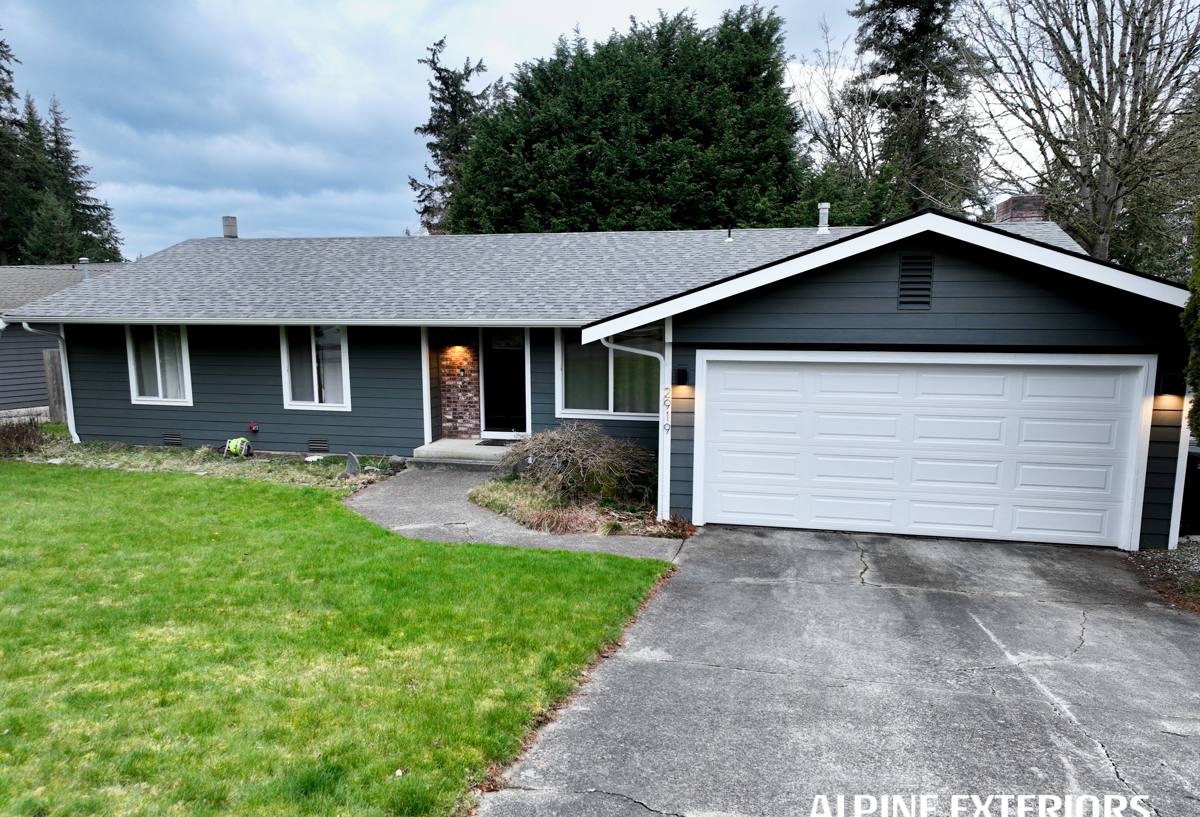
What James Hardie Brings to a Home in This Climate
We install James Hardie fiber cement siding exclusively — no vinyl, no LP SmartSide, no Cemplank or Allura, no primed spruce or cedar. That's a deliberate standard, not a default. Fiber cement is dimensionally stable, doesn't absorb water into a wood substrate, and won't support the kind of fungal growth that engineered wood products are vulnerable to when their outer coating gets compromised. In a climate defined by driving rain and long stretches of humidity, that stability is the difference between siding that needs attention in year eight and siding that's still doing its job in year thirty.
HZ5 — Built for This Region
James Hardie makes climate-specific product lines, and the HZ5 line is engineered for regions with freeze-thaw cycles and sustained moisture exposure — which describes Whatcom County well. It's formulated to resist moisture-related damage and hold up to the freeze-thaw swings that happen here in winter, when a wet wall can go from soaked to frozen overnight. Installing the correct HZ variant matters; it's one of the reasons product selection isn't something we treat as interchangeable across regions.
ColorPlus Factory Finish
Most Everson installations we recommend use Hardie's ColorPlus finish — a factory-applied, baked-on finish that's more UV- and moisture-resistant than field-applied paint, and backed by its own finish warranty separate from the product warranty. In a climate where a field-painted finish is fighting rain more months than not, starting with a finish that was cured under controlled conditions — not on a scaffold in April drizzle — is a meaningful head start.
Moss, Moisture, and Why Installation Details Matter More Than the Siding Itself
Fiber cement is a genuinely durable material, but durability on paper doesn't mean much if the installation ignores how water actually moves on a wall. Most of the siding failures we get called out to inspect in Whatcom County aren't material failures — they're installation failures. Panels nailed too tight, missing rainscreen gaps, flashing details skipped to save an hour. In a dry climate those shortcuts might not show for years. Here, they show fast.
What Correct Installation Actually Involves
A correct James Hardie install in a moss-and-rain climate like this one includes a drainage plane behind the siding (not siding nailed directly to sheathing), proper head flashing above every window and door, correct fastener spacing and depth so panels aren't over-driven, and clearance at grade so the bottom edge of the siding never sits in contact with soil, mulch, or hardscape. Every one of those details is invisible once the job is finished — which is exactly why it matters who's doing the work, not just what material they're using.
What Homeowners Can Do Between Services
Even correctly installed siding benefits from basic upkeep in this climate. Keep gutters clear so water isn't sheeting down the wall face, trim back plantings and shrubs so they're not holding moisture against the siding, and rinse pollen, moss spores, and grime off the walls once or twice a year — a garden hose and soft brush is usually enough for fiber cement; pressure washers held too close can force water behind panels or damage the finish. None of this replaces correct installation, but it extends the life of a system that's already built for the job.
Why We Standardized on James Hardie Instead of the Alternatives
We get asked fairly often why we don't offer vinyl or LP SmartSide as a lower-cost option. Both have their place, and neither is a scam — but neither holds up the way fiber cement does under sustained Pacific Northwest moisture. Vinyl can warp, fade, and its seams and butt joints give water a path in over time, especially as caulking ages and shrinks. LP SmartSide is a wood-strand product with an engineered outer resin coating; if that coating is compromised — by a hairline crack, a poorly sealed cut edge, or just age — the wood core underneath is exposed to exactly the kind of sustained damp conditions this region delivers for most of the year. James Hardie's fiber cement composition doesn't have a wood core to protect in the first place, which removes that failure mode entirely. That's the whole reason behind the standardization: fewer weak points in a climate that's good at finding them.
Comparing Siding Materials for an Everson Climate
| Material | Moisture Behavior | Moss/Algae Resistance | Typical Lifespan Here |
|---|---|---|---|
| James Hardie Fiber Cement | Dimensionally stable, no wood core to rot | Good, especially with ColorPlus finish | 30-50 years with correct install |
| Vinyl | Can warp/expand; seams allow water intrusion | Moderate; surface staining common | 15-25 years |
| LP SmartSide | Wood-strand core vulnerable if coating fails | Moderate; edge/cut exposure is the risk point | 20-30 years, coating-dependent |
| Cedar | Absorbs moisture directly; needs ongoing maintenance | Poor without regular treatment | 15-25 years with upkeep |
These are general ranges, not guarantees — actual lifespan always comes down to installation quality, sun/shade exposure on each elevation, and how consistently a home gets basic maintenance. But the pattern holds across the county: materials with a wood component or reliant on seams and caulking to stay watertight need more attention here than fiber cement does.
Our Process for an Everson Siding Project
The process doesn't change much from house to house, but the details we pay attention to are shaped by what we've seen fail on homes in this area.
- On-site assessment. We look at every elevation separately — north and shaded walls that hold moss longer get evaluated differently than sun-exposed south walls.
- Moisture and substrate check. Before any siding goes up, we check what's underneath. Soft sheathing or trapped moisture from a prior installation gets addressed first, not covered over.
- Drainage plane and flashing. We install a proper rainscreen/drainage gap and correct flashing at every penetration, window, and door before the first Hardie panel goes on.
- Hardie installation to spec. Correct fastener type, spacing, and depth; proper panel gaps and clearances; manufacturer-spec grade clearance at the base.
- Final walkthrough. We go over the finished job with the homeowner, including basic upkeep expectations for this climate.
What a Correct James Hardie Job Should Include
- Written scope specifying the exact HardiePlank/HardieShingle profile and HZ product line being used
- Drainage plane or rainscreen gap behind the siding, not direct-to-sheathing installation
- Proper head flashing above every window, door, and trim penetration
- Correct nail/fastener spacing per Hardie's installation specs, not over-driven or under-driven
- Grade clearance at the base of the wall — siding never in direct contact with soil or hardscape
- ColorPlus finish detailing at cut edges, or field-primed and painted cut edges if field finish is used
- Clear explanation of what's covered under the Hardie product warranty versus the installer's workmanship warranty
What Affects the Cost of a James Hardie Project in Everson
Every Everson home is different, so it's not useful to throw out a flat number — but the same handful of factors drive cost on nearly every project we quote in this area.
| Factor | Why It Matters |
|---|---|
| Tear-off vs. new construction | Removing and disposing of existing siding, and repairing any sheathing damage found underneath, adds labor that new construction doesn't require |
| Siding profile chosen | HardiePlank lap siding, HardieShingle, and HardiePanel each have different material and installation labor costs |
| Number of elevations and complexity | Homes with more corners, dormers, and trim detail take longer to flash and fit correctly than a simple rectangular footprint |
| Moisture or rot repair needed | If sheathing or framing was compromised by a prior siding failure, that repair happens before new siding goes up |
| Finish choice | Factory ColorPlus finish costs more upfront than field-primed siding, but it removes the recurring cost of repainting down the road |
The only way to get real numbers is a walkthrough of your specific house — which is exactly what a free estimate is for.
Why a Crew That Already Works in Everson Makes a Difference
Whatcom County covers a lot of ground, and conditions shift meaningfully between the coast, the valleys, and the foothills. A crew that already works in and around Everson has a working sense of which elevations on a typical local home hold moisture longest, how the moss season here compares to areas closer to the water, and what permitting and inspection expectations look like in this part of the county. That local pattern recognition doesn't replace following Hardie's installation spec — it supplements it, catching the things a generic install checklist wouldn't flag on its own. It also means fewer surprises during the project itself: knowing which suppliers stock the right HZ product locally, and how weather windows in this specific area tend to break, keeps a job moving instead of stalling out.
If you're weighing a siding replacement or repair on an Everson home, we're happy to walk the property, look at what your current siding is telling us, and talk through what a correctly installed James Hardie system would look like for your specific house. Reach out for a free, no-pressure estimate — there's no obligation, and no pressure to move forward until you're ready.