 Blaine Siding
 Why Dakota Creek Puts Different Demands on Siding
Dakota Creek sits close enough to the water and to open farmland that homes here take on a specific combination of punishment: salt-laden air drifting in off the Strait of Georgia and Semiahmoo Bay, long stretches of driving rain pushed in by winter storms, and a moss season that can run most of the year in the shadier, north-facing parts of a lot. None of these things alone is unusual for Whatcom County. Together, over years, they're what separate a siding job that looks fine at installation from one that actually holds up.
Salt air accelerates corrosion on fasteners and trim metal. Driving rain finds every gap in flashing and caulk that a calmer climate would never test. And moss doesn't just sit on a roof — given a shaded wall, damp siding, and a few seasons of neglect, it will colonize horizontal ledges, behind trim, and anywhere water sits instead of shedding. A siding system for a Dakota Creek home has to be chosen and installed with all three of those realities in mind, not just the one that's easiest to talk about.
Why Fiber Cement Fits This Climate
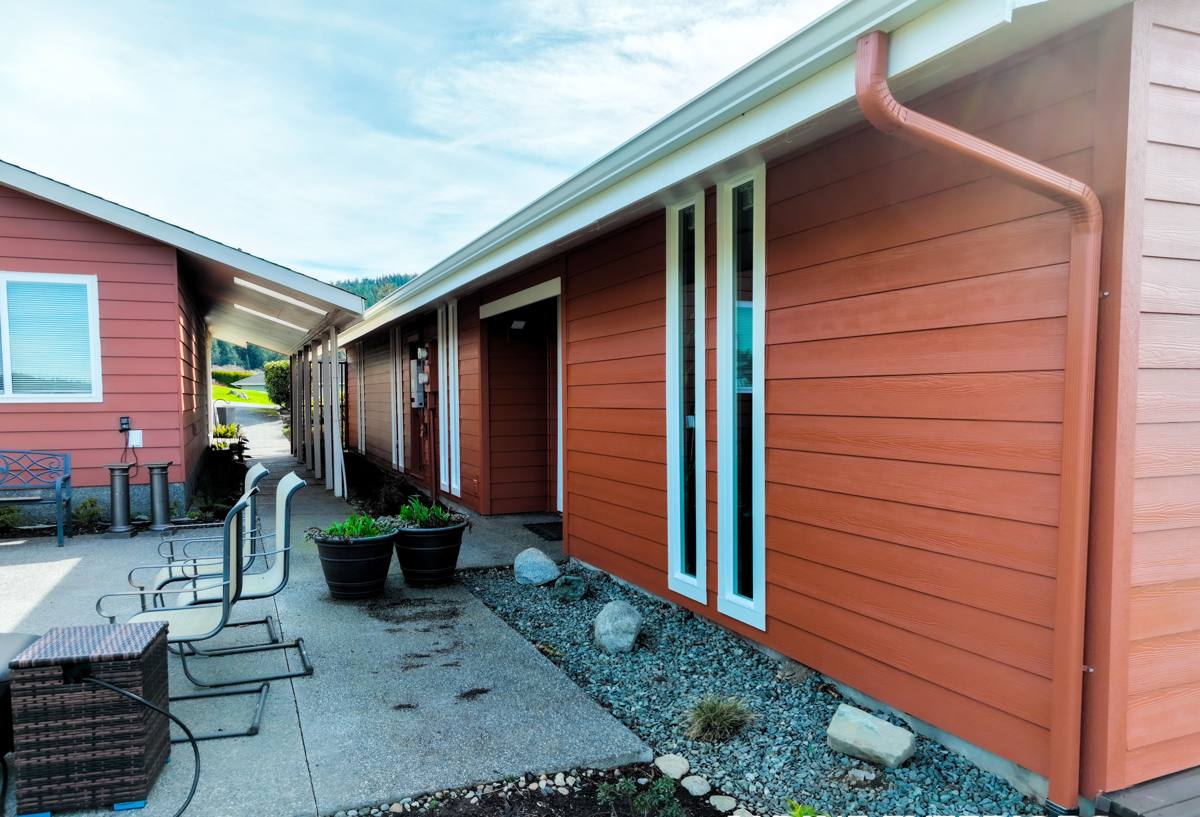
Fiber cement — specifically James Hardie's product line — holds up to this combination better than the materials it's replaced on most local jobs. It doesn't rot when it stays damp for extended periods, it doesn't provide the organic surface that some wood-based products do for moss and mildew to grip, and it's dimensionally stable enough that it doesn't cup, crack, or pull away from fasteners the way some engineered wood products can once moisture cycles through them repeatedly. It's also non-combustible, which matters less for coastal moisture but is still part of why we standardized on it.
We install James Hardie exclusively. We don't install vinyl, LP SmartSide, Cemplank, Allura, or primed wood species like spruce or cedar. That's not a knock on every homeowner who has one of those products on their house today — it's a statement about what we're willing to put our name behind on a new install, given what we see fail first in this specific climate.
What Salt Air Actually Does to a Wall System
Airborne salt is corrosive to exposed fasteners, uncoated flashing, and cheaper trim hardware. Over time it also holds moisture against surfaces longer than dry inland air would. Fiber cement itself isn't harmed by salt exposure the way bare or thinly coated metal is, but the fasteners, flashing, and trim details around it need to be chosen with that in mind — which is a job detail, not a product detail.
What Driving Rain Tests
Wind-driven rain in this area doesn't just fall on a wall, it gets pushed sideways into joints, seams, and anywhere a board meets a window, door, or corner trim. A siding system's water resistance is decided almost entirely at those transition points. The field of the wall is rarely where a Dakota Creek siding job fails first — the corners, the window heads, and the bottom courses near grade are.
What Moss Season Adds
Shaded, north- and east-facing walls in Dakota Creek can stay damp for days after a storm passes. Moss and algae will grow on almost any siding surface that stays wet long enough, but they get a foothold fastest on porous or textured surfaces and anywhere water is allowed to pool instead of drain. ColorPlus factory-finished Hardie board's smoother, denser finish gives moss and mildew less to grip than raw or field-painted wood-based sidings, which helps — but proper drainage behind the cladding and correct clearances at grade do more of the actual work.
What a Correct Fiber Cement Installation Involves
The product itself is only part of the equation. Most siding failures we get called out to inspect in this climate trace back to installation shortcuts, not the material. A correct James Hardie install on a Dakota Creek home includes:
- A weather-resistive barrier installed and lapped correctly, with a drainage plane behind the siding so incidental moisture can escape instead of getting trapped against the sheathing
- Flashing at every window, door, and roof-to-wall intersection — installed to shed water down and out, not just caulked and hoped for
- Correct fastener type and spacing per James Hardie's published installation instructions, with fasteners set to the manufacturer's specified depth, not overdriven
- Proper clearance between the bottom edge of the siding and grade, roofing, decks, and paved surfaces, so splash-back and standing water don't sit against the board
- Caulked and sealed joints only where James Hardie specifies them — some joint types are designed to be left uncaulked to allow drainage, and sealing them wrong can trap water instead of shedding it
- Factory-primed cut edges resealed with the correct touch-up product before installation, since an unsealed cut edge is one of the few ways moisture can get into the board itself
Skipping or rushing any one of these doesn't usually show up as a problem in year one. It shows up in year five or eight, as a stain, a soft spot at a window corner, or moss taking hold somewhere it shouldn't.
Which Hardie Product Line Fits a Dakota Creek Home
James Hardie engineers its HZ5 product line specifically for the wetter, milder climate zones that include western Washington. It's formulated and warrantied for regions that see sustained moisture exposure rather than freeze-thaw extremes. For Dakota Creek, that HZ5 formulation — paired with a ColorPlus factory finish rather than field paint — is the combination we recommend on almost every job, whether it's lap siding, board-and-batten, or a shingle-style accent.
ColorPlus finish matters more here than in a drier climate. It's baked on at the factory under controlled conditions, which gives it better adhesion and fade resistance than a field-applied coat, and it comes with its own finish warranty separate from the substrate warranty. In a climate where a wall can stay wet for days at a stretch, a finish that isn't fighting adhesion problems from day one is worth the difference in cost.
How Fiber Cement Compares for This Climate
| Factor | James Hardie Fiber Cement | Vinyl | Engineered Wood / LP-Type |
|---|---|---|---|
| Moisture tolerance | Does not rot; stable through wet/dry cycles | Doesn't rot, but can warp/gap in temperature swings | Vulnerable at unsealed cuts, edges, and joints |
| Moss/algae resistance | Dense factory finish, less organic surface to grip | Resists moss but can trap moisture behind panels | Wood-based surface can support growth if damp long-term |
| Salt air durability | Board itself unaffected; hardware needs correct spec | Board unaffected; seams can become brittle over time | Board more sensitive to sustained coastal humidity |
| Finish life before repaint/recoat | Long-life factory finish (ColorPlus) | Color molded in; can fade and chalk | Field paint typically needed sooner |
| Fire resistance | Non-combustible | Combustible | Combustible |
This isn't a claim that other products are unusable — plenty of homes around Whatcom County have vinyl or engineered wood siding performing adequately. It's a summary of the trade-offs that led us to install only one product system, and why that system holds up to Dakota Creek's specific mix of salt, rain, and shade better than the alternatives we used to install.
Our Process on a Dakota Creek Job
Every job starts with a walk of the exterior, not a quote off a photo. We're looking at grade clearances, existing flashing condition, roof-to-wall transitions, and which elevations get the least sun — those north and east walls are usually where moss has already gotten a start and where drainage details matter most.
- On-site assessment of the existing wall assembly, drainage, and problem areas specific to the home's orientation
- Removal of old siding and inspection of the sheathing underneath for hidden moisture damage before anything new goes up
- Installation or repair of the weather-resistive barrier and drainage plane
- Flashing installed at every penetration and transition per manufacturer detail, not generic practice
- James Hardie HZ5 siding installed to spec — correct fastener pattern, clearances, and joint treatment
- Final walk-through so the homeowner understands what maintenance, if any, the finish needs going forward
Maintenance in a Salt Air, High-Moss Environment
One reason homeowners like fiber cement in this area is how little upkeep it needs compared to what they're used to — but "little" isn't "none." A few habits keep a Dakota Creek installation performing the way it's designed to:
- Rinse salt residue and organic buildup off the siding once or twice a year, especially on walls facing prevailing weather
- Keep gutters clear so overflow doesn't run down the wall face and stay wet longer than it should
- Trim back vegetation and tree cover that keeps a wall shaded and damp, since that's where moss gets its foothold first
- Check caulking at windows and trim every couple of years — caulk is the one component in the system that wears out on a schedule
- Address any moss or algae growth promptly with a gentle wash rather than pressure-washing, which can force water behind joints
Why Local Installation Experience Matters Here
Manufacturer installation instructions are written for a wide range of climates. Applying them correctly to a Dakota Creek home means knowing, from having done it before, which elevations need extra flashing attention, how much clearance actually holds up against this area's rain patterns, and where moss tends to establish first on a given lot orientation. That's the difference between a crew installing Hardie board to the letter of a generic spec sheet and a crew installing it for the specific way weather behaves in this part of Whatcom County.
If your Dakota Creek home needs new siding, or you want a straight answer about whether your current siding is holding up the way it should, we're glad to come take a look. The estimate is free, there's no pressure, and you'll get a specific answer about your home rather than a generic pitch.