 Blaine Siding
 Siding Repair for Grandview Homes
Grandview homes sit within the same demanding climate belt as the rest of the Blaine area — close enough to the water that salt air is a daily condition, exposed enough to catch storms coming off the water with real wind behind the rain, and mild and damp enough that moss has most of the year to work on any exterior surface that stays wet. That combination is hard on siding in ways that homeowners further inland in Whatcom County don't have to think about nearly as much, and it means a repair job that looks fine from the driveway can still be hiding a problem that started months or years earlier.
This page is specifically about siding repair in Grandview — not a full replacement pitch, not a generic siding overview. It covers what actually causes siding problems in this part of Whatcom County, how we tell a real repair from a job that should really be a replacement, what a correct repair involves, and why it matters to hire a crew that already knows how Grandview homes age rather than one working it out for the first time on your project.
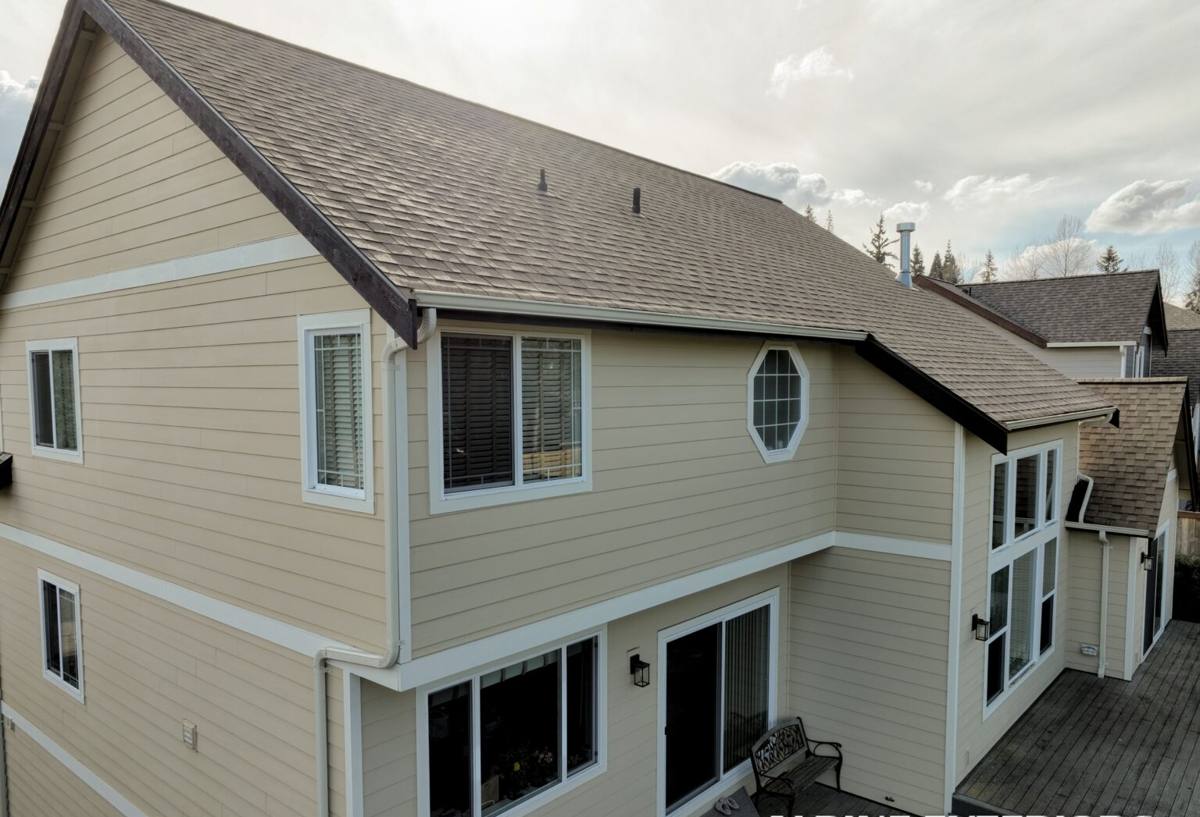
What Actually Damages Siding in This Part of Whatcom County
Salt Air and Fastener Corrosion
Salt-laden air moves inland off the water and settles on every exterior surface it reaches, not just the walls facing the coast directly. Over time it accelerates corrosion in nails, staples, and any exposed metal trim or flashing. A corroding fastener doesn't usually announce itself — it shows up later as a panel that's started to work loose, a slight gap at a butt joint, or trim that's begun to pull away from the wall. In a repair context, that means the visible symptom (a loose board, a gap) is often a sign the fastening has already failed underneath, not just a cosmetic nuisance to caulk over.
Driving Rain and Wind-Driven Moisture
Storms in this part of the county rarely drop rain straight down. Wind pushes it sideways into wall assemblies, corners, and anywhere two materials meet — window trim, doors, roof-to-wall transitions. That sideways-driven moisture finds gaps that vertical rainfall never would, which is why so much real siding damage starts at joints, seams, and penetrations rather than out in the open field of a wall. A repair that only addresses the visible crack or gap without checking what's happening at the surrounding joints is usually an incomplete repair.
A Long Moss Season
Mild temperatures combined with near-constant moisture give moss and mildew a growing season that can run most of the year on shaded or north-facing walls. Moss holds moisture directly against the siding surface far longer than an exposed wall would otherwise stay wet, and any siding material with even minor surface porosity becomes a place for it to take hold. On a repair job, moss buildup is often the first visible clue that a section of wall has been staying wetter than it should — worth checking before simply cleaning the surface and moving on.
Repair vs. Replace: How We Tell the Difference
Not every siding problem in Grandview needs the same answer, and getting this call right the first time is the actual value of a proper inspection rather than a quick estimate from the curb.
| What We Find | Usually a Repair | Often Points to Replacement |
|---|---|---|
| A few cracked or damaged panels in one area | Yes — if the rest of the wall and substrate are sound | Only if damage is widespread across multiple walls |
| Loose or popped fasteners | Yes — re-fastened or panels reset to spec | If corrosion is widespread throughout the fastening |
| Gapped or failed caulking at joints and trim | Yes — resealed and checked for moisture behind it | If moisture has already tracked into the wall assembly |
| Soft or spongy siding to the touch | Rarely — usually a sign of deeper moisture damage | Yes — soft siding often means compromised sheathing behind it |
| Widespread moss, staining, or fading across the home | Cleaning helps but won't fix the underlying cause | Worth evaluating if it's tied to an aging, failing system |
| Siding that's an older, discontinued, or mismatched product | Limited — matching material may not exist anymore | Often, once patch options are exhausted |
The honest answer is that a real inspection changes this table for every specific home. Two houses with similar-looking damage can need very different scopes once we've actually pulled a panel or two and looked at what's behind it.
How We Diagnose Before We Recommend Anything
A repair estimate that's worth trusting starts with an actual inspection, not a guess based on what's visible from the ground. On a Grandview siding call, that typically includes:
- Checking the condition of the wall behind visibly damaged panels, not just patching over the surface symptom
- Probing for soft spots around window and door trim, where wind-driven rain most often finds its way in
- Inspecting fasteners and flashing for corrosion, especially on walls that face prevailing weather
- Identifying whether existing siding is a matchable product or one we'd need to source, blend, or address differently
- Checking house wrap and moisture barrier condition wherever panels are already off or damaged enough to expose it
- Looking at moss and staining patterns as a clue to which walls are staying wet longest, not just a cosmetic issue
That inspection is what tells us whether we're looking at a straightforward repair, a larger repair with some substrate work involved, or a section of wall that's past the point where patching makes sense.
What a Correct Siding Repair Involves
Repair work has to meet the same standard as new installation, because a sloppy repair just becomes the next failure point. On every job, that means:
- Matching the existing reveal and profile so repaired sections don't stand out or create uneven water paths across the wall
- Correct fastener type and placement — the same spec that governs new installation applies to replacement panels, not a shortcut because it's "just a repair"
- Checking and repairing house wrap or flashing behind any section that's opened up, since a new panel over a compromised moisture barrier just delays the next problem
- Sealing joints and transitions properly, especially anywhere the repair meets original siding, trim, or a window and door opening
- Verifying drainage so water that gets past the surface — as it eventually does on any siding system — has somewhere to go instead of sitting against the wall
Skipping any of these to save time on a repair almost always costs more later, either as a callback or as damage that's spread further by the time it's caught again.
Why Material Matching Matters on a Repair
We install James Hardie fiber cement exclusively, and that standard carries into repair work too. If the siding on a Grandview home is already Hardie, a repair means sourcing matching panels and trim and installing them to the same spec as the original job, including getting the ColorPlus finish as close a match as the product line allows. If the existing siding is a different product — vinyl, an engineered wood product, or an older material that's simply reached the end of what patching can fix — we'll say so plainly rather than stretch a repair further than it should go. In those cases, we'll walk through what a section replacement or a full re-side with Hardie would actually look like, and let the homeowner make that call with real information instead of a sales push.
We don't install LP SmartSide, vinyl siding, Cemplank, Allura, primed spruce, or cedar, and we won't recommend patching a failing system of one of those materials with mismatched parts just to avoid a harder conversation. It's a professional standard we hold to on repair calls the same way we do on new installations.
Cost Factors for Siding Repair in Grandview
| Factor | Why It Matters |
|---|---|
| Extent of visible damage | A handful of panels versus damage spread across multiple walls changes scope significantly |
| Condition behind the siding | Sound sheathing and house wrap keep a job a simple repair; compromised substrate adds real work |
| Material availability | Matching an existing Hardie profile and color is straightforward; matching an older or discontinued product may not be possible |
| Access and wall height | Second-story and hard-to-reach sections take longer and require more setup |
| Root cause fixes | Flashing or drainage corrections add scope but prevent the same failure from returning |
These are general drivers, not a quote — the only way to give a real number is to walk the property and, in many repair cases, physically pull a section of damaged siding to see what's underneath before finalizing scope.
Signs a Grandview Home Might Need Siding Repair
- Cracked, split, or visibly displaced siding panels in one or more areas
- Soft or spongy siding when pressed, especially low on the wall or near ground level
- Gapped, cracked, or missing caulking at trim, corners, and window or door openings
- Moss or dark staining that returns quickly after cleaning
- Rust streaking around fasteners or trim
- Visible warping, buckling, or separation between panels
- Interior signs like soft drywall, peeling paint, or musty smell near an exterior wall
Why a Crew That Already Works Grandview Matters
Siding repair rewards local experience more than most exterior work, because so much of the job is judgment calls made once panels are already off the wall — whether a section of house wrap is still doing its job, whether a soft spot is isolated or a sign of something bigger, whether a color match is close enough to be worth it or whether the homeowner is better served planning for a fuller re-side down the road. A crew that regularly works Grandview and the greater Blaine area has already seen how salt air, driving rain, and this region's long moss season play out on real homes here, not just on a spec sheet. That experience shapes better decisions on repair day, and it means fewer surprises and fewer callbacks once the job is finished.
Get a Free, No-Pressure Estimate
If siding on your Grandview-area home is cracked, loose, soft, or just not holding up the way it used to, we're glad to take a look and give you a straightforward read on whether it's a repair, a partial section replacement, or something bigger — without a sales script attached. Reach out using the form below to schedule a free, no-pressure estimate.