 Blaine Siding
 Why Lynden Homes Need Siding Repair Sooner Than Owners Expect
Most homeowners assume siding problems show up gradually, in plain sight, over many years. In Whatcom County, that's not always true. Between salt-laden air moving in off the Salish Sea, long stretches of driving rain, and a moss season that can run for months, siding here takes on moisture stress that homes in drier climates simply don't experience. A house that looks fine from the driveway can have soft trim, failed caulk joints, or moisture trapped behind a panel that's been quietly doing damage for a year or more.
For Lynden homeowners, that means siding repair isn't just a cosmetic fix. Done right, it's a chance to catch a moisture problem before it becomes a rot problem, and to make sure whatever goes back on the wall is built to handle the next wet season, not just patch over the last one.
How Moisture Actually Gets In
Siding failure almost never starts with the siding itself. It starts at the seams: a nail hole that wasn't sealed, a butt joint that opened up, flashing above a window that was installed a little short, or caulking that dried out and cracked after a few Whatcom County winters. Driving rain — the kind that comes in sideways during a windstorm rather than falling straight down — pushes water into gaps that would stay dry in a calmer climate. Once water gets behind the siding, it doesn't dry out quickly here. Cool, damp air and long overcast stretches slow evaporation, so a small leak can sit and work on the sheathing and framing for a long time before anyone notices a soft spot or a stain.
Moss, Shade, and Trapped Moisture
Lynden's mix of in-town lots and larger tree-shaded properties means a lot of siding sits in partial shade for a good part of the day. Combine that with our long moss season and you get siding that stays damp longer than it should, even after the rain has stopped. Moss and algae growth isn't just an appearance issue — it holds moisture directly against the surface of the siding, and on materials that aren't built to handle sustained dampness, that constant contact accelerates whatever damage is already starting underneath.
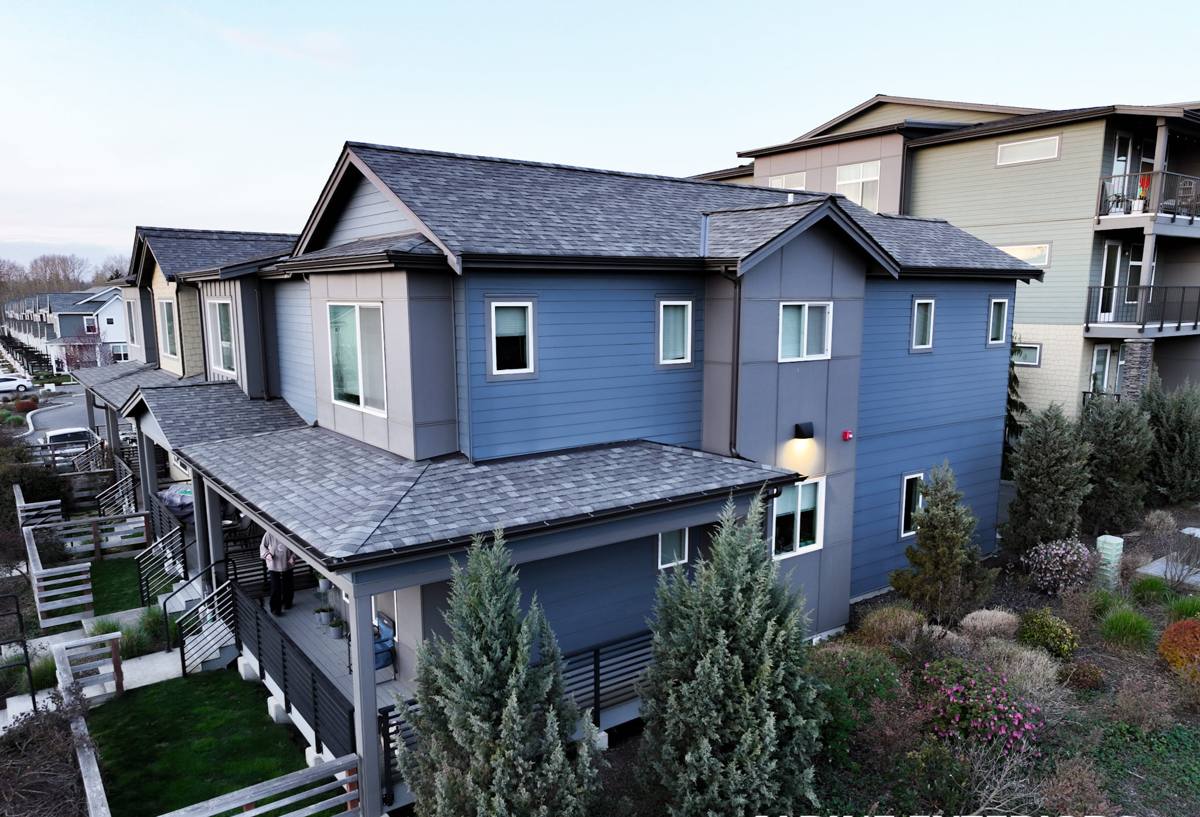
What a Correct Siding Repair Actually Involves
A quick patch — cutting out a bad section and slapping in a new piece — can hide a problem for a season or two, but it doesn't fix anything if the underlying cause is still there. A correct repair starts with figuring out why that section failed in the first place, not just replacing what's visibly damaged.
Diagnosing the Real Problem First
Before we touch a saw, we want to know whether we're looking at a one-time issue (a impact, a missed caulk joint) or a symptom of something larger, like a flashing detail that was never installed correctly or a drainage plane that isn't doing its job. Repairing the visible damage without addressing the cause means the same spot — or the one next to it — will likely fail again within a few years.
Matching Material and Installation Method
Repairs also have to match the performance of the surrounding siding, not just the color. Mixing incompatible materials, using the wrong fasteners, or failing to maintain proper clearances and gaps can create a new weak point even in an otherwise sound wall. This is one of the reasons repair work takes more judgment than people expect — it's not just carpentry, it's understanding how water is supposed to move around and off the building.
Common Siding Repair Issues We See Around Lynden
| Issue | Typical Cause | What It Looks Like |
|---|---|---|
| Soft or bubbling siding near trim | Failed caulk joint letting driving rain behind the board | Panel flexes under light pressure, paint may be peeling |
| Persistent moss or algae staining | Shaded exposure, poor airflow, long damp season | Green or black streaking, especially on north-facing walls |
| Cracked or split boards | Impact damage, or material not rated for our moisture swings | Visible cracks, sometimes with water staining around the edge |
| Warping or buckling panels | Trapped moisture expanding the material from behind | Wavy or uneven surface when viewed at an angle |
| Rot at corners and butt joints | Water intrusion at unsealed seams over multiple seasons | Soft, crumbly wood; sometimes a musty smell nearby |
Repair or Replace? How We Help You Decide
Not every damaged section needs a full re-side, and not every repair is worth doing on its own. The right call depends on how much of the wall is affected, what's causing the failure, and how much useful life is left in the rest of the siding.
| Factor | Leans Toward Repair | Leans Toward Replacement |
|---|---|---|
| Extent of damage | Isolated to one or two sections | Spread across multiple walls or elevations |
| Underlying material | Sound material, isolated seam or impact failure | Material itself is failing (delamination, chronic warping) |
| Age of existing siding | Relatively recent installation | Nearing or past its expected service life |
| Moisture history | Single identifiable cause, now corrected | Recurring leaks in multiple spots, unclear cause |
When damage turns out to be more widespread than expected, we'll tell you plainly rather than keep billing for spot repairs that won't hold up through another wet season.
Why We Repair — and Replace — Using James Hardie Fiber Cement Only
When a repair calls for new material, what goes back on the wall matters as much as the workmanship. We install and repair with James Hardie fiber cement exclusively. We don't work with vinyl, LP SmartSide, cedar, primed spruce, or other fiber cement brands, and that's a deliberate standard, not a brand preference.
Fiber cement is non-combustible and dimensionally stable, meaning it doesn't swell and shrink with moisture the way wood-based products can — a real advantage in a climate where siding spends a lot of the year damp. James Hardie's ColorPlus factory finish is baked on under controlled conditions, which holds up better against the kind of sustained moisture and shaded, moss-prone exposure common around Lynden than a field-applied paint job. Hardie's HZ5 product line in particular is engineered for the freeze-thaw and moisture patterns of the Pacific Northwest, and the manufacturer backs it with a strong, transferable warranty when it's installed to spec.
What This Means If Your Home Isn't Currently Hardie
If your existing siding is a different material, we'll still repair what can be reasonably repaired and be straight with you about its limitations. But when a section needs full replacement, or when repeated repairs point to a material that's reached the end of what it can reasonably do in this climate, we'll walk you through what switching to fiber cement would involve — no pressure, just the honest tradeoffs.
Our Siding Repair Process
Every repair follows the same basic sequence, whether it's a single panel or a larger section of wall:
- On-site inspection to identify both the visible damage and its likely cause
- Check of surrounding flashing, caulking, and drainage details, not just the damaged section itself
- Clear explanation of what we found and what repair (or replacement) makes sense, in plain language
- Careful removal of damaged material without disturbing sound siding around it
- Correction of the underlying issue — flashing, sealant, clearances — before new material goes on
- Installation of matched Hardie fiber cement material, fastened and sealed to manufacturer spec
- Final walkthrough so you know exactly what was done and what to watch for going forward
Why a Crew That Already Works in Lynden Matters
Siding repair done by someone unfamiliar with this climate tends to treat every job the same way, regardless of region. A crew that regularly works in Lynden and the surrounding Whatcom County area already knows how driving rain behaves against different wall orientations, where moss tends to build up fastest on shaded elevations, and how quickly a small unsealed gap can turn into a real moisture problem here. That local pattern recognition shows up in the details — where extra attention to flashing and sealant makes sense, and where a standard repair is genuinely enough. Blaine Siding Companies works this area regularly, which means the diagnosis on your home isn't a guess based on a different climate's rules.
Keeping Your Siding in Good Shape After the Repair
A correct repair should hold up well, but a little seasonal attention helps it — and the rest of your siding — go the distance in this climate.
- Rinse off moss and algae buildup before it has a chance to hold moisture against the surface long-term
- Keep gutters and downspouts clear so runoff isn't dumping extra water down the wall
- Trim back landscaping that's keeping any section of siding in constant shade and dampness
- Do a visual check after major windstorms for any loosened caulk or displaced trim
- Address small issues — a cracked caulk line, a loose panel edge — before the next wet season rather than after
Get a Straight Answer on Your Siding
If you're seeing soft spots, moss buildup, cracked boards, or just want a second opinion on whether a section of siding needs repair or full replacement, we're happy to take a look. We offer a free, no-pressure estimate for Lynden homeowners — you'll get an honest read on what's going on and what it would take to fix it right.