 Blaine Siding
 Decking Built for the Nooksack Climate
Homes in and around Nooksack sit close enough to the Strait of Georgia and Semiahmoo Bay to catch salt-laden air on a regular basis, and far enough into Whatcom County's marine climate to get months of steady, low-intensity rain followed by a long stretch of shade and moss growth every fall and winter. That combination is hard on decks. Wood decking cups, splinters, and grays out fast under those conditions, and even some composite products struggle if they weren't chosen or installed with this specific weather pattern in mind. A deck built for Arizona or even inland Washington isn't automatically right for a deck fifteen minutes from the water in Blaine.
When we build or replace a deck for a Nooksack property, we're planning around three things every time: moisture that never fully goes away for half the year, organic growth (moss, algae, lichen) that thrives in shaded, damp conditions, and the slow corrosive effect of salt air on fasteners and hardware. Composite decking, installed correctly, handles all three far better than wood — but "installed correctly" is doing a lot of work in that sentence, and it's where a lot of decks in this area go wrong.
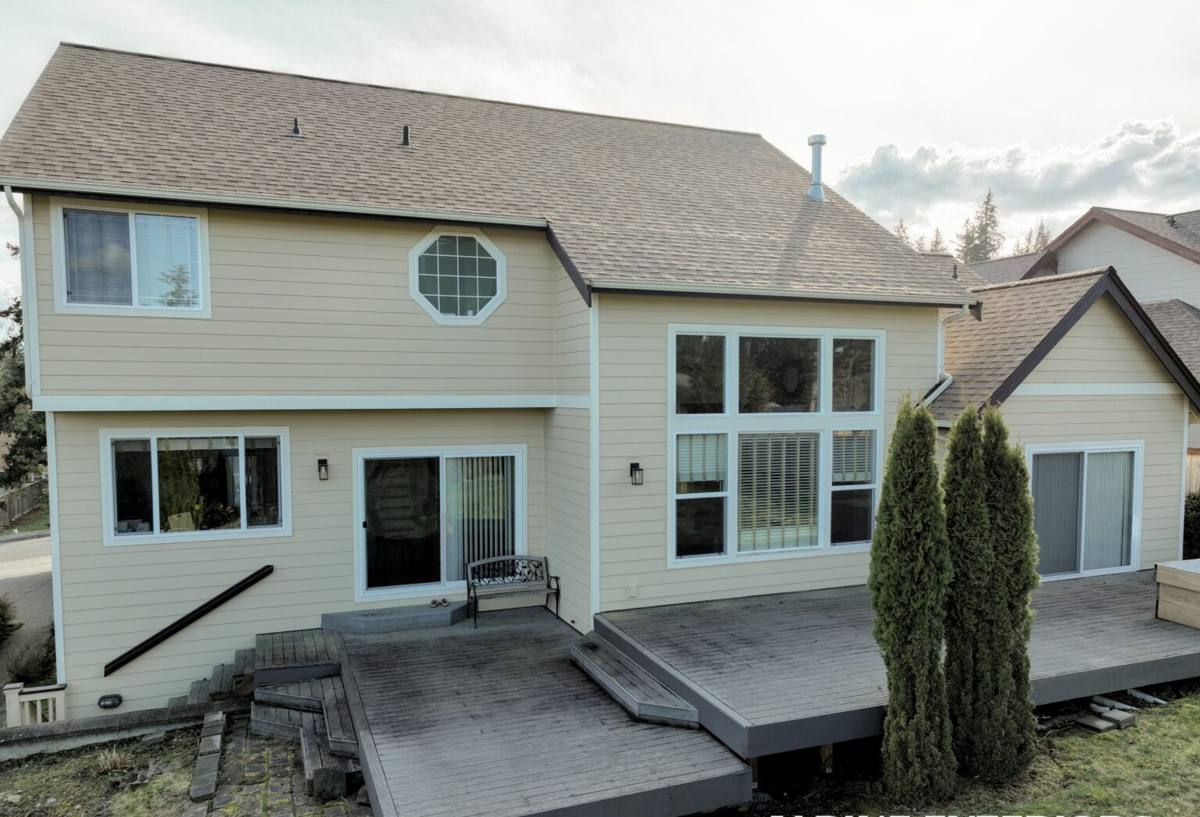
Why Composite Makes Sense Here
Composite decking is a blend of wood fiber and plastic, capped or coated to resist moisture absorption, fading, and staining. For a property near Nooksack, the appeal isn't cosmetic — it's practical:
- It doesn't absorb water the way solid wood does, so it's far less prone to the cupping, splitting, and rot that show up on wood decks after a few wet Whatcom County winters.
- Capped composite boards resist mold and algae staining better than uncapped wood or early-generation composite, which matters a lot in shaded, moss-prone yards.
- It doesn't need annual staining or sealing, which is one less maintenance task for a deck that's going to spend half the year under gray skies.
- Color and texture hold up better under UV and salt exposure than paint or stain on wood.
That said, composite isn't maintenance-free, and it isn't immune to moss and mildew — nothing that sits outside in this climate is. The difference is that a properly installed composite deck sheds water instead of holding it, and that single fact is what keeps moss, rot, and structural decay from taking hold the way they do on an aging wood deck.
Where Homeowners Get Surprised
Composite decking is often marketed as "maintenance-free," which isn't quite accurate. It's low-maintenance compared to wood, but boards still need periodic cleaning to keep organic growth from getting a foothold, especially in shaded areas of the yard or under overhangs where sunlight and airflow are limited. We tell every Nooksack customer this upfront rather than let them find out the hard way.
What a Correct Composite Deck Build Involves
The composite boards themselves get most of the attention, but the structure underneath and the details around the edges are what actually determine whether a deck performs well in this climate for the next 20-plus years.
Substructure and Framing
We frame with moisture-resistant or properly treated lumber, and we pay close attention to ledger board flashing where the deck meets the house — that connection point is one of the most common sources of hidden water intrusion on decks in wet climates. A poorly flashed ledger board can let water track into the rim joist and wall framing for years before anyone notices a problem.
Joist Protection
Composite boards resist moisture, but the joists underneath are usually still wood. We use joist tape or a comparable barrier on top of every joist to keep water from sitting in the small gap between the joist and the deck board — a detail that's easy to skip and expensive to regret later.
Fastening and Hardware
Given the salt air common to this part of Whatcom County, we use fasteners and structural hardware rated for coastal or corrosive environments, not standard interior-grade hardware. Standard screws and joist hangers can start showing corrosion within a few years this close to the water; corrosion-resistant hardware costs a little more upfront and avoids a much bigger repair bill later.
Drainage and Spacing
Proper board spacing and a substructure that allows airflow underneath the deck are essential for drying the assembly out between rain events. A deck built too low to the ground, or without enough ventilation underneath, stays damp longer — and a deck that stays damp is a deck that grows moss and mildew, composite or not.
Comparing Decking Materials for This Climate
| Material | Moisture Resistance | Moss/Algae Resistance | Maintenance | Typical Lifespan Here |
|---|---|---|---|---|
| Pressure-treated wood | Fair — absorbs water, needs sealing | Poor without regular treatment | Annual staining/sealing, regular cleaning | 10-15 years |
| Cedar | Fair — natural oils help but fade over time | Fair, needs upkeep | Regular sealing, cleaning | 12-18 years |
| Capped composite | Good to excellent | Good with periodic cleaning | Occasional washing, no sealing | 25-30+ years |
| PVC decking | Excellent | Good to excellent | Minimal, occasional washing | 25-30+ years |
We install composite most often for Nooksack customers because it strikes the best balance of upfront cost, appearance, and long-term performance in this climate. PVC decking is a reasonable option for homeowners who want to prioritize moisture and moss resistance above all else and are comfortable with the tradeoffs in appearance and cost. We're happy to walk through both during an estimate.
Our Process, Start to Finish
- On-site assessment. We look at drainage, sun/shade exposure, existing structure condition (if replacing a deck), and how close the site is to salt air exposure and prevailing wind and rain direction.
- Material selection. We go over board options, color, and structural hardware suited to your specific site conditions — a shaded, moss-prone yard gets different guidance than a sunnier, more exposed lot.
- Demolition (if applicable). Old decking, and any compromised framing found underneath, gets removed and disposed of properly.
- Framing and flashing. Ledger flashing, joist protection, and structural connections are installed to code and built for long-term moisture exposure, not just the minimum required to pass inspection.
- Decking installation. Boards are installed with proper spacing, fastening, and attention to expansion gaps — composite expands and contracts with temperature more than people expect.
- Final walkthrough. We go over basic care with you: what cleaning routine keeps moss and algae from gaining a foothold, and what to watch for over the first year.
Maintenance That Actually Matters in Nooksack
Composite decking cuts maintenance dramatically compared to wood, but it doesn't eliminate it — especially in a climate with a real moss season. Here's what actually keeps a composite deck performing well near Blaine:
- Sweep debris (leaves, needles, seed pods) off the deck regularly, especially in fall — trapped organic matter holds moisture and feeds moss and algae growth.
- Wash the deck surface once or twice a year with a composite-safe cleaner, particularly in shaded areas that don't get much direct sun to dry out.
- Check and clear gaps between boards periodically so water and debris don't build up and restrict drainage.
- Rinse off salt residue after storms if the deck is directly exposed to wind off the water.
- Inspect fasteners and railing hardware annually for early signs of corrosion, especially on decks close to the coast.
Why Local Installation Experience Matters
A lot of composite decking problems we get called out to fix aren't the material's fault — they're installation shortcuts that don't show up as a problem until the deck has been through a few wet Whatcom County winters. Skipped joist tape, under-flashed ledger boards, standard hardware instead of corrosion-resistant fasteners, or a substructure built too tight to the ground for proper airflow: none of these fail on day one. They fail two, five, or ten years in, after enough freeze-thaw cycles and enough moss season has passed to expose the weak point.
We work on decks in this specific stretch of Whatcom County regularly, which means we're not guessing at how a build detail will hold up here — we've seen what happens when it's done right and what happens when it isn't. That's the value of hiring a crew that already knows the difference between a deck built for a dry climate and one built for salt air, driving rain, and a long moss season.
Permits and Structural Considerations
Deck projects in Whatcom County typically require a permit, particularly for decks above a certain height or attached to the home. We handle the structural side of that process — footings, ledger attachment, railing height and spacing — so the finished deck is both code-compliant and built to actually last in local conditions, not just built to pass a single inspection.
Get an Estimate for Your Nooksack Deck
If you're planning a new composite deck or replacing an aging wood deck near Nooksack, we're glad to take a look and give you straightforward guidance on materials, structure, and cost — no pressure, no upsell. Fill out the form below for a free estimate.