 Blaine Siding
 Why Roofs Near the Peace Arch Wear Differently Than Roofs Inland
The homes around the Peace Arch sit close to the water, right along the Whatcom County coastline near the international border. That location is scenic, but it's also demanding on a roof. Salt-laden air moves in off the water almost daily, wind-driven rain comes in sideways during winter storms rather than falling straight down, and the long stretch of damp, low-sun months between fall and spring gives moss every advantage it needs to take hold. None of that means asphalt shingles are the wrong choice for this neighborhood — they're still one of the most practical, cost-effective roofing systems available. It means the installation details matter more here than they would on a roof forty miles inland, and it's worth understanding what those details are before you sign a contract.
A shingle roof that's installed to a generic standard, without accounting for salt exposure, wind uplift, and moss pressure, will show its age faster in this location than the same roof would somewhere drier and more sheltered. A roof built with this specific climate in mind will hold up close to its full rated lifespan. The difference between the two isn't the brand of shingle on the shelf — it's the flashing, the fasteners, the underlayment, and the workmanship underneath it.
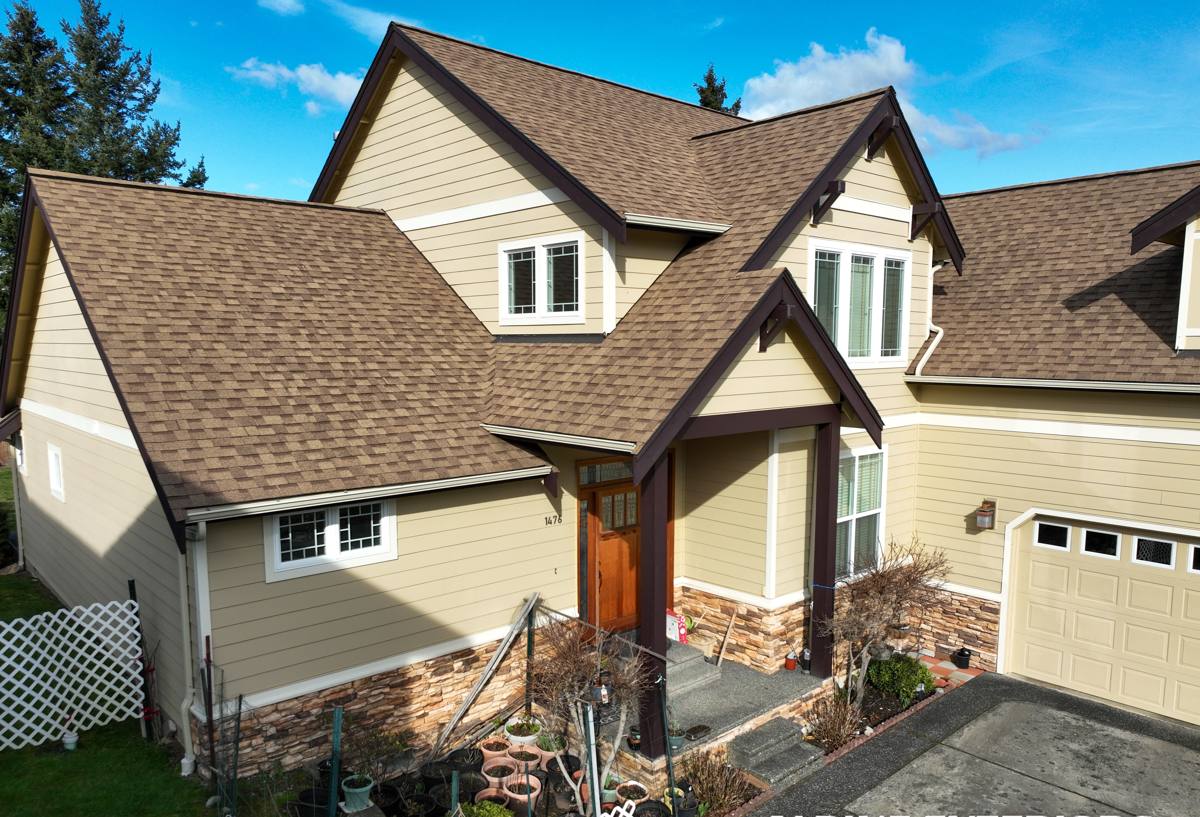
What Salt Air Actually Does to a Roof
Salt air is corrosive, and a roof has more exposed metal than most homeowners realize: nail heads, drip edge, valley flashing, step flashing around chimneys and walls, pipe boots, and any exposed roofing fasteners. Standard electro-galvanized fasteners hold up fine in a lot of the country, but in a coastal, salt-air environment they can start to lose their coating and corrode years before a comparable roof further from the water. Once a fastener starts to rust, it loses holding power, and a shingle with a weakened fastener is a shingle that's more likely to lift in wind or work loose over time.
This is why fastener and flashing spec matters as much as shingle selection for a Peace Arch roof. Hot-dip galvanized or stainless fasteners, and metal flashing with a coating rated for coastal exposure, cost a little more up front and are a non-negotiable part of doing this job right so close to the water.
Where Salt Exposure Shows Up First
- Nail heads and exposed fasteners on ridge caps and hip lines
- Valley metal, where water concentrates and metal stays wet longest
- Step flashing at chimneys, dormers, and roof-to-wall transitions
- Pipe boots and any rubber or plastic penetration seals, which age faster with UV and salt exposure combined
- Gutters and gutter fasteners, which take on both roof runoff and airborne salt directly
Driving Rain and the Parts of a Roof That Actually Keep Water Out
Winter storms in this part of Whatcom County don't just drop rain — they push it, often sideways, driven by wind off the water. That kind of wind-driven rain behaves differently than a straight-down downpour. It can work up under shingle tabs, find its way through poorly lapped underlayment, and exploit any gap in the flashing details that a fair-weather installation might get away with elsewhere.
The shingles themselves are only the outer layer of a roof's defense. What's underneath them — the underlayment, the ice-and-water membrane at vulnerable points, and the flashing at every transition — is what actually stops wind-driven rain from reaching the roof deck. On a Peace Arch roof, we treat these as full requirements, not upgrades:
- Self-adhering waterproof membrane at eaves, valleys, and around all penetrations, not just felt paper
- Properly lapped synthetic underlayment across the full deck, shingled correctly so every course sheds water onto the one below it
- Metal drip edge at both eaves and rakes, set correctly relative to the underlayment layers
- Step flashing — never continuous "roll" flashing — at every wall and chimney intersection
- Correctly sized and sealed valley flashing, since valleys concentrate the most water on any roof
Skip any one of these and the roof can still look fine for a season or two. The failures show up later, usually as a stain on an interior ceiling nowhere near where the actual leak started, because water traveled sideways under the shingles before it found a way in.
Moss, Shade, and the Long Wet Season
Blaine's moss season isn't a minor nuisance — it's a genuine roofing concern. Moss holds moisture against the shingle surface long after the rain has stopped, and on north-facing slopes or roof sections shaded by trees or neighboring structures, that moisture can sit for days at a time during the wetter months. Over time, moss growth lifts shingle edges, traps debris, and accelerates granule loss, which shortens the shingle's usable life regardless of how good the shingle itself was.
Moss control has to be built into both the roofing materials and the maintenance plan, not treated as an afterthought:
- Algae-resistant (AR) shingles with copper- or zinc-infused granules along the exposed course, which discourage moss and algae growth without harsh treatment
- Copper or zinc control strips near the ridge on roofs with heavy shade or a history of moss
- Keeping tree limbs trimmed back from the roof surface to reduce shade and let the roof dry between storms
- Gentle, low-pressure moss removal rather than power-washing, which can strip granules and do more damage than the moss itself
A roof installed without any of this in mind will grow moss just as readily here as any other roof in the area — the climate doesn't make exceptions for a roof that wasn't built for it.
Choosing the Right Shingle for This Location
Not every asphalt shingle product is built the same way, and the differences matter more in a coastal, high-moss environment than they would in a milder climate. The table below compares the shingle classes we typically discuss with Peace Arch homeowners.
| Shingle Type | Wind Rating | Moss/Algae Resistance | Typical Lifespan Here |
|---|---|---|---|
| Standard 3-tab | Lower — more prone to lifting in gusty, wind-driven storms | None unless specified | Shorter, especially on shaded or exposed slopes |
| Architectural (laminated) | Higher, especially with proper nailing and starter strips | Available with AR granules | Longer, more consistent performance near the water |
| Premium/designer laminated | Highest ratings available in asphalt | Standard on most product lines | Longest asphalt option, higher upfront cost |
For most Peace Arch homes, an architectural shingle with algae-resistant granules and a wind rating suited to open, coastal exposure is the practical middle ground — solid performance against the specific conditions here without paying for features a given roof doesn't need. We'll walk through the honest trade-offs for your roof's slope, exposure, and shade during your estimate rather than defaulting to one product for every house.
What a Correct Installation Involves
A roofing job can look complete from the ground and still be missing the details that determine whether it lasts fifteen years or thirty in this climate. Before we call a Peace Arch roof finished, it needs to check every item on this list:
- Full tear-off and deck inspection — soft or water-damaged decking gets replaced, not covered over
- Self-adhering waterproof membrane at eaves, valleys, and penetrations
- Synthetic underlayment, correctly lapped, across the entire deck
- Coastal-rated drip edge and step flashing, not continuous flashing or caulk-only details
- Corrosion-resistant fasteners throughout, hand-driven or gun-set to proper depth
- Shingles nailed to manufacturer spec for the wind zone, not just "close enough"
- Ridge and hip caps matched to the field shingle's wind and moss-resistance rating
- Proper attic ventilation confirmed or corrected, since trapped moisture from below shortens shingle life just as much as water from above
- Final walk-through covering flashing, valleys, and penetrations before cleanup
Our Process, Start to Finish
We keep the process straightforward because a roof replacement is disruptive enough without added confusion:
- On-site assessment. We inspect the current roof, deck condition, ventilation, flashing points, and any moss or shade issues specific to your property.
- Written estimate. You get a clear scope of work and prices for the shingle and flashing options that make sense for your roof — no pressure toward the most expensive option.
- Material delivery and site protection. Landscaping, siding, and gutters get protected before tear-off begins.
- Tear-off and deck inspection. Old roofing comes off down to the deck, and any damaged sheathing is identified and replaced.
- Underlayment and flashing installation. This is where most of the long-term protection is actually built, well before a single shingle goes down.
- Shingle installation. Installed to the wind-rated nailing pattern the product and location call for.
- Cleanup and magnetic sweep. Debris and stray fasteners are cleared from the property, not just the roof.
- Final walk-through. We review the finished roof with you and answer any questions before we consider the job done.
What Drives the Cost of a Peace Arch Roof
Every roof is different, but the same handful of factors drive most of the cost variation we see on jobs in this area.
| Cost Factor | Why It Matters Here |
|---|---|
| Roof size and pitch | Steeper pitches take longer and require more safety setup |
| Deck condition | Salt air and past moss damage can mean hidden sheathing repairs |
| Shingle class | Standard vs. architectural vs. premium AR-granule products |
| Flashing and fastener spec | Coastal-rated metal and fasteners cost more than standard-grade material |
| Number of valleys, chimneys, and penetrations | Each one adds flashing labor and material |
| Ventilation upgrades | Correcting inadequate attic ventilation adds cost but protects the new roof from below |
We put all of this in writing before any work starts, so there's no guessing about what you're paying for or why.
Maintenance That Actually Extends the Roof's Life
A correctly installed shingle roof still needs a little ongoing attention in this climate to reach its full lifespan:
- Clear gutters and downspouts before the fall rains, so water isn't backing up under the eaves
- Keep overhanging limbs trimmed back to reduce shade and debris buildup
- Have moss addressed early with gentle removal methods, before it lifts shingle edges
- Schedule a walk-around inspection after any major wind event to check for lifted shingles or displaced flashing
- Address small flashing or sealant issues promptly, since they're inexpensive to fix early and expensive to ignore
Why Local Roofing Experience Matters Here
A roofing crew that mainly works drier, more sheltered parts of the country can do competent work and still under-spec a roof for what the Peace Arch area actually experiences — because they've never had to build for it. Crews that already work this stretch of the Whatcom County coastline know which fastener and flashing grades hold up against the salt air, which slopes in this neighborhood tend to hold moss the longest, and how wind-driven rain behaves differently here than it does even a short distance inland. That knowledge shows up in the details you can't see once the roof is finished — the flashing choices, the fastener spec, the underlayment lap — which is exactly where a roof's real lifespan gets decided.
If you're weighing a repair against a full replacement, or just want an honest read on how much life is left in your current shingle roof, we're happy to take a look. Reach out for a free, no-pressure estimate using the form below.