 Blaine Siding
 Why Peace Arch's Climate Is Hard on Exterior Siding
Peace Arch sits at the far northwest edge of Whatcom County, close enough to the water that salt-laden air is simply part of daily weather, not an occasional event. Add to that the driving rain that blows in off the Strait of Georgia during the fall and winter months, plus a moss and algae season that in this part of Blaine can run nine or ten months out of the year, and you have a combination that is genuinely tougher on a home's exterior than most siding products were ever tested for.
None of this means Peace Arch is a bad place to have wood-look siding on a house. It means the siding has to be chosen and installed with these three specific stressors in mind: salt exposure, wind-driven moisture, and near-constant dampness that feeds moss and algae growth. A siding job that would hold up fine in a drier inland climate can fail years early here if it wasn't matched to this environment.
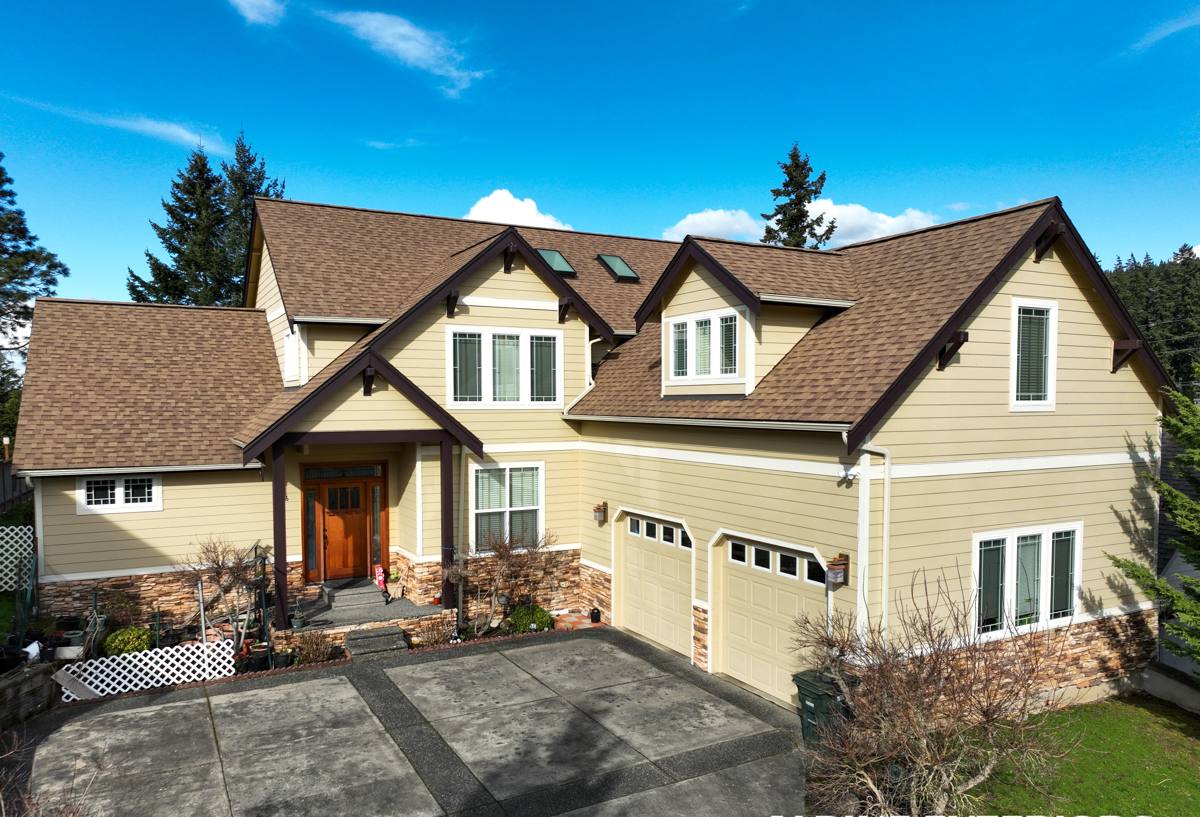
What Local Homes Actually Need From Their Siding
Moisture Management, Not Just Water Resistance
"Water resistant" and "moisture managed" are not the same thing. In a climate where rain comes in sideways for days at a time, the siding assembly needs a plan for the water that gets past the surface — a drainage gap, correct flashing at every horizontal transition, and a material that doesn't swell, rot, or delaminate if it stays damp longer than it would somewhere drier.
A Surface Moss and Algae Don't Love
Moss doesn't grow because a material is "bad" — it grows on any surface that stays cool and damp long enough, especially on north-facing walls and areas shaded by trees, which describes a lot of Peace Arch lots. The goal isn't a siding that magically repels moss forever; it's a surface and finish that doesn't feed it, and that can be cleaned without damaging the material or stripping the color underneath.
Salt Air Tolerance
Salt air accelerates the breakdown of a lot of exterior products — it pulls moisture into porous materials, and it can chalk or fade paint finishes faster than inland UV exposure alone would. Homes closer to the water need a siding and finish system that was engineered with coastal exposure in mind, not just a general-purpose exterior product.
Why We Install James Hardie in This Climate — and Only James Hardie
This is a James Hardie-only company. We don't install vinyl, LP SmartSide, Cemplank, Allura, primed spruce, or cedar, and in a climate like Peace Arch's, the reasoning is straightforward rather than a sales pitch.
Fiber Cement Doesn't Feed Moisture the Way Wood-Based Products Do
James Hardie siding is cement, sand, and cellulose fiber — there's no wood substrate to absorb water, swell, or rot if the drainage plane behind it ever gets damp. In a climate with this much driving rain and ambient humidity, that's not a minor detail. It's the difference between a siding system that tolerates the occasional moisture intrusion and one where moisture intrusion is a slow-motion problem.
HardiePlank HZ5 Was Built for Exposure Like This
James Hardie engineers its HZ product lines by climate zone, and the HZ5 formulation used in the Pacific Northwest is built specifically for high-moisture, high-humidity regions. It's not a generic product — it's the version of the product matched to exactly the kind of weather Peace Arch sees most of the year.
ColorPlus Finish Holds Up to Salt and UV
James Hardie's factory-applied ColorPlus finish is baked on under controlled conditions and backed by its own finish warranty, and it's noticeably more resistant to fading and chalking from salt air and UV exposure than field-applied paint on other siding materials. For a coastal-adjacent neighborhood like Peace Arch, that matters over a 10-15 year horizon, not just in year one.
Non-Combustible
James Hardie fiber cement doesn't burn, which isn't specific to this neighborhood's climate but is part of why we standardized on it everywhere we work.
What a Correct James Hardie Installation Involves
The Details That Matter More Than the Panel Itself
The siding material only performs as well as the installation behind it. James Hardie publishes detailed installation specifications, and in a climate that pushes water at the wall this hard, following them isn't optional:
- A weather-resistant barrier and a proper drainage gap so any water that gets behind the siding has somewhere to go
- Flashing at every window head, door head, deck ledger, and horizontal trim transition — the single most common source of hidden moisture damage on any siding job
- Correct fastener placement and depth, per Hardie's spec, so panels aren't over-driven or under-driven
- Proper clearance from grade, roof lines, and decks — Hardie specifies minimum gaps for a reason, and skipping them invites wicking
- Factory-cut and painted edges wherever possible, with any field cuts sealed per Hardie's touch-up guidance to protect the ColorPlus finish
- Caulking only at the joints Hardie specifies — not as a substitute for correct flashing
Why This List Matters More Here Than Elsewhere
Every item on that list matters everywhere Hardie siding goes up. In Peace Arch, the consequences of skipping one show up faster — driving rain finds gaps in flashing quicker than a gentle inland rain would, and any spot where moisture does get trapped stays damp longer given the ambient humidity and salt air. A shortcut that might take a decade to show up somewhere drier can show up in a few winters here.
Our Process for a Peace Arch Siding Job
1. On-Site Assessment
We look at the existing siding and sheathing condition, note any moisture damage already present (especially around windows, decks, and roof transitions), and check exposure — how much direct salt air and wind-driven rain that specific wall sees.
2. Tear-Off and Substrate Check
Old siding comes off and we inspect the sheathing underneath before anything new goes up. This is the point where hidden moisture damage from a prior installation gets caught — and fixed — instead of covered over.
3. Weather Barrier and Flashing First
The drainage plane and flashing details go in before a single piece of Hardie siding touches the wall. This step is where most of the long-term performance of the job actually gets decided.
4. Installation to Hardie Spec
HZ5 panels, correct fastening, correct clearances, correct joint treatment — installed by a crew that installs this product and only this product, every day.
5. Final Walkthrough
We walk the finished job with the homeowner, checking caulking lines, touch-up paint on any field cuts, and trim details before calling it done.
Comparing Siding Options for a Climate Like This
| Factor | James Hardie Fiber Cement | Vinyl | Wood-Based / Engineered Wood |
|---|---|---|---|
| Moisture behavior | Doesn't swell or rot; cement-based | Doesn't rot itself, but seams and gaps can trap moisture behind it | Wood substrate can absorb and hold moisture over time |
| Salt air / UV finish life | Factory ColorPlus finish, warrantied | Color molded in, but can chalk and become brittle over time | Field-applied paint, shorter repaint cycle in this exposure |
| Fire resistance | Non-combustible | Melts/deforms under heat | Combustible |
| Moss/algae cleanability | Cleans without damaging substrate | Cleans easily but can crack with pressure or impact | Aggressive cleaning can damage finish or substrate |
| Maintenance cycle | Long, low-maintenance with periodic washing | Low maintenance but limited repair options if damaged | Regular repainting and moisture monitoring needed |
Living With Hardie Siding in a Salt Air, Moss-Prone Climate
Routine Care
James Hardie siding is genuinely low-maintenance, but "low-maintenance" isn't "no-maintenance" in a climate this damp. A homeowner's siding upkeep checklist in Peace Arch should include:
- A soft wash (not high-pressure) once or twice a year to clear moss, algae, and salt residue before it builds up
- Checking caulked joints annually and re-caulking any that have cracked or pulled away
- Keeping gutters clear so overflow doesn't run directly down siding walls
- Trimming back vegetation and tree cover that keeps a wall shaded and damp longer than it needs to be
- A visual check after major windstorms for any dented, cracked, or loosened panels near rooflines and corners
What Not to Do
Avoid pressure washing directly at siding joints or fasteners, and avoid harsh chemical moss treatments not rated for painted fiber cement — they can strip or dull the ColorPlus finish faster than the moss itself would have.
Why It Matters to Hire a Crew That Already Works Peace Arch
A siding crew that regularly works this stretch of Blaine already knows which walls take the worst of the wind-driven rain, how far salt air exposure extends inland from the water, and where moss problems tend to concentrate on a typical lot. That's not something you can fully substitute with a spec sheet — it shapes decisions like where to add extra flashing attention, which elevations need a closer look at drainage detailing, and what maintenance schedule actually fits the property. It also means a crew that has already worked through Whatcom County permitting and inspection expectations, so there are fewer surprises mid-project.
Cost Factors to Expect
| Factor | Why It Affects Price |
|---|---|
| Tear-off condition | Hidden moisture or rot damage found under old siding adds repair scope |
| Home size and wall complexity | More corners, windows, and trim details mean more flashing and cutting labor |
| Product line and profile | Lap width, texture (smooth vs. cedar-look), and panel vs. lap siding affect material cost |
| Color selection | Standard ColorPlus palette vs. custom color has different lead times and pricing |
| Site access | Water-adjacent lots and steep or tight sites can affect staging and labor time |
We don't quote a job over the phone or from a photo — every estimate is based on a walk-through of the actual house, because the tear-off condition and wall exposure are what really drive the number.
If you're weighing a siding project for a home in Peace Arch, we're happy to take a look and give you a straightforward, no-pressure estimate — what your walls actually need, what a correct James Hardie installation would involve, and a real number to work from. Use the form below to get started.