 Blaine Siding
 Point Roberts Homes Take More Weather Punishment Than Most of Whatcom County
Point Roberts sits on its own small peninsula, surrounded on three sides by the Strait of Georgia and Boundary Bay, which means almost every home there is exposed to open water in at least one direction. That's a different situation than a house tucked into a wooded lot further inland in Whatcom County. Wind carries salt spray onto siding, gutters, and trim year-round, driving rain hits at an angle instead of falling straight down, and the marine layer keeps humidity high enough, long enough, that moss and algae have a long season to take hold. Siding that would hold up fine in a more sheltered part of the county can start showing problems years early out here.
We've worked on homes throughout this stretch of the county long enough to know that "good siding" isn't a single standard — it depends on what the house is actually facing. For Point Roberts, that means picking a material built to shrug off salt exposure and constant moisture, and installing it in a way that accounts for wind-driven water instead of assuming it'll run straight down and off.
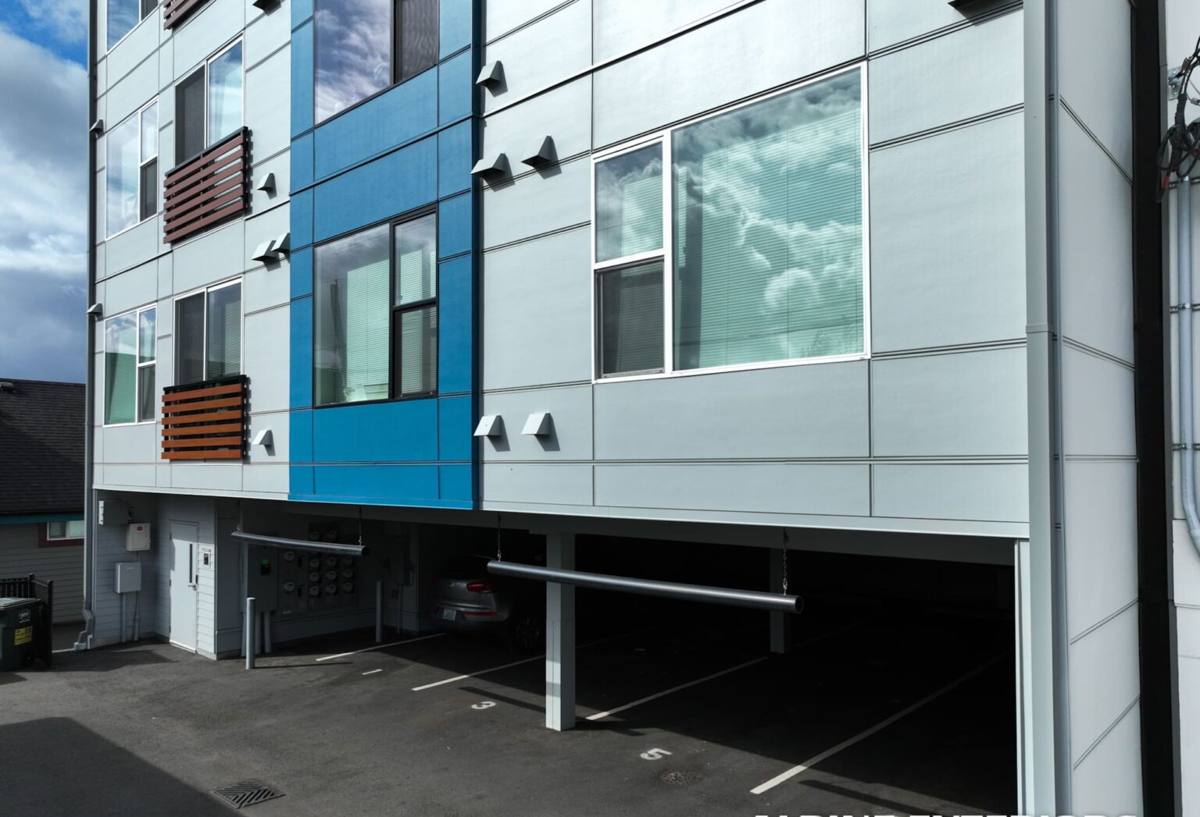
What Salt Air, Driving Rain, and Moss Season Actually Do to Siding
Salt air doesn't just sit on the surface of a wall — it works into seams, fastener heads, and any spot where a coating has thinned or chipped. Over time it accelerates corrosion of exposed metal fasteners and trim, and it breaks down lower-grade paint finishes faster than inland UV exposure alone would. Combine that with wind-driven rain and you get moisture pushed sideways into laps, joints, and corners that a standard installation might not have fully sealed.
Then there's the moss and algae problem. Point Roberts stays damp enough, for long enough stretches of the year, that north-facing walls and shaded sides of a house can stay wet for days after a storm passes. Materials that absorb any moisture at all give moss and mildew something to grow into, not just onto — which means the problem doesn't just wash off, it comes back.
None of this means Point Roberts is an impossible place to side a house. It means the material and the installation both have to be chosen with this specific exposure in mind, not a generic "siding job."
Why We Only Install James Hardie Fiber Cement in This Kind of Exposure
We standardized on James Hardie fiber cement siding company-wide, and Point Roberts is exactly the kind of environment that explains why. Fiber cement is made from cement, sand, and cellulose fiber — it doesn't rot, it isn't a food source for moss or mildew the way wood-based products can be, and it holds its shape in swings of moisture and temperature far better than wood or engineered-wood siding. That matters on a peninsula where the humidity rarely lets up.
HZ5 Climate Engineering
James Hardie manufactures its siding in different formulations for different climate zones, and the Pacific Northwest falls under their HZ5 engineering — a version of the product formulated specifically for wetter, more humid regions like ours. It's not a generic siding board shipped to every state; it's built for the moisture load this part of Washington actually deals with.
ColorPlus Factory Finish vs. Field-Applied Paint
Most Hardie siding we install carries their ColorPlus finish — a multi-coat, baked-on finish applied under factory conditions rather than brushed or sprayed on-site. That matters in a salt-air environment specifically because factory-applied finishes bond and cure more consistently than field-applied paint, which means fewer thin spots for salt and UV to work through over the years. It also comes backed by its own finish warranty, separate from the product warranty on the board itself.
This is also why we don't install vinyl, LP SmartSide, cedar, or primed spruce on homes in this area. Each of those has a legitimate use somewhere, but every one of them has a real weak point in exactly the conditions Point Roberts sees hardest — vinyl can warp and become brittle with UV and temperature swings, wood-based products are more vulnerable to moisture absorption and rot over time, and field-primed products depend heavily on paint maintenance schedules that are easy to fall behind on. We'd rather stand behind one product we trust in this climate than install something we'd need to caveat.
What a Correct Installation Actually Requires Out Here
Fiber cement is only as good as the installation behind it. In a high-exposure spot like Point Roberts, a few details matter more than they would on a sheltered inland lot:
- A proper rain screen or drainage gap behind the siding, so any wind-driven moisture that gets past the surface has somewhere to drain and dry instead of sitting against the sheathing.
- Corrosion-resistant fasteners rated for coastal exposure — standard fasteners can start showing rust streaks on light-colored siding within a few seasons in salt air.
- Correct flashing at every penetration — windows, doors, hose bibs, light fixtures — since wind-driven rain finds gaps that straight-down rain never would.
- Kick-out flashing at roof-to-wall intersections so runoff is directed away from the siding field instead of behind it.
- Manufacturer-specified nailing patterns and clearances, including gap allowances at butt joints and a minimum clearance above grade, decks, and roof lines.
- Sealant chosen for movement and UV exposure, applied only where Hardie's own installation instructions call for it — not as a substitute for correct flashing.
Skipping any one of these doesn't usually show up as a problem on day one. It shows up two or three winters later, as a stain, a soft spot, or a piece of trim that's started to fail — right around the time it's expensive to trace back to the original install.
How Fiber Cement Stacks Up Against Other Siding Options Here
| Material | Salt Air / Moisture Resistance | Moss & Mildew Behavior | Maintenance Burden | Typical Longevity |
|---|---|---|---|---|
| Vinyl | Can become brittle with UV and salt exposure over time | Doesn't feed growth, but seams trap moisture and debris | Low, but prone to warping in heat and cracking with age | Variable; shorter in harsh coastal exposure |
| Cedar / wood | Absorbs moisture; needs consistent sealing to hold up | Organic material — most vulnerable to moss and rot | High — regular refinishing required | Depends heavily on maintenance follow-through |
| Engineered wood (LP-type) | Improved over solid wood, but still moisture-sensitive at cut edges and seams | Lower risk than cedar, still organic-based | Moderate — edge sealing and paint upkeep matter | Solid if maintained on schedule |
| James Hardie fiber cement | Non-combustible, dimensionally stable, engineered for wet climates (HZ5) | Doesn't feed growth; surface can be cleaned without damaging the board | Low — periodic washing, no refinishing needed with ColorPlus | Long-term, backed by a transferable product warranty |
Working in Point Roberts: What Hiring a Local Crew Actually Means
Point Roberts is a bit of a logistical outlier — it's part of Whatcom County, but the only land route in and out crosses the border. A crew that doesn't regularly work this area has to plan every material delivery and every crew day around that crossing, which turns small scheduling hiccups into real delays on a job site. We already build that into our planning because we've done it before, which means fewer surprises about timelines once a project starts.
Beyond logistics, working this coastline repeatedly teaches you where the actual failure points are on these homes — which walls take the worst of the wind-driven rain, where moss tends to build up first, where trim details get missed on a rushed job. That's the kind of thing you learn from doing the work here, not from a general siding background alone.
Living With Fiber Cement Through Moss Season
Correctly installed Hardie siding is genuinely low-maintenance, but "low-maintenance" doesn't mean "ignore it." A yearly rinse-down with a garden hose (not a pressure washer aimed directly at seams) keeps salt residue and organic buildup from accumulating on north-facing and shaded walls, which is where moss gets its best foothold here. It's also worth a quick annual look at caulking around windows, doors, and trim — sealant is the one part of the system that wears out on a schedule and needs occasional touch-up, even when the siding itself isn't going anywhere.
What to Ask Before Hiring Anyone for Siding Work Here
Whoever you hire, it's worth asking a few direct questions before they start:
- Do they install to the manufacturer's written specifications, including rain screen and flashing details, or just "however it's usually done"?
- Will they show you the fastener and flashing materials they plan to use, and confirm they're rated for coastal exposure?
- Do they carry manufacturer certification or documented experience specifically with fiber cement, not siding in general?
- How do they handle scheduling and material delivery for a Point Roberts job specifically?
A contractor who's done this work here before should be able to answer all four without hesitation.
If you're weighing your options for a Point Roberts home, we're happy to take a look and walk through what your house actually needs — no pressure, no obligation. A free estimate is the easiest way to find out what a correct fiber cement installation would look like on your specific home.