 Blaine Siding
 Why Birch Point Roofs Wear Differently
Birch Point sits close enough to the water that the air itself works against a roof year-round. Salt-laden moisture off the bay settles into shingle granules and metal fasteners, moss spores ride the same damp air and take hold in shaded valleys and north-facing slopes, and winter storms push rain sideways instead of straight down. None of this is dramatic on its own, but stacked together over a decade or two, it ages a roof faster than the same product would age twenty miles inland.
That's the honest starting point for any roof replacement conversation out here: this isn't a climate where you can install whatever's cheapest and expect average lifespan. Material choice, underlayment, flashing detail, and ventilation all need to account for salt exposure, wind-driven rain, and a moss season that can run most of the year in Whatcom County's marine climate.
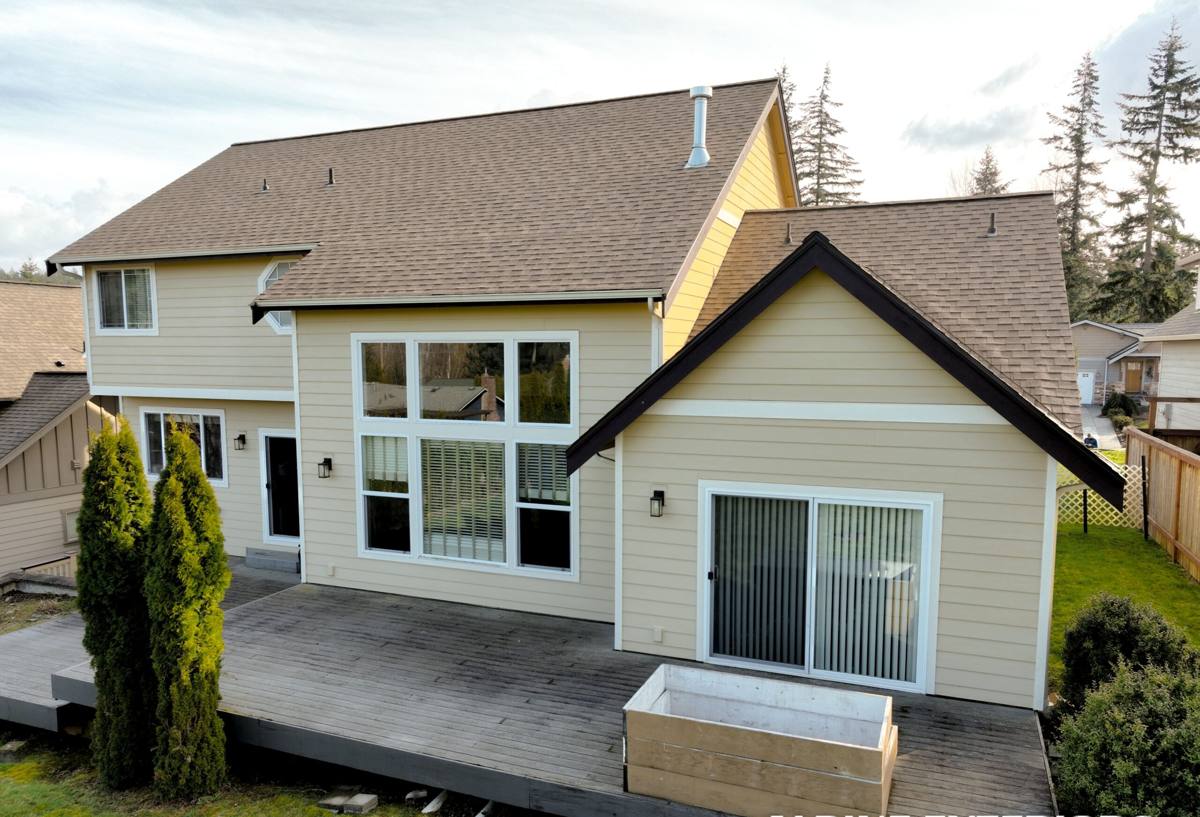
Signs It's Time for Replacement, Not Another Repair
Not every roof problem in Birch Point calls for a full tear-off. But there's a point where patching stops making financial sense and starts masking a bigger issue underneath. A few signs worth taking seriously:
- Granule loss heavy enough that you can see bare asphalt mat in multiple spots, not just one weathered corner
- Shingles that are cupping, curling, or cracking across large sections rather than isolated repairs
- Moss that's lifted shingle edges enough to let water track underneath, not just surface staining
- Soft or spongy decking felt through the roof during an inspection, usually a sign of long-term moisture intrusion
- Flashing around chimneys, skylights, or vent stacks that's rusted, separated, or was never properly step-flashed to begin with
- A roof already past 20-25 years old (for asphalt) that's now needing repairs more than once a year
If you're only seeing one of these, a repair may genuinely be the right call — we'll tell you that if it's true. Replacement makes sense when the underlying materials, not just the surface layer, have reached the end of their useful life.
Roofing Materials That Hold Up Near Birch Bay
There's no single "best" roofing material for every home — budget, roof pitch, home style, and how much shade and moss pressure a particular lot gets all factor in. What changes near the water is how much weight we put on salt tolerance and moisture shedding when we walk through options with a homeowner.
| Material | Salt-air performance | Moss resistance | Typical lifespan |
|---|---|---|---|
| Architectural asphalt shingle | Good with quality fasteners and flashing | Fair — benefits from zinc/copper strips | 25-30 years |
| 3-tab asphalt shingle | Fair — thinner profile weathers faster | Poor without added protection | 15-20 years |
| Standing seam metal | Very good with coastal-rated coatings | Excellent — moss struggles to grip | 40-50+ years |
| Cedar shake | Fair — needs diligent maintenance | Poor without regular treatment | 20-30 years with upkeep |
Asphalt Composition Shingles
Still the most common choice for good reason — reasonable upfront cost, wide style and color range, and solid performance when the product line and installation are matched to the exposure. For Birch Point homes, we generally steer toward heavier architectural-grade shingles over builder-grade 3-tab, since the added mat thickness and adhesive strip hold up better against both wind uplift and granule loss from salt exposure.
Standing Seam Metal
Metal earns its reputation in this climate. A properly coated standing seam roof sheds moss almost entirely — there's no rough surface for spores to anchor into — and handles wind-driven rain better than any lapped shingle system because there are far fewer horizontal seams for water to find. The tradeoff is upfront cost, which runs meaningfully higher than asphalt. For homeowners planning to stay long-term, the math often works out given how few maintenance calls a metal roof needs afterward.
Cedar Shake
Cedar has real appeal for the right home style, but we're candid with clients about the maintenance load it carries here. Untreated cedar in a damp, shaded, salt-air environment is exactly the combination that accelerates moss growth and rot at butt joints. If a homeowner wants the cedar look, we talk through treatment schedules honestly upfront rather than let it become a surprise a few years in.
What a Correct Roof Replacement Involves
A roof replacement is only as good as what's underneath the shingles. In a climate that throws wind-driven rain at a roof for months at a stretch, the underlayment and flashing details matter as much as the visible material — sometimes more.
Underlayment and Wind-Driven Rain
We use synthetic underlayment as the standard base layer across the deck, with self-adhered ice and water shield at the eaves, valleys, and any low-slope transitions where wind-driven rain is most likely to get pushed backward under a shingle edge. On homes with more open water exposure, we'll often extend that membrane further up the roof plane than code minimum requires, because the driving rain here doesn't always behave like a straight-down storm.
Flashing Details
Most roof leaks we get called out to trace back to flashing, not the field shingles. Step flashing at wall intersections, proper counter-flashing at chimneys, and correctly lapped flashing around vent penetrations all need to be done in a specific sequence with the underlayment and shingle courses — not caulked over as an afterthought. Caulk is a short-term fix; correctly layered flashing is the long-term one.
Ventilation
A hot, poorly ventilated attic in summer and a damp, poorly ventilated one in winter both shorten shingle life and can contribute to moisture issues in the decking. We check intake (soffit) and exhaust (ridge or roof vents) balance as part of every replacement, since a new roof installed over bad ventilation just repeats the old problems on a new timeline.
Our Roof Replacement Process, Start to Finish
We keep the process straightforward and try to remove the guesswork for homeowners who haven't been through a replacement before.
- Roof inspection and estimate — we get on the roof (not just a drone photo review), check the decking condition where accessible, look at existing flashing and ventilation, and discuss material options based on your home and budget.
- Written proposal — a clear scope covering materials, underlayment, flashing approach, and a firm price, no vague allowances.
- Scheduling and material delivery — timed around the weather window, since a multi-day tear-off left exposed to a Whatcom County storm system is a risk we plan around, not gamble on.
- Tear-off and deck inspection — old roofing removed down to the deck, with any soft or damaged sheathing identified and replaced before anything new goes down.
- Underlayment, flashing, and moss protection — installed per the plan, including zinc or copper strips near the ridge where moss pressure is high.
- Roofing material installation — installed to manufacturer specification, which is also what keeps the material warranty valid.
- Final walkthrough and cleanup — magnetic sweep for nails, debris hauled off, and a walk-through so you know what was done and what to watch for.
Moss and Long-Term Roof Care
A new roof in Birch Point isn't maintenance-free, even with the right materials. Moss season here is long, and a little consistent care goes a lot further than an occasional aggressive cleaning.
- Have gutters and valleys cleared of needles and debris at least twice a year — trapped organic matter is what gives moss spores something to hold onto
- Ask about zinc or copper control strips near the ridge at install time — rain washing over them naturally inhibits new moss growth downslope
- Avoid pressure washing shingles directly — it strips granules and shortens the roof's life faster than the moss itself would
- Trim back overhanging branches where practical to cut down on shade and debris load
- Get a visual roof check after major windstorms, especially around flashing points
- Address small moss patches early with a proper roof-safe treatment rather than letting it spread across a full slope
What Affects the Cost of a Roof Replacement
Every roof is different, so we don't quote sight-unseen numbers, but these are the factors that move a price up or down on most Birch Point homes:
| Factor | Why it matters |
|---|---|
| Roof size and number of planes | More squares and more valleys/hips mean more material and labor time |
| Roof pitch and accessibility | Steep or hard-to-access roofs require more safety setup and slow the work |
| Material choice | Asphalt, metal, and cedar carry meaningfully different material and labor costs |
| Decking condition | Rotted or soft sheathing found during tear-off adds material and labor to replace it |
| Layers of existing roofing | Multiple old layers add tear-off labor and disposal cost |
| Flashing and ventilation upgrades | Bringing older flashing or attic ventilation up to a proper standard adds scope but reduces future leak risk |
Broadly, asphalt shingle replacements on an average home tend to land in the mid-five-figure range, with metal roofing running higher given material and specialized installation costs. The only way to get an accurate number is a real on-roof inspection, which is what we start every estimate with.
Why Hire a Crew That Already Works Birch Point
Roofing crews that mostly work drier, inland climates don't always think about wind-driven rain protection or moss control the same way — because they haven't had to. Working this stretch of Whatcom County regularly means we've seen how salt air ages fasteners, how moss actually establishes itself on north-facing slopes near the tree line, and which flashing details hold up against storms coming off the water versus which ones fail in year three. That's not a sales pitch — it's just what repeat exposure to this specific climate teaches a crew over time.
It also means we're not guessing at permitting, disposal logistics, or scheduling around this area's weather windows. A roof replacement is a significant investment, and a crew that already understands the conditions your roof will actually face tends to make fewer assumptions and fewer callbacks.
If your Birch Point roof is showing its age or you just want an honest read on where it stands, we're happy to take a look. Reach out for a free, no-pressure estimate using the form below — there's no obligation, just a straight assessment of what your roof needs.