 Blaine Siding
 Sandy Point Sits Right in the Path of the Weather
Sandy Point is a beach community, and that means the siding on every home there is doing a harder job than siding just a few miles inland in Blaine. Homes here face wind coming straight off the water, salt-laden air that settles on every exterior surface, and driving rain that hits siding at an angle instead of falling straight down. Add Whatcom County's long, damp shoulder seasons, and you've got a climate that never really gives siding a break to dry out.
We've installed and repaired siding on enough waterfront and near-waterfront homes in this area to know that "good enough inland" siding choices often fail early in a spot like Sandy Point. The product, the prep work, and the installation details all have to be matched to what this specific location throws at a house.
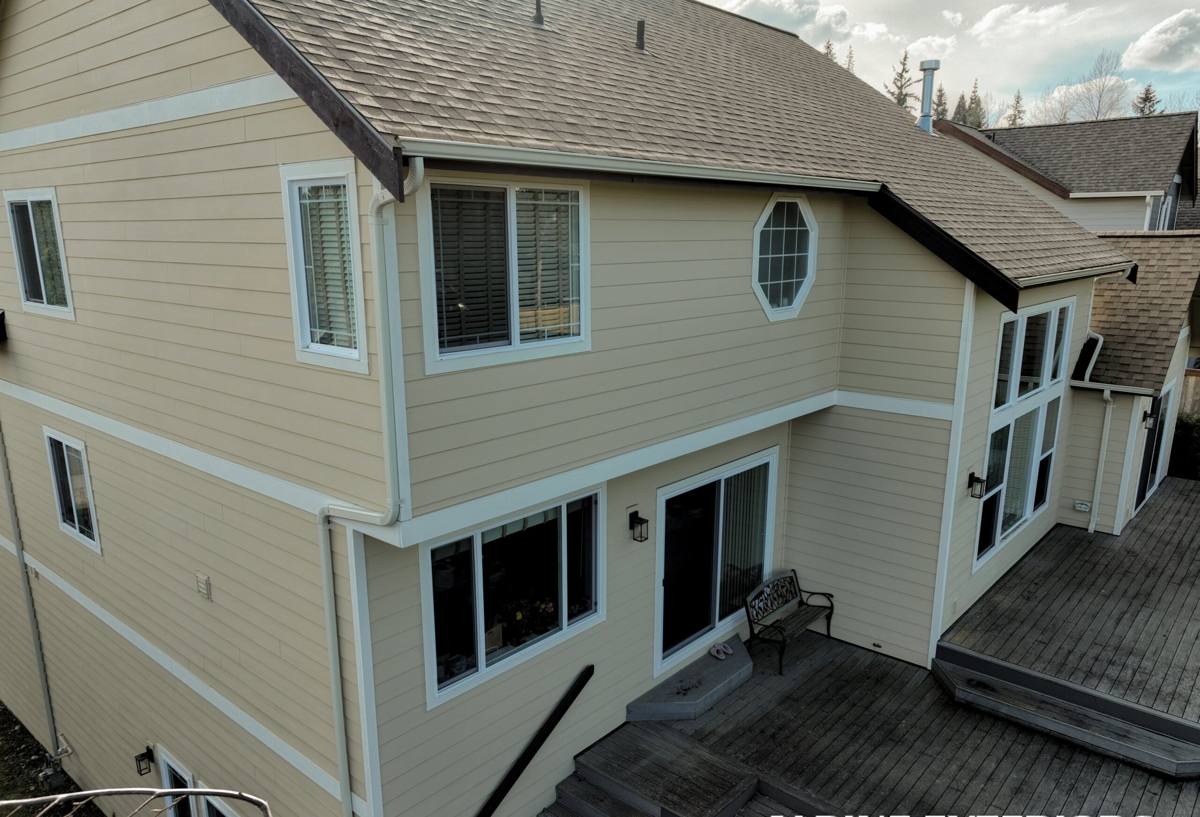
What Salt Air, Driving Rain, and Moss Actually Do to Siding
Salt Air
Airborne salt is corrosive and it doesn't stay near the beach — wind carries it onto siding, trim, and fasteners across the whole property. Over years, salt exposure accelerates the breakdown of paint films, degrades caulking, and corrodes any fastener or flashing that isn't rated for the exposure. Siding materials that rely on a painted surface film for protection are the first to show it, usually as chalking, fading, or peeling well ahead of their expected repaint schedule.
Driving Rain
Wind-driven rain doesn't just wet the face of the siding — it pushes moisture up and under laps, into seams, and around penetrations like light fixtures, hose bibs, and vents. A siding system is only as good as its ability to shed that water back out rather than trap it against the wall sheathing. This is a detailing problem as much as a material problem.
Moss and Prolonged Dampness
Whatcom County's wet season runs long, and shaded, north-facing, or tree-adjacent walls near Sandy Point can stay damp for extended stretches. That's exactly what moss and algae need to establish. Once organic growth takes hold on a porous or textured surface, it holds even more moisture against the siding, which speeds up whatever deterioration process is already underway.
What Sandy Point Homes Actually Need From Their Siding
- A material that doesn't rely solely on a surface coating for weather resistance
- Fasteners and flashing rated for salt-air corrosion resistance
- A drainage plane behind the siding so any moisture that gets past the surface can escape
- A factory finish that holds color and resists chalking without frequent repainting
- Dimensional stability — siding that won't swell, cup, or warp as humidity swings through the seasons
- A product that's fire-resistant, given the dry-summer wildfire risk that's become part of Pacific Northwest life
Why We Install Only James Hardie Fiber Cement
We made the decision to standardize on James Hardie siding exclusively — we don't install vinyl, LP SmartSide, Cemplank, Allura, or raw wood siding. That's not a marketing position, it's a practical one built on what holds up in this climate over the long term.
James Hardie fiber cement is engineered from cement, sand, and cellulose fiber, which makes it non-combustible and dimensionally stable in a way wood-based and vinyl products can't match. It doesn't swell with moisture the way engineered wood siding can, and it won't soften, warp, or melt the way vinyl can under heat or impact. Hardie's ColorPlus factory finish is baked on and backed by its own finish warranty, which matters directly here — a finish that resists fading and chalking in salt air saves homeowners from repainting on a compressed schedule.
Hardie also builds region-specific product formulations — its HZ5 line is engineered for climates like ours, with freeze-thaw cycling and moisture exposure factored into the product itself, not just the paint on top of it. That's the kind of engineering match we want behind every job we do near the water.
What a Correct Installation Involves
Fiber cement siding is only as good as the installation behind it. A rushed or generic install can undercut even the best material, and that risk goes up in a high-exposure spot like Sandy Point.
Wall Prep and Drainage Plane
Before any siding goes up, the wall needs a properly lapped weather-resistive barrier and, in most cases here, a rainscreen or drainage gap so water that gets behind the siding has somewhere to go besides the sheathing. This step is invisible once the job is done, which is exactly why it's the step that gets skipped by crews trying to move fast.
Flashing and Penetrations
Every window, door, vent, light fixture, and hose bib is a place water can find its way in. Correct flashing — installed in the right order, lapped correctly, and sealed with the right products — is what keeps driving rain from Sandy Point's exposed sites from becoming a moisture problem inside the wall.
Fasteners and Hardware
In a salt-air environment, fastener choice matters more than it does a few miles inland. We use fasteners and flashing hardware specified for the exposure, not whatever is cheapest or fastest to source, so corrosion doesn't become the weak point in an otherwise solid siding system.
Fastening and Clearances
James Hardie publishes specific nailing patterns, clearances from grade, roof lines, and decks, and gapping requirements at butt joints. Following those specs — not eyeballing them — is what keeps the installation eligible for Hardie's warranty and what actually keeps water moving out and away from the wall assembly.
Caulking and Paint Touch-Up
ColorPlus finish is designed to minimize field painting, but joints and cut edges still need the correct sealant and factory-matched touch-up product. Using the wrong caulk or skipping touch-up at cut ends is a small shortcut that shows up as an early failure point.
How Hardie Compares to the Alternatives in This Climate
| Material | Salt Air Performance | Moisture Behavior | Fire Resistance | Finish Longevity |
|---|---|---|---|---|
| James Hardie Fiber Cement | Strong — corrosion-resistant hardware, stable substrate | Doesn't swell or rot; needs correct flashing detail | Non-combustible | Factory ColorPlus finish, long fade resistance |
| Vinyl Siding | Can chalk and become brittle faster under UV and salt | Prone to warping/buckling with heat and wind | Softens and can melt under high heat | Color molded in, but fades and can't be repainted well |
| LP SmartSide / Engineered Wood | Coating can degrade faster in salt exposure | Wood-based core is vulnerable if moisture gets past the coating | Combustible | Depends heavily on maintaining the surface coating |
| Cedar / Wood Siding | Requires frequent refinishing to resist salt and moisture | Absorbs moisture, prone to rot and cupping | Combustible | Needs recoating on a short cycle in this climate |
Our Process for a Sandy Point Job
- On-site assessment — we look at wind exposure, shading, existing moisture damage, and how the home's current siding and trim have held up, since that tells us a lot about what the house actually experiences.
- Scope and product selection — we walk through Hardie's plank, panel, and shingle profiles and ColorPlus options, matched to the home's exposure and the look the owner wants.
- Prep and tear-off — removal of failing siding, inspection of the sheathing underneath for hidden moisture damage, and repair of any compromised wood before new material goes up.
- Weather barrier and drainage plane installation — done to spec, not shortcut, since this layer is what protects the wall long after the siding itself is up.
- Hardie installation — following manufacturer fastening, clearance, and flashing specifications throughout.
- Final walkthrough — checking caulking, touch-up, and trim details before we consider the job finished.
Living With Hardie Siding in a Salt Air, High-Moss Environment
James Hardie siding is low-maintenance compared to the alternatives, but "low-maintenance" doesn't mean "no maintenance" — especially this close to the water. A little seasonal attention goes a long way toward protecting the investment.
- Rinse salt residue and grime off siding a couple of times a year with a garden hose and soft-bristle brush — avoid high-pressure washing, which can force water behind laps and damage the finish
- Keep gutters clear so runoff isn't sheeting down the siding face during heavy rain
- Trim back vegetation and tree branches that keep walls shaded and slow to dry, since that's where moss gets a foothold first
- Check caulking at trim, windows, and joints annually and have any cracked or missing sealant redone promptly
- Address any moss or algae growth early with a gentle cleaning approach rather than letting it spread across a wall
- Have flashing and fastener points inspected periodically, since these are the components most affected by ongoing salt exposure
Why It Matters That We Already Work in Sandy Point
A crew that mostly works drier, inland neighborhoods can install siding correctly by the book and still miss the details that matter specifically for a waterfront-adjacent property — the extra attention to flashing, the fastener choice, the drainage detailing that a more sheltered site could get away without. Working regularly in and around Sandy Point means we're not guessing at how a house here behaves; we've seen how salt air, wind exposure, and moss pressure actually play out on homes in this exact setting, and we build the installation around that from the start.
It also means practical things go smoother — we're familiar with the access, staging, and logistics of working a beach community property, and we plan the job accordingly instead of learning it on the fly.
If your Sandy Point home needs new siding or you're weighing options after storm damage or age-related wear, we're happy to take a look and walk you through what a correctly installed James Hardie system would involve for your specific property. Reach out for a free, no-pressure estimate using the form below.