 Blaine Siding
 Why Peace Arch Siding Takes a Different Kind of Beating
Blaine sits at the very top of Whatcom County, and homes in the Peace Arch area catch weather that's a notch harsher than what you'd see a few miles inland. Salt-laden air drifts in off the nearby coastal waters, wind-driven rain gets pushed sideways into wall assemblies instead of falling straight down, and a long gray season gives moss and algae months to get established before a real dry stretch ever shows up. None of that just makes siding look tired — it speeds up the underlying failures that eventually show up as soft spots, staining, and cracked panels.
Siding repair here isn't just cosmetic touch-up work. Done right, it's diagnostic work first and cosmetic work second, because the visible damage is almost always a symptom of something happening behind the surface.
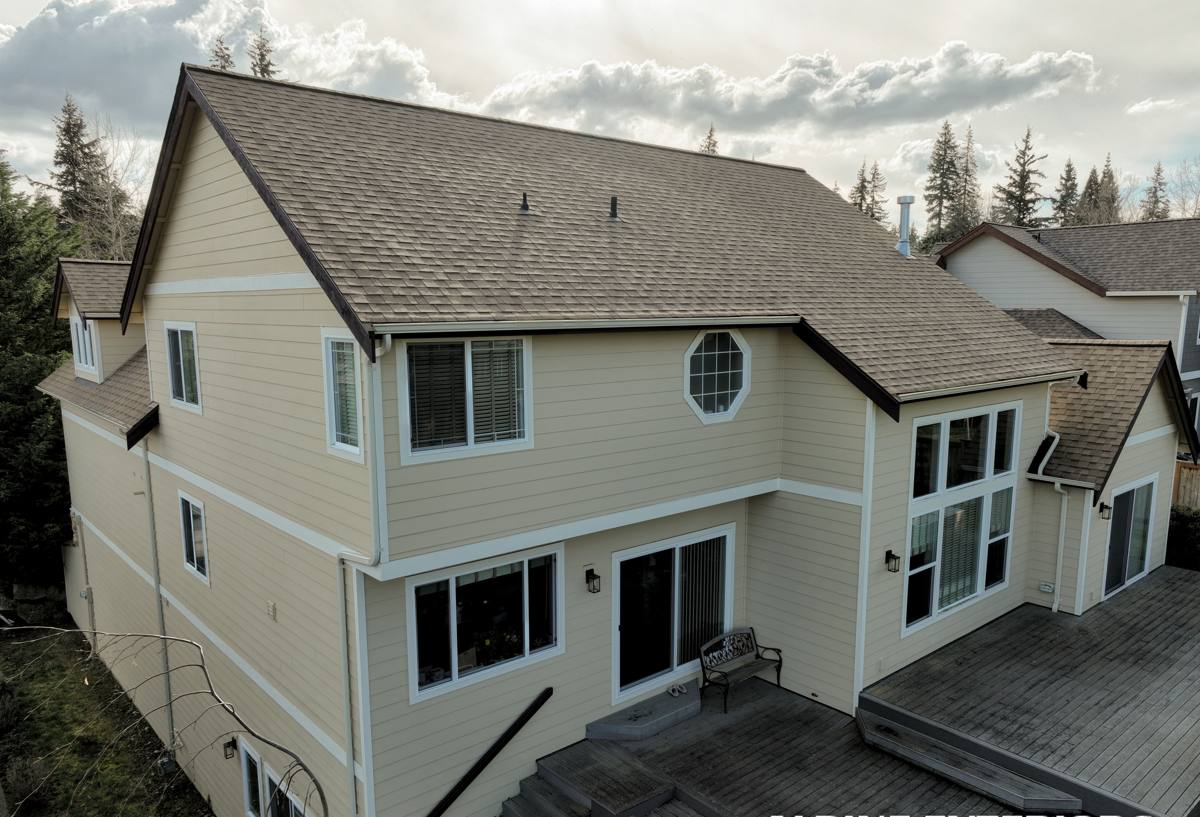
Signs Your Siding Needs Repair, Not Just a Wash
Some siding problems are obvious. Others hide in plain sight for a year or two before they become expensive. Here's what we tell Peace Arch homeowners to watch for between inspections:
- Soft or spongy spots when you press on the siding with your hand
- Paint or factory finish bubbling, cracking, or peeling in isolated patches
- Visible cracking or splitting at panel edges and butt joints
- Staining that spreads outward from nail heads, seams, or trim joints
- Moss or algae that returns within a few weeks of cleaning, especially on shaded walls
- Gaps opening up at corner boards, window trim, or where siding meets the foundation
- A musty smell in the room on the other side of an exterior wall
- Visible daylight, drafts, or water staining around vents, hose bibs, or light fixtures
Any one of these on its own might be minor. Two or three together, especially on the same wall, usually means water has been getting behind the siding for a while.
What's Really Going Wrong Under the Surface
Moisture Finding a Way In
Most repair calls trace back to water getting behind the siding at laps, seams, or penetrations — around hose bibs, vent stacks, light fixtures, or window and door trim. Peace Arch's rain doesn't always fall straight down; wind off the water pushes it sideways and upward under overlaps that were only ever designed to shed vertical rain. Once water gets behind the cladding, it sits against sheathing that doesn't dry out quickly in this climate.
Moss and Algae Holding Moisture Against the Wall
North-facing and shaded walls in this area rarely get enough sun or airflow to dry out between rain events. Moss doesn't just look bad — it holds moisture against the siding surface for weeks at a time, which accelerates rot in wood-based products and breaks down caulk and sealant faster than a dry wall would.
Salt Air and Slow Corrosion
The salt content in the air near Blaine's coastal waters is hard on anything metal — fasteners, flashing, and trim connectors corrode faster here than they would inland. A failed nail or a rusted-through flashing piece is a small, cheap fix if it's caught early, and a much bigger repair if it's left to fail quietly behind the siding.
Repair or Replace? How We Make the Call
Not every damaged section needs to become a full re-siding project, and not every repair is worth doing in isolation. We look at a handful of factors before recommending either path:
| Factor | Repair Usually Makes Sense | Replacement Usually Makes Sense |
|---|---|---|
| Extent of damage | Isolated to a few boards or one section of wall | Spread across multiple walls or elevations |
| Sheathing condition underneath | Dry and solid once the siding is opened up | Soft, delaminating, or visibly stained |
| Age and material | Newer fiber cement with isolated impact damage | Aging vinyl, LP, or cedar nearing the end of its service life |
| Moisture pattern | One-time event, like an impact or a single flashing failure | Chronic, recurring across multiple seasons |
| Cost over time | Lower upfront cost, addresses the specific issue | Repair costs start approaching 40-60% of full replacement |
We'll always tell you honestly which side of that table your house falls on, even if it means recommending a smaller job than you expected — or a bigger one.
What a Correct Siding Repair Actually Involves
A repair that just nails a new board over the old damage looks fine for a season and then fails again in the same spot. A repair done correctly involves a few extra steps that don't show up in the finished look but determine whether the fix actually holds:
- Removing affected material back to sound, dry substrate — not just the visibly damaged piece
- Inspecting the house wrap or moisture barrier underneath and repairing any tears or gaps
- Checking flashing at windows, doors, and penetrations, and correcting it if it's the actual water source
- Addressing the cause of the moisture intrusion, not just patching the symptom
- Matching the reveal, profile, and fastening pattern of the surrounding siding
- Priming or sealing cut edges before they're exposed to weather
- Re-caulking correctly at joints — not relying on a heavy bead of caulk to do a flashing detail's job
Skip the substrate and flashing check and you've just delayed the same failure by a year or two.
Matching Materials: Why Repairs Often Point Toward James Hardie
Most of the repair calls we get in the Peace Arch area involve older vinyl, LP SmartSide, or cedar siding — not because those products are inherently bad, but because they're common in this area's housing stock and they're reaching the age where moisture and UV exposure start to show. Each behaves differently once it's damaged:
Vinyl
Vinyl becomes brittle with age and sun exposure, and discontinued colors or profiles are hard to match a decade or more after installation. A patch is easy to install but often visibly mismatched.
LP SmartSide
Repairs to LP address the visible damage, but if the underlying engineered wood substrate has already absorbed moisture, the same failure tends to resurface nearby within a few years.
Cedar
New cedar boards weather at a different rate than the surrounding siding, so patches often stand out in color and texture for years before they blend in — if they ever fully do.
James Hardie fiber cement, by contrast, is what we install on every new project and every full section replacement, because its ColorPlus factory finish is stable and consistently reproducible, and the material itself doesn't absorb moisture the way wood-based products do. When a repair job on a different material turns out to be more extensive than expected, we'll say so plainly and give you the honest option of replacing the affected wall or section with Hardie rather than chasing patches on a product that's already near the end of its useful life. That's not an upsell — it's the same standard we hold for every job.
Our Repair Process, Start to Finish
- Free, no-pressure on-site inspection of the damaged area and a look at what's driving it
- Moisture readings behind the siding where warranted, so we're not guessing at the extent of the problem
- A written scope that spells out exactly what's being repaired and why
- Sourcing matching material — including color-matched James Hardie ColorPlus where applicable
- Removal of damaged material, substrate and flashing correction, and reinstallation to spec
- Cleanup and a final walkthrough so you know exactly what was done and why
Why a Crew That Already Works Peace Arch Matters
Repair work rewards local familiarity in a way new construction doesn't always require. A crew that's already worked on homes in this part of Blaine knows which wall orientations take the worst of the wind-driven rain, how aggressively moss establishes on shaded siding here, and what Whatcom County permitting and code requirements apply to exterior work. That familiarity means less time spent diagnosing and more time spent fixing the actual problem — and a faster response when a repair needs to happen before the next storm rolls through.
Keeping Repaired Siding From Failing Again
A good repair should last. A few habits go a long way toward making sure it does:
- Give siding a gentle wash once a year to knock back moss and algae before they get established
- Keep gutters and downspouts clear so runoff doesn't sheet directly down exterior walls
- Trim back vegetation and branches that keep siding shaded and slow to dry
- Re-inspect caulking at windows, doors, and penetrations annually, especially before the wet season
- Watch the repaired area and the walls around it for any return of the original symptoms
If you're seeing soft spots, recurring stains, or moss that won't quit on your Peace Arch home, we're happy to take a look and give you a straight answer about what it needs — repair, partial replacement, or nothing at all. Reach out for a free, no-pressure estimate using the form below.