 Blaine Siding
 Sumas Homes Face a Specific Kind of Weather Wear
Sumas sits in the low-lying farm country of northern Whatcom County, close enough to the Salish Sea to pick up salt-laden air on prevailing winds, and squarely in the path of the marine storm systems that move through this corner of Washington most of the year. Homes here don't fail because of one bad storm. They fail slowly, from siding that never fully dries out between rain events, fasteners that corrode a little more with every damp season, and paint film that can't keep up with moisture cycling year after year. If you're planning a siding replacement in Sumas, the material and the installation both need to be chosen with that slow, cumulative wear in mind — not just how the house looks the day the crew leaves.
Salt Air and Fastener Corrosion
Whatcom County's proximity to Puget Sound and the Strait of Georgia means airborne salt reaches further inland than a lot of homeowners assume, especially on homes with open exposure to west and northwest wind. Salt air accelerates corrosion on unprotected or under-spec'd fasteners, trim flashing, and any exposed metal detailing. Over years, corroding fasteners can telegraph through paint as rust streaks, and in the worst cases they lose holding power in the siding itself. This is a big part of why fastener spec and flashing material matter as much as the siding panel you choose.
Driving Rain and Water Management
Pacific storm systems in this region regularly bring rain on a horizontal wind, not just straight-down rain. That kind of driving rain finds every gap in a weather barrier, every under-lapped joint, and every place where trim meets siding without proper flashing. A siding system can be excellent on paper and still leak if the water-resistive barrier, flashing, and lap details underneath it aren't done correctly. In Sumas, where storms roll through with real regularity for much of the year, water management behind the siding is not optional detail work — it's the difference between a wall assembly that lasts decades and one that rots from the inside out.
Moss, Shade, and Slow-Drying Siding
Sumas has plenty of tree cover and shaded exposures, and combined with a long wet season, that means moss and algae growth on north-facing and shaded walls is a real, ongoing issue for local homes. Moss holds moisture against the siding surface far longer than open sun-exposed walls dry out on their own. Siding materials that absorb water or swell when saturated are especially vulnerable in these conditions — they stay wet longer, which speeds up paint failure, warping, and eventual rot at the substrate.
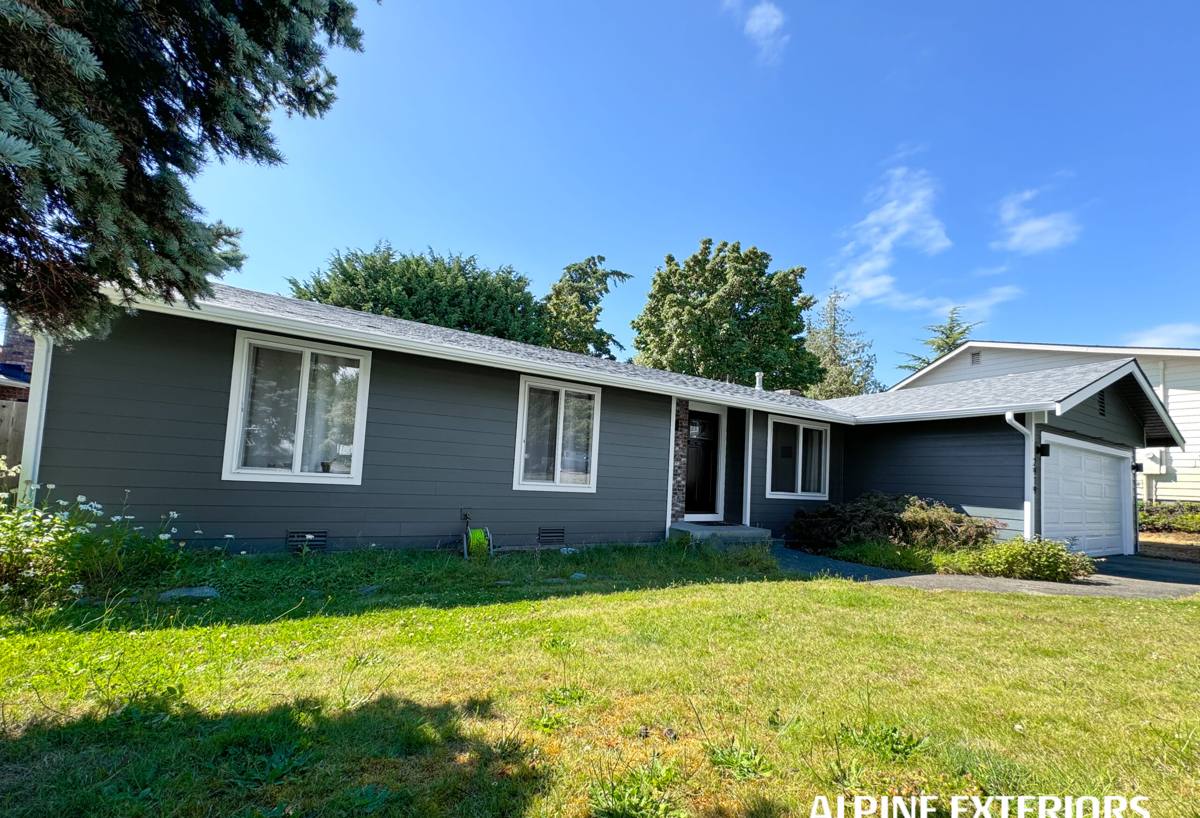
Why We Install Only James Hardie Fiber Cement Here
We made a standing decision as a company to install James Hardie fiber cement siding exclusively — not vinyl, not LP SmartSide, not primed wood products. That decision is rooted directly in the climate conditions described above. Fiber cement is non-combustible and dimensionally stable; it doesn't absorb and swell with moisture the way wood-based or wood-fiber composite siding can, and it holds paint and factory finish far more consistently through repeated wet-dry cycles than vinyl, which can warp, fade, or crack in temperature swings and UV exposure over time.
How Fiber Cement Behaves Differently in a Wet Climate
Wood-based siding products, including engineered wood siding, rely on a resin-treated wood strand core. That core performs well when installation and maintenance are perfect, but any breach in the factory coating — a cut edge left unsealed, a fastener hole, a scratch — gives moisture a path into the wood fiber, and once that happens in a climate like Sumas's, the clock starts on swelling and eventual failure. James Hardie's fiber cement composition is cement, sand, and cellulose fiber — it does not swell or delaminate from moisture exposure the way wood-based products can, which is exactly the property that matters most in a place that stays damp for months at a stretch.
ColorPlus Factory Finish
James Hardie's ColorPlus finish is baked on at the factory in a controlled environment, which gives it more consistent coverage and adhesion than field-applied paint, and it comes with its own finish warranty separate from the substrate warranty. In a climate where field-applied paint is fighting rain, humidity, and a short dry-weather painting window every year, a factory-cured finish is a real practical advantage, not just a marketing point.
What a Correct James Hardie Installation Involves
The siding panel itself is only part of the system. Most siding failures we're called to diagnose — on any brand — trace back to installation details, not the product. A correct Hardie install in a climate like this one includes several details that are easy to skip and expensive to skip.
Weather Barrier and Flashing
Every penetration, window, door, and horizontal trim transition needs proper flashing integrated with the weather-resistive barrier behind the siding, lapped correctly so water sheds outward and down, never inward. This is the layer that actually keeps a wall dry — the siding is the second line of defense, not the first.
Fastening and Clearances
James Hardie specifies fastener type, spacing, and embedment depth for a reason, and those specs change depending on exposure and wind zone. We also hold proper clearance between the bottom edge of siding and the ground, roofline, decks, and patios so water can't wick up into the plank from grade or splash-back — a detail that's frequently ignored and one of the more common causes of bottom-edge rot on any siding brand.
Joint Treatment and Caulking
Butt joints, trim-to-siding joints, and any place two pieces meet need the right sealant, applied correctly, or they become a moisture entry point regardless of how good the siding itself is. We follow Hardie's caulking and joint guidance specifically because it's engineered around how the product expands, contracts, and sheds water.
HardiePlank, Panel, and Trim: Matching the Product to the Home
James Hardie makes several distinct product lines, and the right one depends on the home's style, exposure, and existing trim details. Here's how the main options compare for a typical Sumas-area home.
| Product | Best Use | Local Consideration |
|---|---|---|
| HardiePlank Lap Siding | Traditional horizontal lap look, most common residential choice | Widely used look in this area; performs well against driving rain when lapped and fastened to spec |
| HardiePanel Vertical Siding | Modern vertical look, board-and-batten style | Good for accent walls or full elevations; batten joints need careful sealant work in wet climates |
| HardieShingle | Staggered or straight-edge shingle look | More surface detail means more joints to flash correctly — worth the extra install care for the look |
| HardieTrim | Fascia, corner boards, window and door trim | Matching trim system reduces mismatched material transitions, a common leak point |
For most Sumas homes we work on, HardiePlank in a HZ5 climate formulation covers the bulk of the exterior, with HardieTrim used consistently at corners, windows, and fascia so the whole envelope is one integrated, warrantied system rather than a patchwork of materials.
Our Process, Start to Finish
We keep the process straightforward because the details that matter are in the execution, not in complicated scheduling. Here's what a typical Sumas project looks like:
- On-site walkthrough to assess current siding condition, existing water damage, and trim/flashing needs before any pricing is discussed
- Written estimate that separates siding, trim, and any necessary sheathing or moisture-barrier repair as distinct line items
- Removal of old siding with an inspection of the sheathing underneath for rot, especially at corners, window sills, and the bottom wall plate
- Repair or replacement of any compromised sheathing before a single piece of new siding goes up
- Installation of weather-resistive barrier and flashing at every penetration, window, door, and trim transition
- HardiePlank, panel, or trim installation to manufacturer fastening and clearance specifications
- Final joint sealing, cleanup, and a walkthrough so you can see the finished detailing before we call the job done
We don't sell siding by the square foot without first understanding what's happening behind the existing wall. In a climate that hides water damage well — under moss, under old paint, under caulking that looks fine from the ground — that inspection step is where a lot of real problems get caught before they're covered up again.
Why It Matters That We Already Work in Sumas
A crew that already does regular work in and around Sumas has a working sense of what this specific stretch of Whatcom County throws at a house — which exposures take the worst of the wind-driven rain, which wall orientations grow moss fastest, and what condition older siding and trim tend to be in on homes of a given age here. That's not a substitute for a proper on-site inspection of your home, but it does mean fewer surprises and a crew that isn't learning the local climate on your project. It also means a shorter distance to travel for warranty follow-up, punch-list items, or a maintenance question a year or two down the road — which matters more with siding than with almost any other exterior trade, since siding problems are usually slow-developing and easiest to fix early.
Maintenance After Installation
James Hardie siding is genuinely low-maintenance compared to wood-based alternatives, but "low-maintenance" doesn't mean "no maintenance," especially in a moss-prone, high-rainfall climate like this one.
What to Watch For
Keep an eye on shaded, north-facing walls for early moss or algae growth and address it before it builds up — a soft wash on a regular schedule is far easier than dealing with years of buildup. Check caulked joints periodically, since sealant is the one component of the system with a shorter service life than the siding or the factory finish. And keep vegetation and sprinkler spray pulled back from the base of the walls so the bottom courses of siding stay dry and get normal air circulation.
If you're planning a siding project in Sumas or anywhere else in the Blaine area, we're happy to come take a look and give you a straightforward, no-pressure estimate — use the form below to get started.