 Blaine Siding
 Building a Deck That Actually Holds Up in Bellingham
Bellingham sits close enough to Bellingham Bay and the Salish Sea that homes here deal with a combination most inland decks never see: salt-laden air, long stretches of driving rain off the water, and a moss season that can run from October well into May. A deck built to a generic spec sheet might look fine the first summer, but by year three the fasteners are bleeding rust streaks, the boards are holding water in the shade, and moss is creeping up from the ground contact points. A deck built for this specific climate is a different project from day one — different fasteners, different footing details, different material choices, and a different maintenance conversation with the homeowner before we ever cut a board.
This page covers what a custom deck built for a Bellingham property actually needs, what correct construction looks like given our conditions, and how we approach the work from first estimate to final walk-through.
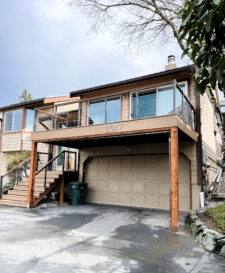
What Whatcom County's Climate Actually Does to a Deck
It helps to be specific about what "tough climate" means here, because each condition attacks a deck differently.
Salt Air and Corrosion
Properties near the water get airborne salt that settles on metal hardware — joist hangers, structural screws, bolts, railing brackets — and accelerates rust far faster than the same hardware would corrode further inland. Standard galvanized fasteners are often not enough this close to the bay; the coating wears through and rust takes hold at the fastener heads first, which is usually the first visible sign a deck was built with the wrong hardware.
Driving Rain
Rain here doesn't just fall straight down — wind off the water pushes it sideways into ledger boards, under flashing laps, and into any gap where two pieces of wood meet. A deck that's technically "waterproofed" with a single layer of standard building paper behind the ledger board will eventually let water track behind the siding and into the rim joist, which is one of the more expensive repairs a homeowner can face because it's hidden until the rot shows up.
Moss and Constant Moisture
Low winter sun angles and long overcast stretches mean shaded parts of a deck — under trees, on the north side of the house, near dense landscaping — barely dry out between rains. Moss and algae take hold on any surface that stays damp, and on wood decking that moisture gets trapped in the grain, softening fibers and setting up rot even before the moss is visible to the eye.
None of this means a deck can't last decades here. It means the build has to account for these three things specifically, not just meet a generic code minimum.
What a Correctly Built Deck Involves
A deck that's going to hold up under Whatcom County conditions gets a few things right that are easy to skip if a crew is rushing or unfamiliar with the area.
- Ledger flashing done in the right order — flashing that laps correctly with the house's water-resistive barrier so rain sheds outward, not behind the siding.
- Corrosion-resistant fasteners throughout — stainless steel or heavy-coated structural screws and hangers, especially anywhere close to the water or exposed to salt spray.
- Proper board spacing — enough gap between deck boards for water to drain and air to circulate underneath, which is what actually slows moss and mildew growth, not just surface cleaning.
- Footings set below frost depth and clear of standing water — footing holes that account for our wet soil conditions so posts aren't sitting in a pocket that stays saturated all winter.
- Ground clearance and drainage away from the structure — grading and post height that keep the deck's understructure from becoming a year-round damp crawlspace.
Skipping any one of these doesn't usually cause an immediate problem — it causes a problem in year four or five, after the warranty conversation has already happened and the homeowner is left deciding whether to repair or rebuild.
Choosing the Right Decking Material for This Climate
There's no single "best" decking material — it depends on budget, how much upkeep the homeowner wants to do, and how exposed the deck is to sun, shade, and moisture. Here's how the common options actually perform under Bellingham conditions specifically.
| Material | Moisture & Moss Behavior | Maintenance | Typical Lifespan Here |
|---|---|---|---|
| Cedar | Naturally rot-resistant but still needs sealing; can gray and hold moisture in shaded areas without upkeep | Annual cleaning, resealing every 1-2 years | 15-20 years with consistent maintenance |
| Pressure-treated pine | Treated for rot resistance but end cuts and fastener holes are vulnerable; moss takes hold quickly in shade if not cleaned | Annual cleaning, sealing every 1-2 years | 15-20 years with consistent maintenance |
| Composite decking | Doesn't absorb water into the board itself, but algae and mildew can still grow on the surface film in shaded, damp spots | Periodic washing, no sealing required | 25-30+ years, backed by manufacturer warranty |
| PVC decking | Fully synthetic, essentially immune to rot; surface growth is a cleaning issue only | Occasional washing | 25-30+ years, backed by manufacturer warranty |
Our general approach: composite or PVC decking makes the most sense for shaded, north-facing, or heavily tree-covered lots where moss is a persistent fight — the extra material cost up front buys back a lot of maintenance time over the years. Real wood is a perfectly good choice for sunnier, more exposed decks where a homeowner doesn't mind the annual cleaning and sealing routine, and wants the look and feel that only solid wood gives. We'll walk through both honestly during the estimate rather than pushing one material across the board.
Footings, Framing, and Drainage — The Part Nobody Sees
The structure underneath a deck matters more than the decking surface, and it's the part most likely to get shortcut on a rushed job. In our soil and rainfall conditions, footings need to go below frost depth and be poured in a way that doesn't leave a water-collecting void around the post base. Framing lumber should be rated for ground contact where it's close to grade, and joists benefit from a protective tape or coating on top edges where fasteners penetrate — that's one of the more common failure points we see on older decks, where water sits in the fastener holes and starts rot from the inside of the joist outward.
Drainage matters just as much. If the ground under a deck doesn't shed water away from the house, that moisture sits in the shaded space underneath and keeps everything — posts, joists, the underside of the decking — perpetually damp. On lower decks or decks over patios, an under-deck drainage system can keep the space below dry and usable, which is worth discussing if the deck is going over an entertaining area, storage, or a walkout basement door.
Railings, Stairs, and Permits
Most decks over 30 inches off grade need code-compliant guardrails, and stair and railing details are one of the more commonly missed items on owner-built or bargain jobs. Whatcom County and the City of Bellingham both require permits for most deck construction, and permitted work gets inspected at the footing stage and again at framing — which is actually a good thing for the homeowner, because it means an independent set of eyes is checking the structural work before it's covered up. We handle the permit process as part of the job rather than leaving it to the homeowner to navigate.
Our Process, Start to Finish
- On-site assessment — we look at sun exposure, drainage, soil conditions, and how the deck will connect to the house before recommending materials.
- Honest material conversation — we walk through the real tradeoffs between wood and composite/PVC for that specific location on the property, not a one-size-fits-all pitch.
- Permit and design — we prepare and submit what the local jurisdiction requires so the project is inspected and legal, not something that creates a problem at resale.
- Footings and framing — built with corrosion-resistant hardware and drainage details suited to our climate, not a generic national spec.
- Decking, railings, and stairs — installed with proper spacing and fastening for the chosen material.
- Final walk-through — we go over basic care so the deck actually reaches its expected lifespan.
Maintaining a Deck in a Marine Climate
Whatever material a homeowner chooses, a little seasonal attention goes a long way here. This is the routine we recommend to keep moss, mildew, and hardware corrosion from getting ahead of you.
- Sweep debris and standing leaves off the deck surface regularly through fall — trapped leaves hold moisture against the boards and feed moss growth.
- Clean the deck surface at least once a year (more often in heavily shaded areas) with a deck-safe cleaner to remove algae and moss before it establishes.
- Check fastener heads and railing hardware annually for early rust, especially on decks close to the water.
- Reseal wood decking every 1-2 years, or as soon as water stops beading on the surface.
- Keep gutters and downspouts clear so roof runoff isn't dumping extra water directly onto or under the deck.
- Trim back overhanging branches and dense landscaping to let more light and air reach shaded sections of the deck.
Why Hire a Crew That Already Builds in Bellingham
A contractor who mainly builds decks in drier parts of the state may not think twice about fastener grade, footing drainage, or which spots on a property will fight moss year-round — because they've never had to. We build in Whatcom County's conditions regularly, which means the corrosion-resistant hardware, the drainage details, and the material recommendations above aren't an upsell — they're just what a deck needs to actually last here. We also know the local permitting process, which keeps the project moving instead of stalling on paperwork.
If you're planning a new deck, replacing an aging one, or just want a straight answer on whether your current deck's problems are fixable or a sign it's time to rebuild, we're happy to take a look. Request a free, no-pressure estimate using the form below and we'll walk the property with you and talk through real options for your specific spot.