 Blaine Siding
 Why Bellingham Roofs Take a Different Kind of Beating
Roofs here don't fail the way they do in drier parts of the country. A roof twenty miles inland can go decades with nothing more than a missing shingle or two. A roof in and around Bellingham, sitting close to the Salish Sea and exposed to Whatcom County's wet, mild winters, is working against salt-laden air, sideways rain, and shade-grown moss almost year-round. None of that means a roof here is doomed — it means the repair work has to account for conditions a roofer in Spokane or Boise never has to think about.
Salt Air Off the Water
Homes closer to Bellingham Bay and the open water pick up a fine salt residue that settles on metal flashing, fasteners, and vent stacks. Over years, that salt speeds up corrosion on anything that isn't rated for coastal exposure — nail heads rust, flashing pits and thins, and small metal failures turn into water intrusion long before the shingles themselves are worn out. A repair that ignores the metal and only replaces shingles is a repair that fails again in a season or two.
Driving Rain and Wind
Pacific storms coming off the water don't just fall straight down — they come in sideways, pushed by wind that finds every gap in flashing, every lifted shingle tab, and every undersized nail pattern. Whatcom County can see long stretches of steady, wind-driven rain rather than short, hard downpours, and that steady pressure is what finds the weak spot in a roof that a calm-weather inspection would miss.
A Moss Season That Doesn't Really End
Tree cover, overcast winters, and consistent moisture give moss and algae a long growing season on north-facing slopes and shaded roof planes. Moss doesn't just look bad — it holds water against the shingle surface, lifts tabs as it grows, and works its way under the shingle edge, which is exactly where a roof starts to leak. Left alone for a few seasons, a moss problem turns a simple cleaning job into a repair job.
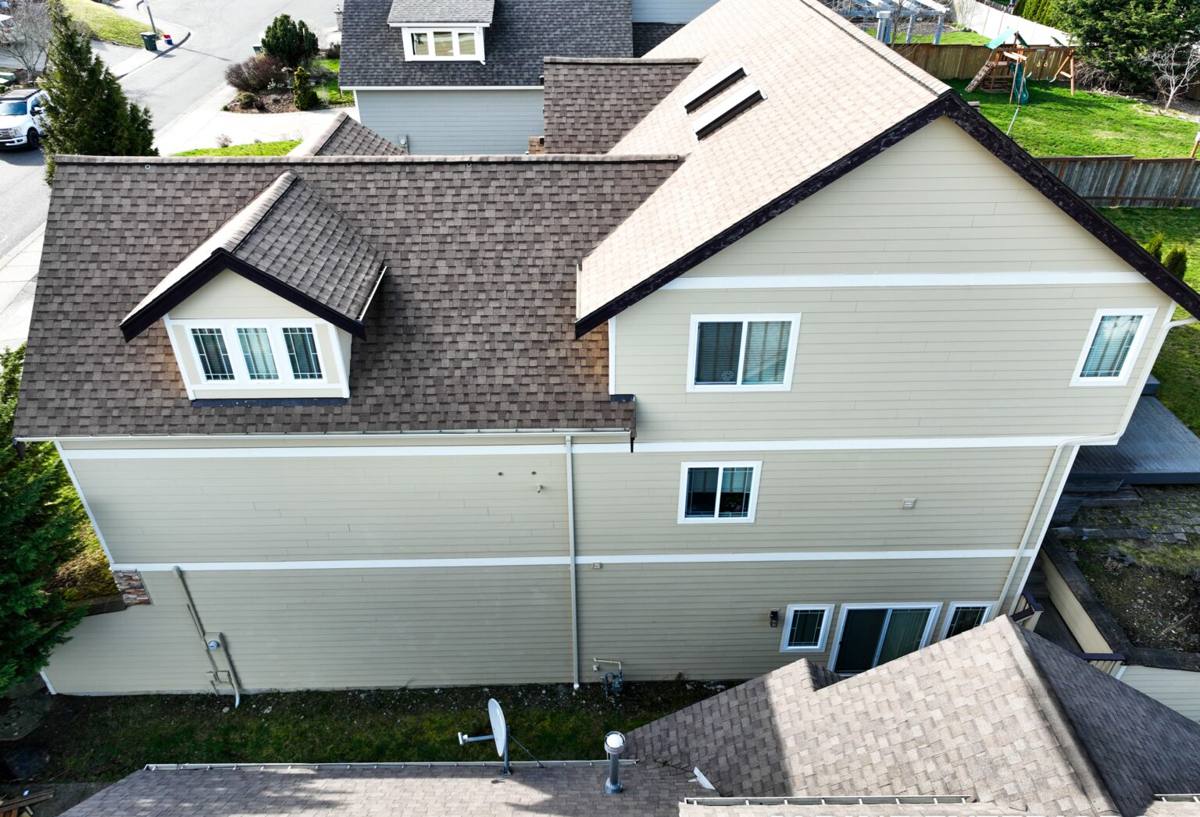
Early Warning Signs a Bellingham Roof Needs Attention
Most roof problems here start small and stay hidden until they show up as a stain on a ceiling. Homeowners who catch these signs early save real money, because a repair costs a fraction of what water damage to decking, insulation, or drywall runs.
- Granules collecting in gutters or at downspout outlets — a sign shingles are wearing faster than they should
- Dark streaking or thick moss growth on shaded or north-facing roof sections
- Curling, cupping, or lifted shingle tabs, especially on slopes that catch the most wind
- Rust staining or visible corrosion around flashing, vent boots, and chimney or skylight edges
- Soft spots, sagging, or discoloration on interior ceilings after a heavy storm
- Daylight visible through the roof deck from inside an attic or crawlspace
- Loose, missing, or exposed fasteners along ridge caps and roof edges
Any one of these on its own might be minor. Two or three together, especially after a windy winter, usually means it's time for an actual inspection rather than a guess from the ground.
What's Usually Behind the Repair Call
Most of the repair calls we get in this area trace back to a small number of causes. Knowing which one you're dealing with changes what the right fix looks like.
| Symptom | What's Really Going On | Typical Repair |
|---|---|---|
| Leak near a chimney, skylight, or vent | Flashing has corroded, shifted, or was never sealed correctly at the transition | Remove and reinstall flashing with proper step and counter-flashing, reseal transitions |
| Leak along the roof edge or in a valley | Wind-driven rain pushed under a lifted shingle tab or worn valley material | Replace affected shingles and valley material, re-nail properly for wind exposure |
| Heavy moss on shaded slopes | Moisture held against the shingle surface from limited sun exposure | Careful moss removal, treatment, and repair of any shingles lifted or damaged underneath |
| Granule loss and thinning shingles | Age combined with constant damp cycling wearing down the shingle surface | Section replacement if isolated, full replacement discussion if widespread |
| Rusted or pitted flashing and fasteners | Salt air corrosion on metal not rated for coastal exposure | Swap in corrosion-resistant flashing and fasteners at the affected areas |
What a Correct Roof Repair Actually Involves
Diagnose Before You Patch
A repair that starts with "which shingle is missing" instead of "why did water get in" usually comes back as a second repair. Before any material goes on the roof, we trace the leak or the damage to its actual source — which, more often than not near Bellingham, is a flashing or transition problem rather than the shingle field itself. Patching over a corroded flashing detail with new shingles hides the problem instead of fixing it.
Flashing and Transitions Matter More Than Shingles
Chimneys, skylights, vent stacks, and valleys are where the vast majority of roof leaks actually start, not in the open shingle field. A correct repair rebuilds these transitions properly — step flashing woven with the shingle courses, counter-flashing tucked and sealed where it meets a chimney or wall, and vent boots replaced rather than just caulked over. Caulk is a temporary answer at best in a climate that stays wet this much of the year.
Matching Materials the Right Way
Shingle repairs that don't match the existing color, profile, or granule wear stand out and can also perform differently in wind and rain than the surrounding material. Where an exact match isn't available, we talk through the options honestly rather than installing something that looks patched or behaves inconsistently with the rest of the roof. At eaves, valleys, and other vulnerable transitions, we also look at what's underneath the shingles — a self-adhering waterproof underlayment at these spots gives a second line of defense against the wind-driven rain this area gets, even when it wasn't part of the original roof.
Ventilation's Role in a Lasting Repair
A repair that only addresses the visible damage can miss a root cause sitting in the attic. Poor attic ventilation traps warm, moist air against the underside of the roof deck, which speeds up moss and algae growth from below just as much as shade does from above, and it can rot decking from the inside even while the shingles up top look fine. When we're already up on a roof for a repair, we check soffit and ridge venting as part of the job, not as an upsell — a repair that ignores blocked or undersized ventilation is treating one symptom while leaving another to keep working against the roof.
Repair or Replacement — How We Make That Call Honestly
Not every roof that's leaking needs to come off. A roof with isolated flashing failures, a few damaged shingle courses, or a moss problem caught early is usually a good repair candidate. A roof with widespread granule loss, multiple leak points, soft decking, or shingles nearing the end of their rated life is often past the point where another repair makes financial sense. We'll tell you which situation you're in and why, including when a repair is the right call even though a replacement would earn us more — that's the standard we hold ourselves to.
What Affects the Cost of a Repair
Every roof and every leak is different, so we won't quote a number without seeing the roof, but a few factors drive most of the variation we see on repair jobs in this area.
| Factor | Why It Matters |
|---|---|
| Extent of damage | A single flashing detail costs far less to fix than a repair that's spread to decking or multiple leak points |
| Roof access and pitch | Steep roofs, multiple stories, or limited ground access add time and safety measures to the job |
| Material availability | Matching an older shingle color or profile can take longer to source than a common current product |
| Underlying cause | A repair tied to ventilation or moisture problems may need more than a surface fix to actually last |
As a rough guide, a straightforward flashing or small shingle-section repair is typically a modest, same-day job, while repairs involving decking replacement, widespread moss damage, or multiple leak points take longer and cost more. We'll walk you through exactly what's driving your estimate before any work starts.
Our Process, Start to Finish
The Site Visit
We get on the roof, not just in the attic or on the ground with binoculars. That means checking flashing, fasteners, decking condition where accessible, and the actual extent of moss or granule loss, not just the spot where the ceiling stain showed up.
The Estimate
You get a clear explanation of what we found, what's causing it, what the repair involves, and a written estimate before anything is scheduled. No pressure to upgrade to a full replacement if a repair will genuinely hold.
The Work Itself
Repairs are scheduled around Whatcom County's weather, not squeezed in between rain systems in a way that risks an open roof getting soaked mid-repair. We protect the work area, remove and dispose of damaged material properly, and rebuild the affected section to match the surrounding roof's performance, not just its appearance.
What We Leave You With
A straightforward explanation of what was done, what to watch for going forward, and honest guidance on when — if ever — this section of roof might need attention again.
Maintenance That Buys You Years Between Repairs
Roofs in this climate don't need to be babied, but a few habits make a real difference in how long a repair — or the roof itself — actually lasts.
- Clear gutters and downspouts each fall before the heavy rain sets in, so water isn't backing up under the roof edge
- Trim back tree limbs that shade roof sections and drop debris, since both encourage moss and hold moisture
- Have moss treated or removed before it establishes rather than after it's visibly thick
- Walk the attic or crawlspace after a major windstorm and check for new light, staining, or damp insulation
- Get flashing around chimneys, skylights, and vents checked every few years, since that's where failures start
- Address small leaks the season they appear — decking and insulation damage from a delayed repair costs far more than the original fix
Why a Blaine-Based Crew Already Working in Bellingham Matters
Whatcom County's coastline runs from Blaine down through Bellingham, and the roofs along it face the same combination of salt air, wind-driven rain, and moss regardless of which side of the county line they sit on. A crew that works this stretch regularly already knows which flashing details tend to fail first in this climate, which slopes hold moss longest, and what a repair actually needs to hold up through another wet winter — not just look finished on a dry afternoon. That's the difference between a repair that lasts and one you're calling about again next year.
If you're dealing with a leak, visible moss, or just want an honest read on what your roof actually needs, we're happy to take a look. Estimates are free, there's no pressure to do more than what the roof actually calls for, and you'll get a straight answer either way — use the form below to get started.