 Blaine Siding
 Why Birch Point Roofs Wear Differently Than Roofs Inland
Birch Point sits right up against the water, and that changes what a roof has to deal with year after year. Homes a few miles inland in Blaine catch plenty of Whatcom County rain, but Birch Point gets the added combination of salt-laden air off the water, wind-driven rain that hits roof planes at an angle instead of falling straight down, and long stretches of shade and dampness that keep moss and moisture active for most of the year. None of that is dramatic on any single day. It's the accumulation — season after season — that separates a roof that holds up for decades from one that starts failing quietly at year twelve or fifteen.
Metal roofing handles that combination better than most other roofing materials, but only when it's specified and installed correctly for a coastal environment. A metal roof installed the same way you'd install one forty miles inland is not the same job, and it won't hold up the same way.
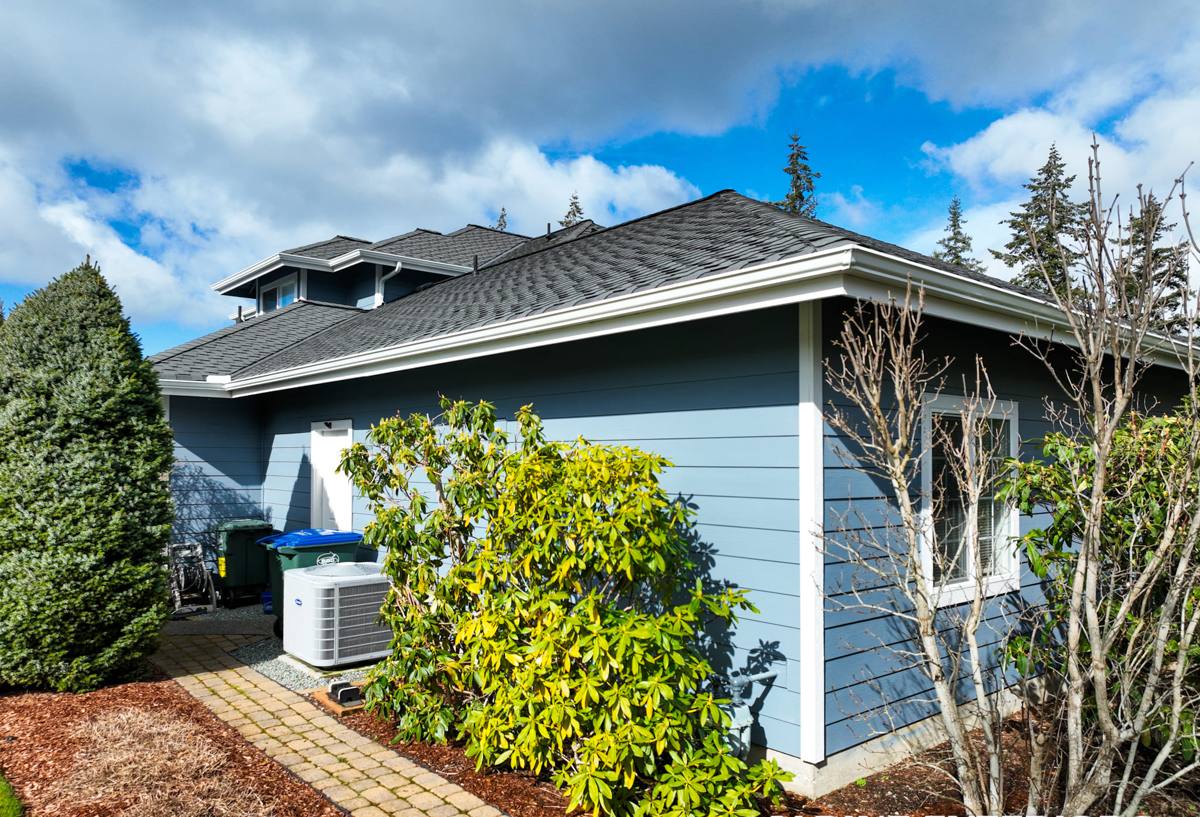
What Salt Air and Constant Moisture Actually Do to a Roof
Salt air isn't just a minor irritant for building materials — it's a slow, steady driver of corrosion. Airborne salt settles on any exposed metal and, combined with the moisture that's almost always present near the water, it accelerates rust and metal fatigue at fasteners, flashings, and any cut edge that isn't properly sealed or coated. On a roof, that shows up first at the small stuff: exposed screw heads, valley flashing, and trim pieces, long before it becomes a problem on the main roof panels themselves.
Moisture and moss are a related but separate issue. Birch Point's tree cover and cooler, damp microclimate near the water mean moss spores have a long season to establish themselves. On an asphalt shingle roof, moss roots into the granule surface and holds water against the shingle mat, which is exactly what breaks shingles down early. Metal roofing gives moss nothing to root into, which is one of the real, practical reasons it fits this location — but it isn't moss-proof on its own. Debris that collects in valleys or against low-slope transitions can still hold moisture long enough for moss and algae to get a foothold on the surface, so roof design and slope still matter.
The Three Things That Cause Most Problems Here
- Uncoated or poorly matched fasteners that rust and streak long before the panel itself shows any wear
- Debris buildup in valleys, behind chimneys, and at low-slope sections where wind-blown organic material collects and stays wet
- Flashing details at penetrations and transitions that were sealed with caulk instead of properly lapped and mechanically fastened metal
Why Metal Roofing Makes Sense for This Location
Metal roofing isn't automatically the right answer for every home, but for Birch Point's exposure it solves several problems at once. It sheds wind-driven rain more reliably than a shingle roof because the panels interlock or overlap in a way that doesn't rely on gravity alone — that matters when rain is coming in sideways off the water instead of falling straight down. It doesn't absorb moisture into a mat the way asphalt shingles do, so it doesn't provide the damp organic surface moss needs to establish itself. And it has a service life, when properly installed, that's measured in decades rather than the 15-to-20-year window typical of asphalt shingles in this climate.
It's also a practical fit for homes exposed to salt air specifically because the better metal roofing systems use factory-applied coatings designed for coastal corrosion resistance. That's not true of every metal roofing product on the market, which is exactly why product selection matters more here than it would forty miles inland.
Metal Roofing Options — What Actually Differs
"Metal roofing" covers a range of products, and the differences matter more in a salt-air environment than they would elsewhere. Here's how the common options compare for a home in this location:
| Option | Coastal Durability | Appearance | Typical Tradeoff |
|---|---|---|---|
| Standing seam panels | Strong — concealed fasteners reduce corrosion points | Clean, modern lines | Higher upfront cost, more installation skill required |
| Exposed-fastener panels | Good, if fastener spec and spacing are correct | Traditional ribbed look | More maintenance long-term at fastener points |
| Metal shingles/shakes | Good with proper coating | Mimics shingle or shake look | More seams and details than standing seam |
| Stone-coated steel | Good with correct underlayment | Mimics tile or shake | Heavier system, more attention to ventilation |
We don't push one product on every roof. The right choice depends on the home's roof pitch, how exposed it is to direct salt spray versus set back from the water, and what look fits the house and the neighborhood. What we won't do is install a system with exposed, uncoated fasteners in a spot getting direct salt exposure and call it a long-term solution — that's a maintenance problem waiting to surface in a few years, not a fix.
What a Correct Installation Actually Involves
The panels themselves get most of the attention, but the parts of a metal roof install that determine whether it lasts are mostly things you won't see once the job is done.
Underlayment and Deck Prep
A synthetic, high-temperature underlayment goes down over a deck that's been checked for soft spots and existing moisture damage — something that shows up more often on older Birch Point homes than people expect, given how long moisture has had to work on the roof deck underneath aging shingles or old metal.
Fasteners and Flashing
Every fastener, clip, and piece of flashing needs to be rated for coastal exposure, not just rated for metal roofing in general. Valleys, chimney flashing, and any wall-to-roof transition get properly lapped and mechanically fastened metal work — not a bead of caulk standing in for real flashing.
Ventilation
A metal roof still needs a properly vented assembly underneath it. Trapped moisture under a metal roof causes deck rot and condensation problems that have nothing to do with the metal itself but get blamed on it anyway. Ridge and soffit ventilation gets checked and corrected as part of the job, not assumed to be fine because the old roof had it.
Panel Installation
Panels get run, seamed, or fastened according to the manufacturer's coastal installation specifications, with attention to expansion and contraction — metal roofing moves with temperature swings, and panels installed without allowing for that will show it at the seams within a few years.
Our Process for a Birch Point Metal Roof
- On-site inspection — we look at the existing roof, deck condition, exposure to wind and salt spray, and ventilation before recommending anything
- Straight answer on scope — what needs full replacement versus what can be addressed, and why, in plain terms
- Product selection — matched to the home's exposure, pitch, and the look you actually want, not a one-size answer
- Tear-off and deck repair — any soft or damaged decking gets replaced before anything new goes down
- Underlayment, flashing, and panel installation — done to manufacturer spec with coastal-rated fasteners and hardware throughout
- Final walkthrough — valleys, flashing, and trim checked together with you before we call the job done
Keeping a Metal Roof Performing Long-Term
Metal roofing is genuinely low-maintenance compared to shingles, but "low-maintenance" in a Birch Point microclimate still means occasional attention, not none at all.
- Clear needles, leaves, and debris from valleys and low-slope areas once or twice a year — this is where moisture sits longest
- Have gutters checked and cleared regularly so water isn't backing up against roof edges or fascia
- Walk the roofline visually after major windstorms for any lifted trim or displaced flashing
- Rinse visible salt residue off lower roof sections near the water if you notice a white haze building up
- Have flashing and penetration points checked every few years rather than waiting for a leak to show up inside the house
Why Local Experience in Birch Point Matters
A roofing crew that hasn't worked this stretch of the Blaine coastline doesn't have a feel for how differently the wind and salt exposure behave on a waterfront lot versus a lot set back a few blocks. That shows up in small decisions — where extra fastener density gets added, which flashing details get upgraded, how ventilation gets handled on a shaded, damp roof — that don't show up in a bid sheet but show up in how the roof performs in year eight or ten. We work throughout Whatcom County and have installed and repaired roofs on homes dealing with exactly this kind of exposure, so we're not guessing at what Birch Point does to a roof over time — we've seen it, and we build for it.
If you're weighing a metal roof for a home in Birch Point, we're glad to come take a look, walk the roof with you, and give you a straight read on condition, options, and what it would actually take to do the job right for this location. There's no cost and no pressure to move forward — just a clear answer so you can decide with real information. The form below gets you on our schedule for a free estimate.