 Blaine Siding
 Birch Point's Climate Is Hard on Windows — Here's Why
Birch Point sits close enough to the water that homes here take a different kind of weather beating than houses even a few miles inland in Whatcom County. Salt-laden air corrodes exposed metal hardware and fasteners faster than manufacturers' warranties usually assume. Driving rain off the Strait doesn't just fall straight down — wind pushes it sideways into every gap around a window frame, which is exactly where most leaks start. And the long, damp moss season here means anything with a horizontal ledge, including window sills and trim, stays wet longer than it would in a drier climate, inviting rot if the original installation didn't account for drainage.
None of this means Birch Point is an impossible place to keep windows in good shape. It means the installation has to be done with those three stressors in mind from the start, not patched around later. A window that's a great fit for a dry inland neighborhood can underperform here if it's hung the same way.
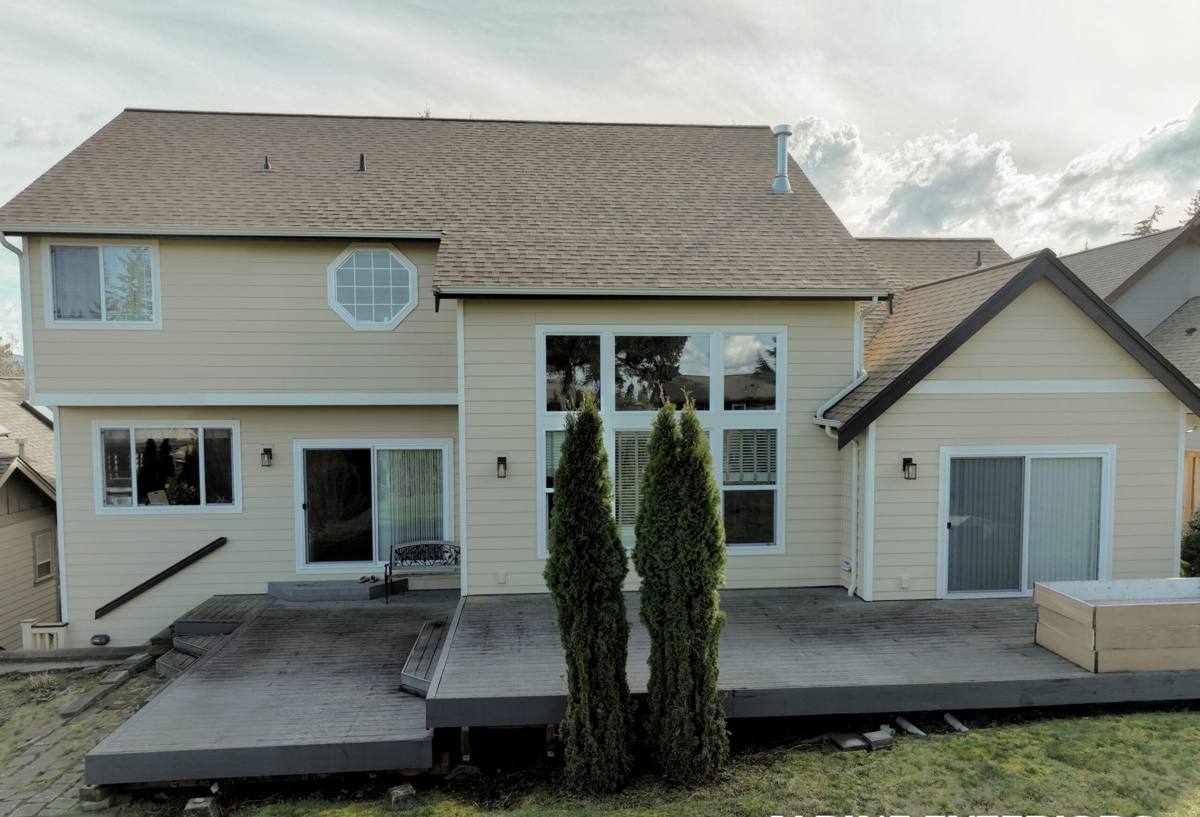
What a Correct Installation Actually Involves
Most window failures we see on service calls in this area aren't glass failures — they're installation failures. The window itself is fine; the way it was sealed into the wall isn't. On a marine-exposed home, the details below matter more than the brand of window you choose.
Drainage Comes First
Every window opening needs a sloped sill pan so any water that does get past the exterior seal drains back outside instead of pooling against the sill framing. This is a basic step, but it's skipped constantly on older installs and on rushed replacement jobs. On a Birch Point home taking direct wind-driven rain, a missing or flat sill pan is often the single biggest reason a window leaks within a few years.
Flashing and Weather Barrier Integration
The window's flashing has to integrate with the house wrap or weather-resistant barrier in the correct shingle-lap order — top piece over the sides, sides over the sill pan — so water is always directed outward and downward, never trapped behind the siding. This is a sequencing issue, not a materials issue, and it's where a lot of DIY and low-bid jobs go wrong.
Sealant Is a Backup, Not the Plan
Caulk and sealant should be the second line of defense, not the only line. A window installed correctly will still shed water even if a bead of sealant fails a few years down the road — because the flashing and sill pan are doing the real work. In salt air, sealants and gaskets degrade faster than the marketing on the tube suggests, so relying on sealant alone is a maintenance problem waiting to happen.
Insulation and Air Sealing
The gap between the window frame and the rough opening should be filled with a low-expansion foam or backer rod and sealant — not stuffed with fiberglass batting, which does nothing to stop air infiltration and can hold moisture against the frame. Proper air sealing here also cuts down on condensation on the interior glass during our cold, wet winters.
Retrofit vs. Full-Frame Replacement
One of the first decisions on any window project is whether to do a retrofit (also called a "pocket" or "insert" replacement, where the new window fits inside the existing frame) or a full-frame replacement that removes everything down to the rough opening. On a coastal property, this decision matters more than it does inland, because it determines whether hidden water damage gets found and fixed or gets sealed back up behind a new window.
| Factor | Retrofit / Insert | Full-Frame Replacement |
|---|---|---|
| Best for | Sound existing frames, siding you want to keep intact | Any sign of rot, past leaks, or old flashing you can't verify |
| Access to check for hidden water damage | Limited — frame stays covered | Full — sill and framing are exposed and inspected |
| Typical cost | Lower | Higher, due to trim, siding, and flashing work |
| Disruption to siding/trim | Minimal | Siding and trim around the opening are removed and reinstalled |
| Right call for Birch Point homes with known past leaks | Not recommended | Recommended |
If a home has a history of moisture issues near a particular window — visible staining, soft trim, or musty smell in that corner — we lean toward full-frame replacement even though it costs more, because a retrofit installed over hidden rot just buys a few more years before the same problem resurfaces.
Frame Material Considerations for a Marine Environment
There isn't one "correct" window material for Birch Point, but salt air and constant moisture do change the trade-offs compared to a drier inland location.
- Vinyl: Handles salt air well since it doesn't corrode, and it's a solid value option. On south- and west-facing exposures with a lot of direct sun and reflected light off the water, lower-quality vinyl can fade or warp over time — we spec heavier-gauge frames on exposed walls for that reason.
- Fiberglass: Very stable dimensionally and resistant to the swelling and shrinking that comes with our humidity swings. Costs more up front, which some homeowners choose to reserve for their most exposed elevations.
- Aluminum-clad wood: Attractive and a common choice for a more traditional look, but aluminum cladding in direct salt exposure needs a quality factory finish and careful sealing at every joint, or corrosion and paint failure show up faster than inland. We treat this as a case where installation and finish quality matter more than usual.
- Hardware and fasteners: Regardless of frame material, we spec corrosion-resistant hardware and fasteners on Birch Point jobs — cheap plated screws are a common point of early rust on coastal homes.
Our Process on Birch Point Jobs
We keep the process straightforward and we don't skip the parts that don't show once the trim goes back on.
- On-site assessment. We look at every opening being replaced, check for existing moisture damage, and note exposure direction — a north-facing window and a west-facing window on the same house can need different details.
- Written scope and estimate. You get a clear breakdown of retrofit vs. full-frame recommendation, materials, and what's included, before any work starts.
- Removal and inspection. Old windows come out carefully so we can inspect the rough opening and sill for hidden rot before anything new goes in.
- Sill pan, flashing, and air sealing. This is the step that determines whether the window performs for the next 20+ years, and it's non-negotiable on our jobs regardless of budget.
- Window installation and leveling. Set, shimmed, and fastened to spec, with attention to reveal and operation, not just fit.
- Trim, siding restoration, and cleanup. Exterior and interior trim finished to match, site cleaned up, and old windows hauled off.
- Walkthrough. We show you how the new windows operate and answer questions before we consider the job done.
Permits and Whatcom County Requirements
Window replacement in Blaine typically falls under Whatcom County building code, and requirements can depend on whether it's a like-for-like replacement or a change in window size or a bedroom egress opening. Bedroom windows have specific egress size and sill-height requirements that matter if you're changing the opening dimensions at all. We handle the permit determination and paperwork as part of the job so you're not left guessing whether your project needs one.
Signs Your Current Windows Are Already Failing
A lot of Birch Point homeowners call us after noticing one of these — worth checking for on your own windows before small problems become bigger ones:
- Fogging or moisture between the panes of a double-pane window (a sign the seal has failed)
- Soft, discolored, or spongy trim or sill wood around the frame
- Visible gaps or daylight around the frame when the window is closed
- Windows that are difficult to open, close, or lock — often a sign the frame has shifted or swollen
- A noticeable draft or cold spot near the window in winter
- Paint or finish peeling on the interior or exterior frame
- Musty smell or visible moss/staining on the siding directly below a window
Any one of these on its own isn't an emergency, but a couple together — especially soft trim plus staining below the window — usually means water has been getting in for a while and it's worth having it looked at before it spreads into the wall framing.
Why a Crew That Already Works Birch Point Matters
Window installation isn't a one-size-fits-all trade, and the details that matter change with the neighborhood. A crew that regularly works Birch Point already knows the common home ages and construction styles in the area, what direction the weather typically comes from, and where past installations around here tend to have cut corners on flashing and drainage. That familiarity means less time spent diagnosing the obvious and more attention going into the parts of the job that actually protect the house.
It also means faster response if something needs a second look after a storm — we're not coming from across the county, and we're not learning the local weather patterns on your project. For a coastal community like Blaine, that local knowledge is part of what a correct installation depends on, not just a convenience.
If you're weighing a window replacement or retrofit for a Birch Point home, we're glad to come take a look, walk the exposures with you, and give you a straightforward, no-pressure estimate — just fill out the form below.