 Blaine Siding
 Deck Replacement Built for Custer's Weather, Not Against It
Custer sits in that stretch of Whatcom County where marine air off the Strait of Georgia meets open farmland, and decks out here take a beating most inland homes never see. Salt-laden air corrodes fasteners and hardware faster than manufacturers' warranties usually account for. Driving rain off winter storms finds every gap in old decking and flashing. And the long, damp shoulder seasons — fall through spring — give moss and algae months to establish themselves on any surface that doesn't drain and dry properly. If your deck is more than 12-15 years old, or if you've noticed soft spots, green film that keeps coming back no matter how often you scrub it, or fasteners bleeding rust streaks into the wood, you're looking at conditions that are common for this specific area, not just normal wear.
A deck replacement done right for Custer isn't the same job as a deck replacement done right in a dry inland climate. The framing, fastener choices, decking material, and drainage details all need to account for what this location actually throws at a structure year-round.
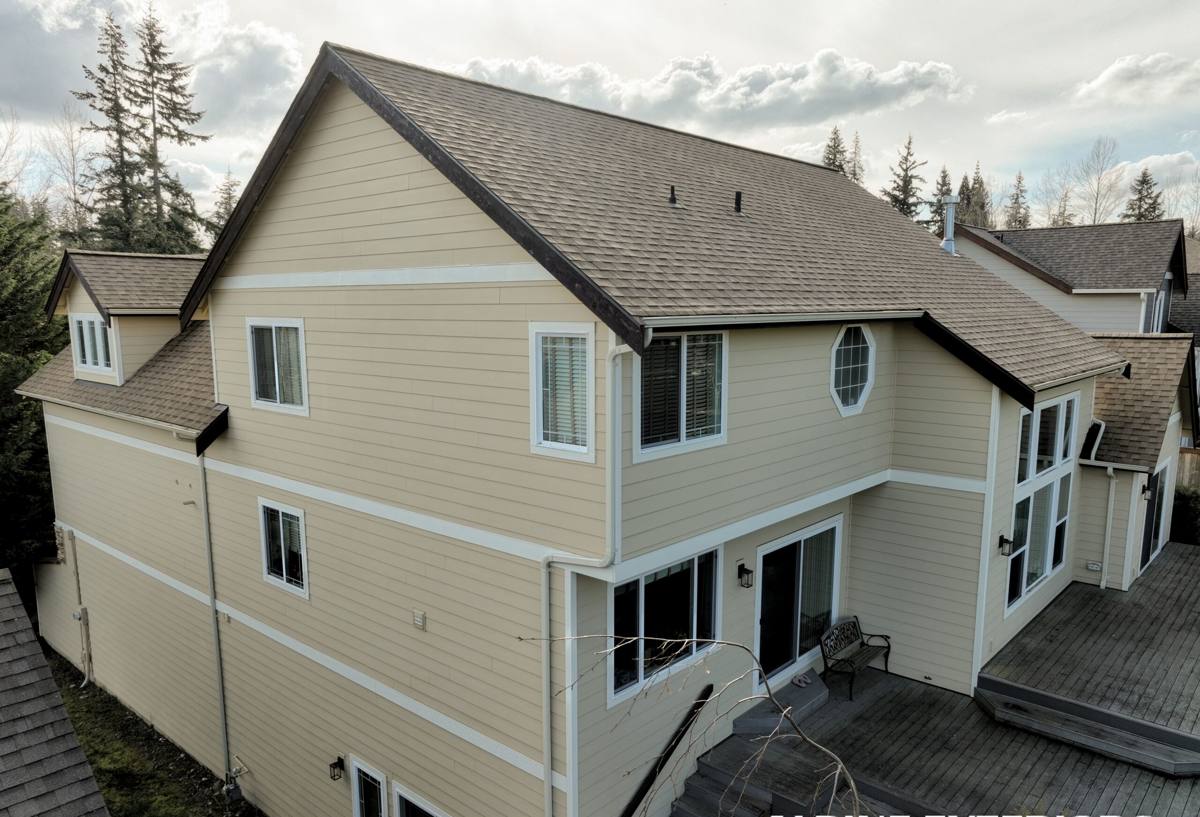
What Blaine's Coastal Climate Does to a Deck Over Time
Salt Air and Metal Fatigue
Being close to the water means airborne salt settles on every exposed surface, including deck hardware. Standard galvanized fasteners and connectors that would last decades elsewhere can start corroding within a handful of years out here. Once a joist hanger or ledger bolt weakens, it's not a cosmetic issue — it's a structural one, and it's usually hidden under the decking where you can't see it happening.
Driving Rain and Water Intrusion
Rain in this part of Washington often comes in sideways with the wind, which means water gets pushed into places a straight-down rain never would — behind ledger boards, under railing posts, into end-grain cuts that weren't sealed. Over time this leads to rot in the framing long before the visible decking looks bad.
Moss, Algae, and Surface Breakdown
Custer gets extended stretches of damp, shaded, low-sun conditions, especially in fall and winter. That's exactly what moss and algae need to take hold. Beyond being slippery and unattractive, moss holds moisture against the decking surface, which accelerates rot in wood and can degrade the surface layer of some composite products if it's never cleaned off.
Signs Your Custer Deck Needs Replacement, Not Repair
- Soft, spongy, or springy spots anywhere in the decking surface
- Visible gaps, cracking, or splitting concentrated where boards meet the ledger or joists
- Rust staining running down from screws or nail heads
- Railing posts that wiggle or have any lateral movement
- Persistent moss or dark staining that returns within weeks of cleaning
- A ledger board connection you can't confirm is properly flashed
- Structural framing you can see is undersized, spaced too far apart, or shows rot when probed with a screwdriver
Some of these can be addressed with targeted repair. But when framing rot, hardware corrosion, and surface failure show up together — which is common on decks in this area once they hit 15-20 years — patchwork repair usually costs more over a few years than a proper replacement would have cost up front.
What a Correct Deck Replacement Involves Here
Tear-Off and Structural Inspection
We remove the old decking and railing down to the framing and inspect every joist, beam, post, and the ledger connection to the house. This is the step that actually determines the scope of the job — you can't accurately quote a deck replacement without seeing what's underneath.
Ledger Flashing Done Properly
The ledger board — where the deck attaches to the house — is the single most common failure point on decks in wet coastal climates. It needs correct flashing that sheds water away from the house framing, not just caulk covering a gap. This detail matters more here than almost anywhere else in the build.
Corrosion-Resistant Fasteners and Hardware
Given the salt air, we use fasteners and structural connectors rated for coastal exposure rather than standard-grade galvanized hardware. It costs more upfront and it's the difference between hardware that lasts and hardware that's corroding again in five years.
Drainage and Airflow Underneath
Framing that can dry out between rain events lasts longer than framing that stays damp. We pay attention to grading underneath the deck, gaps between boards, and ventilation so moisture has somewhere to go instead of sitting against the wood.
Decking Material Selection
We'll walk you through wood versus composite for your specific situation — sun exposure, shade, budget, and how much maintenance you actually want to keep up with. Neither is universally "better"; they trade off differently in this climate.
Choosing a Decking Material for Coastal Whatcom County
| Material | Moss/Moisture Behavior | Maintenance | Typical Lifespan Here |
|---|---|---|---|
| Pressure-treated wood | Needs regular cleaning and re-sealing to resist moss and rot | Annual cleaning, periodic staining/sealing | 10-15 years with upkeep |
| Cedar | Naturally rot-resistant but still needs finish maintenance in wet climates | Regular cleaning, occasional refinishing | 15-20 years with upkeep |
| Composite decking | Resists rot; can still grow surface algae/moss in shaded, damp spots without cleaning | Periodic washing, no staining or sealing | 25-30 years, backed by manufacturer warranty |
Composite tends to hold up with less ongoing work in a climate like this, but it isn't maintenance-free — it still needs to be washed down periodically or moss will find it too. Wood costs less upfront but demands more consistent attention to actually reach its full lifespan out here. We'll give you an honest read on which fits your situation rather than pushing one product across the board.
Framing and Structural Considerations Specific to This Area
Whatcom County building codes set minimum requirements for footing depth, joist spacing, and railing height, and those minimums matter more in a wet climate because the margin for error shrinks as materials age. We frame decks to hold up to the moisture load this area sees, not just to pass inspection on day one. That includes proper post-to-footing connections, joist hangers rated for the exposure, and beam sizing that accounts for real-world load, not just the minimum span table.
If your existing deck was built without a permit or without proper footings — which shows up more often than you'd expect on older Custer properties — a full replacement is also the chance to correct that and have something that's actually built to code.
Why a Crew That Already Works Custer Makes a Difference
Deck replacement isn't a one-size-fits-all trade. A crew that works this specific area regularly already knows which fastener grades hold up against the salt air, how local inspectors want ledger flashing detailed, and which decking products actually perform through a Whatcom County winter versus which ones look good on a showroom sample. That's knowledge you build from doing the work here repeatedly, not from a general contracting background somewhere drier.
We're a Blaine-based crew, and Custer is inside our regular service area — not a stretch job we take occasionally. That means faster scheduling, a realistic sense of what your specific property's exposure and drainage situation calls for, and a crew that's already accountable to a reputation in this community.
Our Process, Start to Finish
- On-site assessment — we inspect the existing deck, framing, and ledger connection, and talk through what you actually need versus want
- Honest scope and estimate — a written quote that reflects what we found underneath, not a guess based on square footage alone
- Material selection — we walk you through wood versus composite options with real trade-offs for your sun exposure and budget
- Tear-off and structural correction — old decking removed, framing repaired or replaced, ledger flashing done correctly
- Installation — decking, railing, and stairs installed to code with coastal-rated hardware throughout
- Final walkthrough — we go over the finished deck with you before calling the job done
Cost Factors to Expect
Deck replacement costs vary based on square footage, framing condition, decking material, railing style, and whether stairs or multiple levels are involved. A straightforward wood deck replacement typically costs less upfront than a composite deck of the same size, but the composite option usually costs less over its full lifespan once you factor in staining, sealing, and repair. We'll break down the real numbers for your specific deck during the estimate rather than quoting off a generic price-per-square-foot number that doesn't account for what condition your framing is actually in.
If you're in Custer and your deck is showing its age, we're glad to take a look. Reach out for a free, no-pressure estimate through the form below — we'll give you a straight assessment of what your deck needs and what it'll cost to do it right.