 Blaine Siding
 Custer Homes Take a Different Kind of Beating Than You'd Think
Custer doesn't get talked about the way waterfront Blaine does, but the homes out here deal with the same three-part climate problem: salt-laden air moving in off the Strait, driving rain that comes in sideways more often than straight down, and a moss season that seems to start earlier and last longer every year. Add in the open exposure you get on a lot of Custer's rural and semi-rural properties — bigger parcels, fewer windbreaks, more direct wind and rain contact on at least one or two walls of the house — and siding here tends to show wear in specific, predictable places. Not everywhere. Specific places.
That's actually good news if you're trying to figure out what's wrong with your siding and what it'll take to fix it. Siding failure in this area isn't random. It follows the weather. Once you know what to look for, a repair can be diagnosed accurately instead of guessed at.
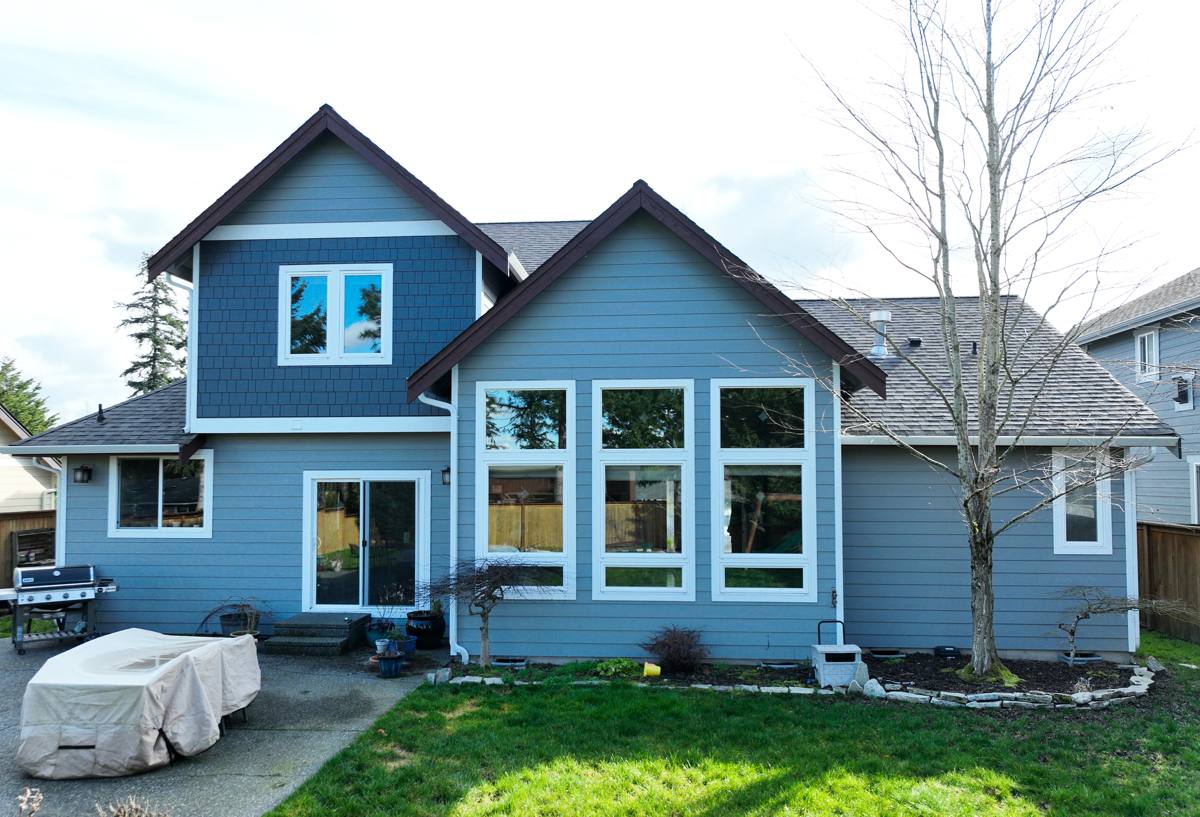
How Salt Air, Rain, and Moss Actually Damage Siding
Salt air and fasteners
Salt-carrying air doesn't just sit on the surface of your siding — it works on the metal that holds it up. Nails, staples, and trim fasteners that aren't corrosion-resistant start to weaken years before anyone notices a problem, and the first visible sign is often small, rust-colored streaks bleeding down from nail heads or seams. By the time you see the streak, the fastener underneath has usually been corroding for a while.
Driving rain and wind-driven moisture
Whatcom County rain rarely falls straight down for long. Wind pushes it sideways, which means it finds its way into laps, seams, and butt joints that were never designed to handle water hitting them at an angle. Over time, water gets behind the siding rather than running off the face of it — and that's where the real damage happens, out of sight, in the sheathing and framing behind the cladding.
Moss, shade, and trapped moisture
North-facing walls, siding under eaves, and anything shaded by trees or a neighboring structure holds moisture longer after every rain. That's exactly where moss and algae take hold. Moss isn't just cosmetic — it holds water against the siding surface for days after everything else has dried out, which accelerates rot in wood-based products and breaks down caulking and sealant joints faster than direct sun exposure ever would.
What a Correct Siding Repair Actually Involves
It starts behind the siding, not on top of it
A repair that only addresses what's visible from the driveway is a cosmetic fix, not a real one. Any legitimate siding repair starts with removing the damaged section and checking what's underneath it — the house wrap or building paper, the sheathing, and in worse cases the framing itself. If there's been water intrusion for any length of time, that's where you'll find soft spots, staining, or actual rot, and none of that gets fixed by simply screwing a new board over the top.
Matching materials the right way
Repairs also have to match what's already on the house — in profile, exposure width, and finish — or the patch will be obvious from the street and the mismatch itself becomes a place for water to collect. This is straightforward when the existing siding is James Hardie fiber cement, since factory-matched boards and ColorPlus finishes are made to be consistent from batch to batch. It gets harder, fast, when the existing siding is vinyl, cedar, primed spruce, or LP SmartSide that's faded, warped, or discontinued, because an exact match may not exist anymore.
Repairing Hardie Siding vs. Repairing Everything Else
We install James Hardie fiber cement exclusively, which shapes how we approach every repair call — including on homes where we didn't do the original install.
If your home already has Hardie siding
This is usually the more straightforward repair. Fiber cement doesn't rot, and it doesn't attract moss growth the way bare wood does, so damage is more often isolated impact damage, a failed caulk joint, or a fastener issue rather than widespread material breakdown. We can typically pull the damaged board, replace it with a factory-matched piece, and either blend it into the existing ColorPlus finish or repaint the affected section depending on the age of the siding and how well the color has held.
If your home has vinyl, wood, LP, or another siding
We'll still repair it honestly where a repair makes sense — a cracked panel, a section of trim, a localized rot spot caught early. What we won't do is pretend a patch is a long-term fix when the underlying material itself is the problem. Vinyl becomes brittle and hard to match after years of sun and salt exposure. Cedar and primed spruce that have taken on moisture damage in one spot are frequently telling you the whole wall is on the same timeline. LP SmartSide relies on factory-sealed edges staying intact, and once those edges are compromised by cutting, impact, or age, moisture tends to travel further than the visible damage suggests. In those cases we'll tell you straight — repair this section now, but plan for replacement, rather than sink repair costs into a wall that's going to keep giving you trouble every wet season.
Our Siding Repair Process
- Inspection. We walk the exterior, focusing first on the sides and corners that take the most wind-driven rain, plus any shaded or north-facing walls prone to moss.
- Diagnosis behind the surface. Where damage looks like more than surface-level, we open it up to check sheathing and framing condition before quoting anything.
- Honest scope. You get a clear explanation of what's isolated damage versus what's a sign of a bigger issue, and what each option costs and involves.
- Material sourcing and matching. For Hardie repairs, we match board profile, exposure, and finish. For other siding types, we source the closest available match and tell you upfront if an exact match isn't realistic.
- Repair, seal, and finish. Damaged sections are replaced, flashing and moisture barriers are corrected where needed, joints are properly sealed, and finish work is blended to the surrounding siding.
- Final walkthrough. We show you what was found, what was fixed, and flag anything worth keeping an eye on going forward.
Repair or Replace? A Straight Answer
Not every siding problem needs a full replacement, and not every problem should be patched. Here's how we think through it:
| Situation | Repair usually makes sense | Replacement usually makes sense |
|---|---|---|
| Damage extent | Isolated to one or two boards or a small section | Recurring damage across multiple walls or elevations |
| Siding age | Siding is well within its expected service life | Siding is near or past the age where the material typically starts breaking down |
| Material match | Matching boards/finish are readily available | Product is discontinued, faded beyond match, or a different generation of the same line |
| Moisture history | Water intrusion caught early, sheathing intact | Sheathing or framing already shows rot or long-term water damage |
| Underlying material | Fiber cement or otherwise inherently water- and moss-resistant | Wood-based or vinyl siding already showing age-related material fatigue |
Signs a Custer Home Should Get a Siding Repair Inspection
- Rust-colored streaks running down from nail heads, seams, or trim
- Moss or dark green/black staining that keeps coming back after cleaning
- Soft, spongy, or slightly bowed-looking sections of siding
- Cracked, warped, or separated boards, especially on walls that take the most wind and rain
- Caulk joints that are cracked, shrunken, or pulling away from trim
- Peeling or bubbling paint/finish, particularly on shaded or north-facing walls
- Visible gaps at butt joints, corners, or around windows and doors
- A musty smell or interior wall staining on the corresponding interior side
Why It Matters to Hire a Crew That Already Works in Custer
A lot of siding damage in this area is diagnosed wrong by crews that don't work here regularly, because the symptoms can look similar even when the causes are different. Streaking that looks like a fastener problem might actually be a flashing problem. Moss that looks cosmetic might be sitting on top of a moisture pocket that's been building for two seasons. A crew that repairs siding across Whatcom County's mix of rural, semi-rural, and coastal-adjacent properties has already seen how salt air, driving rain, and moss season play out on a given wall orientation, lot layout, and construction era — and that experience shortens the distance between "something looks off" and an accurate, honestly scoped repair.
It also matters for the work itself. Correct flashing details, the right fastener choice for a salt-air environment, and finish work that actually blends into existing siding are things you get right more consistently when you've done them repeatedly in this specific climate, not occasionally in a milder one.
If you're seeing streaking, moss buildup, soft spots, or open joints on your Custer home's siding, we're happy to take a look and give you a straight answer on what's actually going on — no pressure, no upsell, just an honest assessment and a free estimate for whatever the right fix turns out to be.