 Blaine Siding
 Ferndale's Climate Asks More of Your Siding Than People Realize
Ferndale sits in that stretch of Whatcom County where three things stack on top of each other all at once: proximity to salt water, heavy driving rain off the water, and a long, damp shoulder season that keeps moss and algae growing for months. Any one of those on its own is manageable. Together, they wear through cheap or poorly installed siding a lot faster than most homeowners expect.
Salt-laden air corrodes exposed fasteners and metal trim over time. Wind-driven rain doesn't just fall straight down — it gets pushed sideways into laps, corners, and butt joints, which means siding here needs to shed water actively, not just sit there and hope gravity does the work. And the region's long stretch of overcast, wet weather from fall through spring gives moss and algae exactly the conditions they need: shade, moisture, and time. Put all three together and you get a climate that's genuinely tougher on exterior materials than a lot of the country deals with.
What This Means for a Ferndale Home Specifically
Homes here — whether close to town, out toward the water, or tucked under tree cover — deal with siding problems that show up as moisture intrusion behind the cladding, paint and finish breakdown from constant damp cycling, and green-black staining on north-facing walls and anything shaded by trees or fencing. None of that is unusual for this part of Whatcom County. It's just what the climate does to a wall that isn't built to handle it.
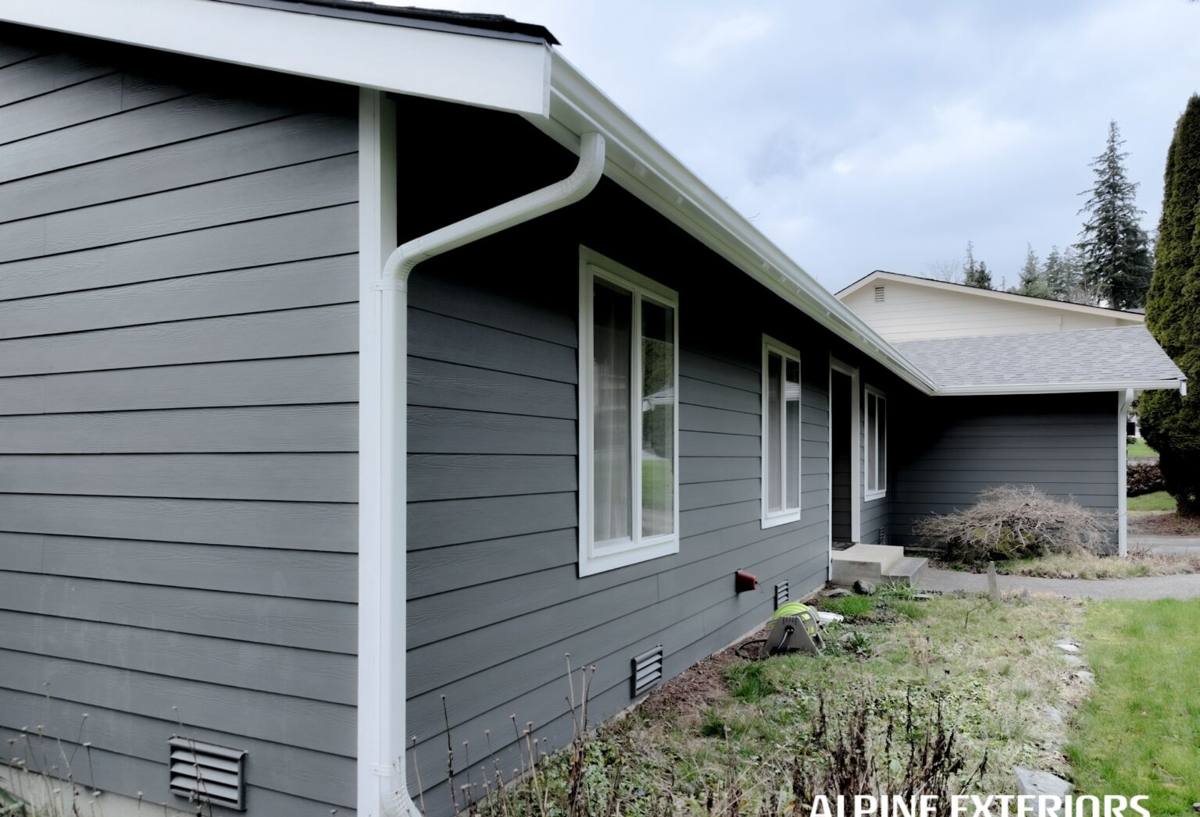
Why Fiber Cement Is the Right Material for This Climate
Fiber cement siding is made from cement, sand, and cellulose fibers, pressed and cured into a dense, stable board. That composition matters here for a few specific reasons. It doesn't rot when it stays damp, it doesn't swell and shrink the way wood does with every wet-dry cycle, and it holds a factory-applied finish far longer than field-painted materials because the coating is baked on under controlled conditions rather than brushed on outdoors.
We install James Hardie fiber cement exclusively — not as a marketing preference, but because it's engineered specifically for climates like this one. Hardie makes region-specific product lines (HZ5 and HZ10) built around exactly the moisture and temperature patterns the Pacific Northwest sees, and the ColorPlus factory finish is designed to resist fading and moisture damage in a way that on-site painted finishes generally can't match over the same number of years.
What It Doesn't Solve on Its Own
Fiber cement isn't magic. It's a material, not an installation. A great board installed with the wrong flashing details, tight-butted joints, or no drainage gap behind it will still trap moisture and fail early — just more slowly than a lesser material would. That's why the install matters as much as the product, which is the next thing worth getting right.
What a Correct Installation Requires Here
In a climate with driving rain and salt exposure, the details that get skipped on a rushed job are exactly the details that determine whether siding lasts fifteen years or fifty. A correct fiber cement install in this area includes:
- A drainage plane (weather-resistant barrier plus a rainscreen gap) that lets any moisture that gets behind the siding drain and dry out, instead of sitting against the sheathing
- Corrosion-resistant fasteners and flashing — stainless or hot-dip galvanized where salt exposure is a factor, not standard-grade hardware that starts staining and weakening within a few seasons
- Proper clearance at the bottom of the siding above grade, decks, and roof lines, so splash-back and standing water don't sit against the board edge
- Correctly lapped and sealed joints, with factory-cut edges caulked or capped per manufacturer spec rather than left as raw cut edges exposed to weather
- Manufacturer-specified fastener patterns and nailing lines, which affect both wind performance and how the board handles expansion and contraction
Skip any one of these and you can end up with a wall that looks fine for a few years and then starts showing problems right at the seams — which is usually where a rushed install cut corners in the first place.
Fiber Cement vs. Other Siding Options for a Ferndale Home
Homeowners comparing options usually land on the same short list. Here's how they actually perform against the specific conditions Ferndale deals with:
| Material | Salt air exposure | Driving rain / moisture | Moss and algae resistance | Long-term finish |
|---|---|---|---|---|
| James Hardie fiber cement | Strong — non-corrosive board, factory finish holds up | Strong when installed with proper drainage detailing | Good; factory finish resists staining better than field-painted wood | Factory-cured ColorPlus finish, backed by a strong warranty |
| Vinyl siding | Adequate, but can become brittle and fade faster in coastal UV/salt conditions | Weak seams and laps under wind-driven rain; prone to water tracking behind panels | Fair; smooth surface sheds spores but seams trap moisture | Color is baked into the material but fades and chalks over time; not repaintable in practice |
| Cedar or primed wood | Poor without constant maintenance; salt accelerates weathering | Weak; wood absorbs moisture and moves seasonally, opening joints | Poor; organic material is a food source for moss and mildew | Requires repainting/staining on a recurring cycle to hold up |
| LP SmartSide (engineered wood) | Fair; treated but still wood-based at the core | Fair; edge and cut-end sealing is critical and easy to miss in the field | Fair; better than raw wood but still an organic substrate | Field or factory finish depending on product; edge exposure is the common failure point |
This is also why we don't install vinyl, LP SmartSide, or bare wood siding as a matter of company policy. Each of those products has real strengths, but none of them hold up against this specific combination of salt air, wind-driven rain, and a long moss season as consistently as properly installed fiber cement does — and we'd rather stand behind one system we trust completely than offer several we have reservations about.
The James Hardie Product Lines We Use
Hardie builds different formulations for different climate zones, which is part of why we standardized on the brand instead of a generic fiber cement product. For Whatcom County, that generally means the HZ5 product line, engineered for regions with freeze-thaw cycling and sustained moisture exposure — which describes this part of Washington accurately.
Board Options
Most Ferndale-area homes end up choosing between HardiePlank lap siding (the traditional horizontal look), HardieShingle for a cedar-shake appearance without the maintenance, or HardiePanel for vertical board-and-batten sections and accent walls. All three come in the same ColorPlus factory-finish system, so mixing them on one home for architectural interest doesn't mean mixing finish quality.
Our Process for a Ferndale Fiber Cement Project
We approach every siding replacement here the same way, regardless of how big or small the job is:
- On-site assessment. We look at the existing siding, the condition of the sheathing underneath, sun and wind exposure, tree cover, and proximity to water — all of which affect product choice and detailing.
- Moisture check. Before anything gets covered up, we check for existing water damage or rot in the wall assembly. Siding installed over a compromised wall just hides the problem.
- Product and color selection. We walk through board profile, texture, and ColorPlus color options based on the home's style and exposure.
- Installation to spec. Drainage plane, correct fasteners, proper clearances, and manufacturer-spec joint treatment — no shortcuts on the details that determine how the wall performs in ten years, not just how it looks on day one.
- Final walkthrough. We review the finished work with the homeowner before considering the job done.
Living With Fiber Cement Siding Through a Moss Season
Fiber cement holds up far better against moss and algae than wood, but no exterior surface in this region is completely maintenance-free. A little seasonal attention keeps a Hardie installation looking the way it should for the long haul:
- Rinse shaded, north-facing, or tree-covered walls once or twice a year to keep spores from getting a foothold
- Keep gutters clear so overflow doesn't run down the siding face and stay wet longer than it should
- Trim back vegetation and branches that shade the siding and keep it damp
- Check caulking at trim and joints periodically — caulk wears out well before the board does
- Address any impact damage or chipped finish promptly so moisture can't get into the exposed core
None of this is heavy maintenance. It's the difference between a wall that looks the same in twenty years and one that starts showing streaking and staining after five.
Why It Matters That We Already Work This Area
Siding details that work fine in a dry inland climate can fall short a few miles from the water. A crew that installs across a lot of different regions may default to generic details that meet code but aren't tuned to what Whatcom County actually throws at a wall. Working consistently in and around Ferndale and Blaine means we're not guessing at how much wind-driven rain a given wall orientation sees, or which walls will fight moss the hardest — we've seen it, and we detail accordingly, from fastener selection to drainage planning.
If you're weighing a siding replacement or repair on a Ferndale-area home, we're happy to walk the property, look at what's actually going on with your current siding, and put together a straightforward, no-pressure estimate. There's no obligation — just an honest look at what your home needs.