 Blaine Siding
 Ferndale Roofs Work Harder Than the Shingle Wrapper Admits
Every asphalt shingle sold in the Pacific Northwest carries a warranty written for average American weather. Ferndale doesn't get average weather. Sitting near the water in Whatcom County, homes here deal with a near-constant flow of moisture-laden air, wind-driven rain that doesn't fall straight down, and a moss season that can run eight months or longer in shaded, north-facing sections of a roof. None of that shows up on a manufacturer's spec sheet, but it shows up on your roof.
A roof that would last three decades in a dry inland climate can start failing in half that time here if it was installed without accounting for these conditions. That's not a knock on any particular shingle brand — it's just physics. Salt-laden air accelerates corrosion on exposed metal fasteners and flashing. Sustained dampness feeds moss and algae growth on anything with texture for it to grip. And driving rain finds every shortcut a crew took around a valley, a chimney, or a vent pipe. Good roof installation in this area isn't about buying a better product off the shelf — it's about installing the right product correctly for the conditions it will actually face.
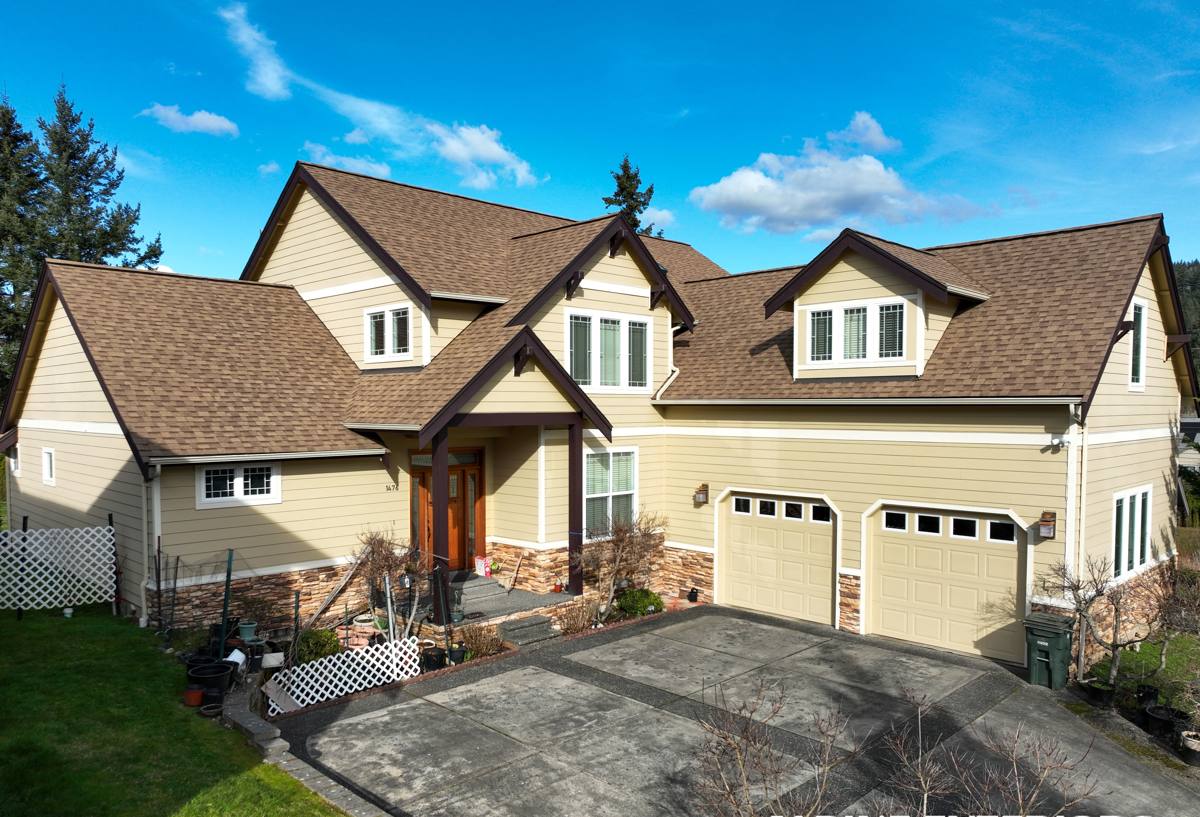
Signs Your Ferndale Roof Needs Replacement, Not Another Patch
Homeowners often call us for a repair and end up needing a conversation about full replacement instead. Here's what typically tips that decision:
- Granule loss heavy enough that you're finding sand-like grit in gutters or at downspout outlets
- Shingles that are cupping, curling at the edges, or cracking when you walk the roofline from a ladder
- Moss established in mats rather than a light surface film, especially on north-facing slopes
- Soft or spongy decking felt underfoot during an inspection, indicating moisture has reached the sheathing
- Daylight visible through the roof deck from inside the attic, or water staining on rafters
- Multiple past repairs in different areas within the last few years, suggesting the whole system is aging out together
- A roof already past 20-25 years old in this climate, even if it looks fine from the ground
One or two of these can often be addressed with targeted repair. Several at once usually means the roof system as a whole is past the point where patching makes financial sense.
What a Correct Installation Actually Involves
Tear-Off and Deck Inspection
We don't install new roofing over old. A full tear-off is the only way to actually see the deck — the plywood or board sheathing underneath everything else — and confirm it's sound. In a climate like this, hidden rot at a valley, around a skylight curb, or along an eave is common enough that skipping this step is how "new roofs" end up leaking within a year or two. Any soft or delaminated sheathing gets replaced before anything new goes down.
Underlayment and Water Protection
The underlayment is arguably more important than the shingle itself in a wet climate, because it's the layer that actually keeps water out if wind drives rain up under the shingle tabs. We use synthetic underlayment across the field and self-adhering ice-and-water membrane at the vulnerable spots — eaves, valleys, and around every penetration — where wind-driven rain and ice damming are most likely to force water backward under the roof covering.
Flashing Details
Flashing is where most roof leaks actually originate, not in the field of the shingles. Chimneys, sidewalls, skylights, and vent pipes all need properly formed, corrosion-resistant flashing installed in the correct sequence with the underlayment and shingles — not caulked over as an afterthought. Given the salt air near the coast, we pay close attention to the flashing metal itself, favoring materials that resist corrosion rather than painted steel that can start rusting at cut edges within a few seasons.
Ventilation
A roof deck that can't breathe traps moisture from inside the house, which speeds up rot from below at the same time salt air and rain are working on it from above. Balanced intake and exhaust ventilation is part of a correct installation, not an upgrade — it protects the deck, extends shingle life, and helps control attic condensation that's common in our damp winters.
Roofing Materials for Whatcom County's Coastal Conditions
There's no single "best" roofing material for every Ferndale home — it depends on your roof's exposure, slope, budget, and how much maintenance you're willing to keep up with. Here's how the common options compare for this specific climate:
| Material | Moss/Algae Resistance | Salt Air Durability | Typical Maintenance |
|---|---|---|---|
| Standard 3-tab asphalt shingle | Low — textured surface holds moisture and debris | Moderate; fasteners are the weak point | Regular moss treatment and gutter clearing |
| Architectural (laminate) asphalt shingle | Moderate, better with algae-resistant granules | Good with corrosion-resistant fasteners and flashing | Periodic moss treatment, less frequent than 3-tab |
| Standing seam metal | High — smooth surface sheds moisture, little for moss to grip | Good to excellent with proper coated/coastal-rated panels | Low; occasional debris clearing |
| Cedar shake | Low without diligent upkeep — natural material feeds moss and moisture retention | Requires careful fastener selection; can be sensitive to sustained dampness | High; regular treatment and inspection needed |
Most of the homes we re-roof in this area land on an algae-resistant architectural shingle or standing seam metal. Both give a good balance of upfront cost, appearance, and realistic maintenance for a climate that never really dries out for long. We're honest about the trade-offs of each option, including the ones we don't push — cedar shake looks great on the right home, but we tell customers plainly that in a persistently damp environment it demands more upkeep than most people expect to sign up for, not because the material is bad, but because moss season here is long.
Our Installation Process, Start to Finish
- On-site assessment — we walk the roof, check the attic, and look at drainage, slope, and shade exposure before recommending anything.
- Written estimate — clear scope, materials, and pricing, no vague allowances buried in fine print.
- Material delivery and site protection — landscaping, siding, and gutters get protected before tear-off begins.
- Full tear-off — old roofing removed down to the deck, with disposal handled as part of the job.
- Deck repair — any compromised sheathing is replaced and documented before covering it back up.
- Underlayment and flashing installation — ice-and-water membrane at vulnerable areas, synthetic underlayment across the field, new flashing at every penetration and edge.
- Ventilation check — intake and exhaust venting confirmed or upgraded to code-appropriate levels.
- Roofing material installation — installed to manufacturer specification, which is what keeps the warranty valid.
- Final walkthrough — cleanup, magnetic sweep for stray fasteners, and a review of the finished roof with the homeowner.
Moss, Algae, and the Long Wet Season
Moss doesn't just look bad — it holds moisture against the roofing material, works into shingle edges, and can lift them enough for wind-driven rain to get underneath. In Ferndale, north-facing slopes and roofs shaded by trees see the heaviest growth, often starting again within a year of a full cleaning if the roof design doesn't help itself. Zinc or copper strips near the ridge, proper attic ventilation, and keeping overhanging branches trimmed back all reduce how aggressively moss returns. We factor moss exposure into the material and detail recommendations for every Ferndale roof rather than treating it as an afterthought once it's already a problem.
What Drives the Cost of a Ferndale Roof Replacement
Every roof is priced on its own specifics, but a few factors consistently move the number up or down:
| Cost Factor | Why It Matters |
|---|---|
| Roof size and number of stories | More area and harder access mean more material and labor time |
| Roof pitch and complexity | Steep roofs and multiple valleys/dormers take longer and need more flashing detail |
| Deck condition | Hidden rot found during tear-off adds material and labor to replace sheathing |
| Material choice | Standard architectural shingle, premium shingle, and metal all carry different material costs |
| Layers of existing roofing | Removing multiple old layers takes more labor and disposal cost than one |
We give real numbers after we've actually looked at your roof, not a phone estimate based on square footage alone — too much of the cost depends on what we find once tear-off starts.
Why a Crew That Already Works Ferndale Matters
A roofing crew based out of the area understands things that don't show up in a generic install guide: which slopes in Ferndale tend to hold moss longest, how the local wind pattern off the water drives rain into valleys and sidewalls, and what permitting looks like in Whatcom County. That familiarity shows up in the details — where we add extra ice-and-water protection, which flashing metal we specify near the coast, and how we set ventilation for a house that sits in near-constant marine air. It also means we're a known, findable crew if a warranty question or a storm-related concern comes up years down the road, not a name that only showed up for one job.
If your roof is showing its age or you just want an honest read on what shape it's really in, we're glad to come take a look. The estimate is free, there's no pressure attached to it, and you'll get a straight answer either way — use the form below to get in touch.