 Blaine Siding
 Ferndale's Climate Is Harder on Siding Than It Looks
Ferndale sits close enough to the water and the marine weather patterns that move through Whatcom County that homeowners here deal with a specific combination of stresses most siding products were never really engineered for: salt-laden air, long stretches of driving rain, and a moss season that can run most of the year in shaded or north-facing spots. None of these alone is unusual for western Washington. Together, over years, they're what determines whether a siding job still looks good at year fifteen or has already started failing.
Salt air accelerates corrosion on fasteners, trim, and any metal flashing that isn't properly protected. Driving rain — rain that hits siding at an angle instead of falling straight down — pushes water into laps, seams, and butt joints that a fair-weather installation might get away with ignoring. And moss doesn't just look bad; it holds moisture against the siding surface far longer than open air would, which is exactly the condition that rots wood-based products and stains or degrades lower-grade siding finishes.
This is the environment we're installing into every time we work in Ferndale, and it shapes real decisions about product, detailing, and sequencing — not just which color to pick.
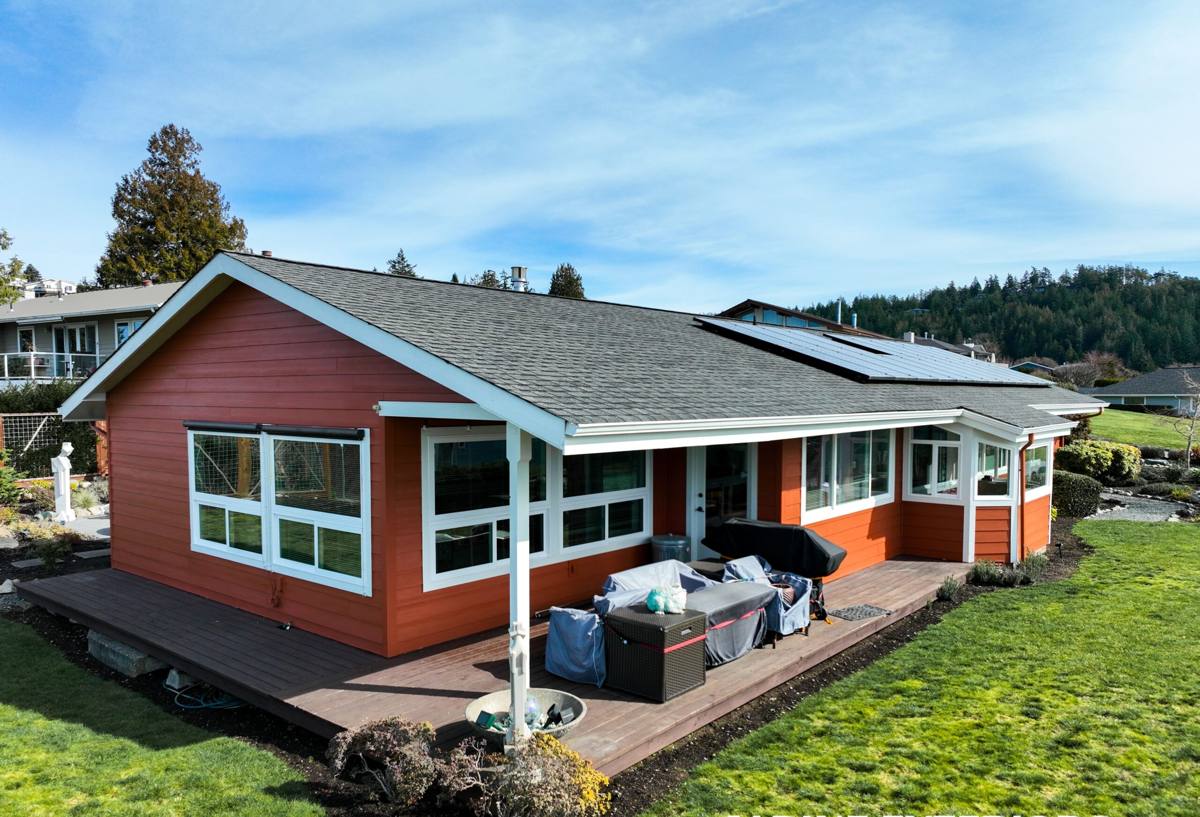
Why We Only Install James Hardie Fiber Cement Here
We install James Hardie siding exclusively. We don't offer vinyl, LP SmartSide, Cemplank, Allura, or primed wood siding, and that's a deliberate standard, not a limitation of what we're capable of installing. Each of those products has legitimate strengths, but in a climate like Ferndale's, the trade-offs — moisture sensitivity in engineered wood products, expansion and fading in vinyl, thinner factory finishes on some competing fiber cement lines — are the kind of thing that shows up as a callback five or ten years down the road, not on installation day.
James Hardie fiber cement is made from cement, sand, and cellulose fiber. It doesn't absorb water the way wood-based sidings can, it won't support combustion, and it holds paint and factory finish far longer than wood products because the substrate itself is dimensionally stable. That stability matters more in a wet coastal climate than almost anywhere else in the country.
Built for the Pacific Northwest Specifically
James Hardie engineers its siding by climate zone under what it calls the HZ5 formulation for the Pacific Northwest and other wetter, more humid regions. It's formulated to resist moisture-related damage in exactly the conditions Ferndale sees for a good chunk of the year — sustained dampness, temperature swings, and long non-drying periods under cloud cover. We spec HZ5 product on Ferndale jobs because it's the version of Hardie's siding actually built for this weather, not a generic national product.
ColorPlus factory finish is the other piece of that equation. It's baked on at the factory in multiple coats under controlled conditions, which gives noticeably better fade and chip resistance than field-applied paint — a real advantage when a house is going to spend years absorbing salt air and UV without much of a break.
What a Correct Installation Involves
Hardie siding performs the way it's supposed to only when it's installed to the manufacturer's specification. A rushed or generic install on fiber cement can trap moisture behind the siding just as easily as a poor install on any other product — the material being water-resistant doesn't fix bad detailing underneath it. In a rainy, salt-air climate, the installation details matter as much as the product choice.
- Weather-resistant barrier and drainage plane — a properly lapped house wrap, with a drainage gap behind the siding so any moisture that does get past the cladding can drain and dry out instead of sitting against the sheathing.
- Correct fastener type, spacing, and penetration depth — corrosion-resistant fasteners driven to Hardie's spec, not overdriven or underdriven, which affects both water resistance and the siding's ability to expand and contract normally.
- Proper clearances — siding held up off roof lines, decks, and grade per Hardie's minimum clearances so splashback and standing water don't sit against the bottom edge.
- Flashing at every horizontal transition — window heads, trim boards, and butt joints all flashed so water is shed outward instead of channeled behind the siding.
- Factory-cut and factory-primed edges wherever possible — field cuts get sealed per spec, since an exposed cut edge is one of the few places fiber cement can take on water if left untreated.
Skipping any one of these doesn't usually cause a visible problem on day one. It shows up years later as staining, soft trim, or moisture damage at the sheathing — the kind of failure that's expensive to trace back to an installation shortcut.
Our Process on a Ferndale Job
- On-site assessment — we look at your home's current siding condition, exposure (which walls take the worst weather and moss growth), existing moisture or rot issues, and trim and flashing condition before quoting anything.
- Product and color selection — we walk you through Hardie's plank, shingle, and panel options and ColorPlus color range, and we'll tell you plainly if a particular style or color has known trade-offs for your home's exposure.
- Written estimate — a clear scope covering tear-off, any sheathing repair, house wrap, trim, and the siding install itself, with no vague allowances.
- Removal and substrate check — old siding comes off and we inspect the sheathing underneath before closing anything up, since covering existing rot or moisture damage is how small problems become big ones.
- Weather barrier, flashing, and install — installed to Hardie's published specifications, not a generalized "siding install" approach.
- Final walkthrough — we go over the finished work with you directly before calling the job done.
Comparing Siding Options for a Ferndale Home
| Factor | James Hardie Fiber Cement | Vinyl | Engineered Wood (LP SmartSide) |
|---|---|---|---|
| Moisture resistance in driving rain | Strong when installed with proper flashing and drainage | Moderate; can allow water intrusion at seams | Vulnerable at cut edges and joints if not maintained |
| Performance in long moss/damp seasons | Holds up well; doesn't absorb moisture | Doesn't rot, but traps moisture behind it | Higher risk of swelling or degrading if moisture sits against it |
| Finish longevity | Factory ColorPlus finish, long fade resistance | Color molded in, can fade and chalk over time | Field or factory paint, needs more frequent upkeep |
| Combustibility | Non-combustible | Combustible | Combustible |
| Typical maintenance | Occasional wash, periodic caulk/paint touch-up | Low, but cracks/warps with age and impact | Regular inspection and prompt repair of any moisture entry |
This isn't a claim that the other products are unusable — plenty of homes around the region have them. It's why, specifically for a wet, salt-exposed climate like this one, we've standardized on Hardie rather than offering a mix of products with different long-term risk profiles.
Why Hiring a Crew That Already Works in Ferndale Matters
Siding installation isn't identical everywhere. A crew that mostly works drier inland climates can install technically "correct" siding that still underperforms here, because the margin for error in flashing, drainage, and clearance details is smaller in a place that gets this much sustained rain and salt exposure. A crew that regularly works Whatcom County homes has already seen where moss builds up first, which wall orientations take the worst weather, and which shortcuts fail fastest in this specific climate — and adjusts the install accordingly instead of applying a one-size-fits-all approach.
Local, consistent work also means straightforward accountability. If a question comes up two years after installation, you're not trying to track down a crew that was passing through the region for a single job.
Maintenance: What Ferndale Homeowners Should Actually Do
Correctly installed James Hardie siding is low-maintenance, not no-maintenance. A little attention once or twice a year keeps it performing the way it's designed to in this climate.
- Rinse siding with a garden hose (not a pressure washer aimed at seams or edges) once or twice a year to clear salt residue, pollen, and grime before they build up.
- Keep an eye on shaded, north-facing, or tree-covered walls where moss and algae tend to establish first, and treat growth early rather than letting it sit for a season.
- Trim back vegetation and keep gutters clear so water is directed away from the siding instead of running down it or splashing back onto lower courses.
- Check caulking at trim joints, window edges, and penetrations annually — caulk is a maintenance item on any siding system, including Hardie.
- Watch for soft spots, staining, or bubbling paint at the bottom courses near grade or decks, which usually points to a clearance or drainage issue worth having looked at.
Signs Your Current Siding Is Losing the Fight
Homeowners often wait longer than they should before replacing failing siding, partly because the damage isn't always obvious from the street. A few signs worth taking seriously:
- Persistent moss or dark streaking that comes right back after cleaning, especially on shaded walls.
- Soft, spongy, or crumbling siding when pressed, particularly near the bottom edges or around windows.
- Paint that's peeling or bubbling rather than just fading — often a sign of moisture trapped underneath.
- Visible warping, buckling, or gaps opening up at seams and corners.
- A musty smell or interior staining near exterior walls, which can indicate moisture has already worked its way past the siding.
If you're seeing any of these, it's worth having the siding and the sheathing behind it looked at before deciding on a repair-versus-replace approach.
Get a Straightforward Estimate
If you're weighing a siding replacement on a Ferndale home, we're happy to come take a look, walk you through what we're seeing, and put together a clear, no-pressure estimate for a James Hardie install built for this climate. There's no obligation — just an honest read on your home's siding and what it would take to get it right.