 Blaine Siding
 Roofing an Exclave: Why Point Roberts Is Its Own Case
Point Roberts sits at the tip of a peninsula that dips south from Tsawwassen, British Columbia, cut off from the rest of Whatcom County by water and from the rest of the U.S. mainland by a stretch of Canadian soil. That geography isn't just a curiosity — it shapes how a roof gets built and maintained out there. Every bundle of shingles, roll of underlayment, and box of nails either crosses the border or comes in by boat. A roofing job in Point Roberts has to be planned differently than one three miles away in Blaine proper, and a crew that hasn't done it before will learn that the hard way, usually on your schedule and your dime.
Add to that a climate that sits directly in the path of wind off Boundary Bay and the Strait of Georgia, with salt-laden air, driving winter rain, and a moss season that runs longer here than almost anywhere else in Whatcom County, and you've got a roofing environment that punishes shortcuts. This page is about one thing done right for one place: asphalt shingle roofing, built for what Point Roberts actually throws at it.
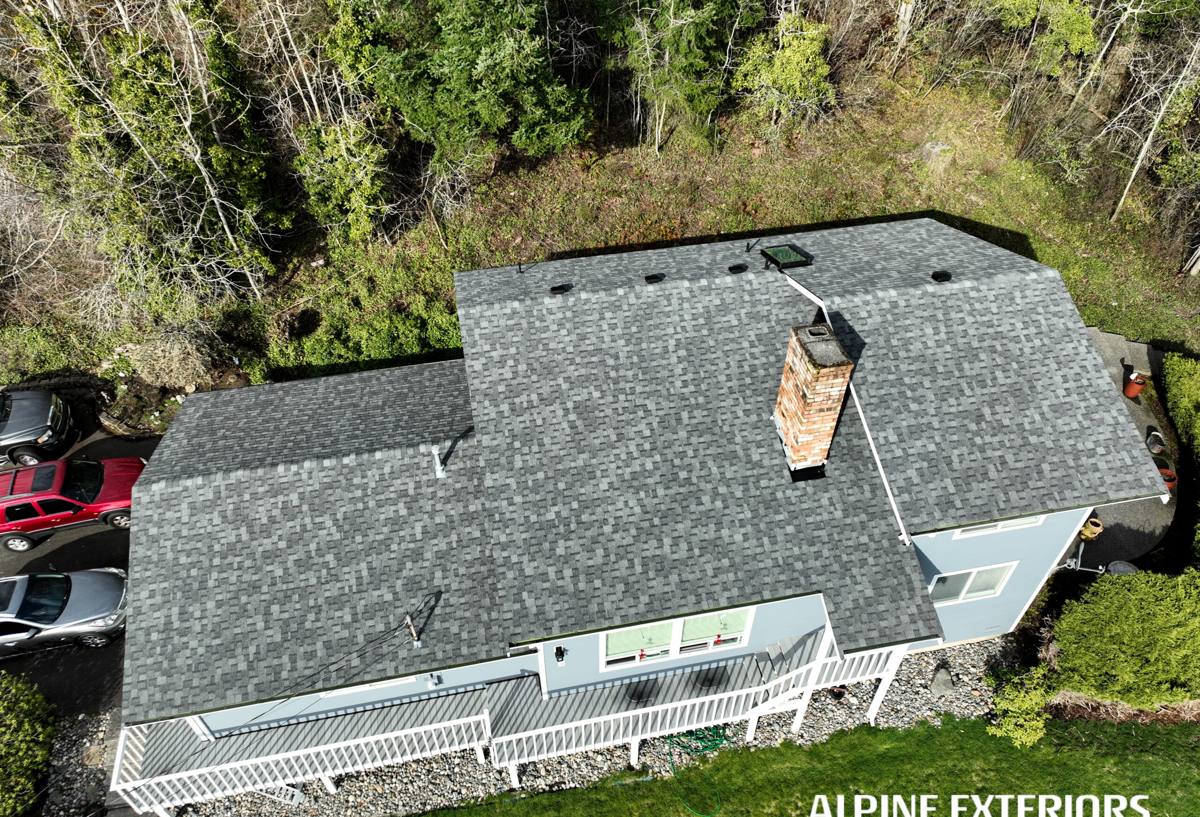
What Salt Air, Wind, and Rain Actually Do to a Shingle Roof
Salt Air and Metal Components
Asphalt shingles themselves tolerate salt air reasonably well, but the metal that holds a roof together does not. Nails, drip edge, flashing, and vent stacks that aren't rated for coastal exposure corrode faster here than they would even a few miles inland. Once fasteners start to weaken or flashing starts to pit, leaks follow — often at the exact seams a homeowner never thinks to check.
Wind-Driven Rain
Point Roberts is exposed on multiple sides to open water, which means wind doesn't just blow rain down onto a roof — it drives it sideways and up under shingle tabs, especially at eaves, rakes, and any point where the roof plane changes. A shingle system that isn't sealed and fastened for wind uplift will eventually let water find a way in, even on a roof that looks fine from the ground.
Moss and Shade
The long, mild, wet winters typical of this part of Washington keep roofs damp for extended stretches, and moss loves exactly that. North-facing slopes, roof sections under tree cover, and anywhere debris collects in a valley or behind a chimney are the spots where moss gets a foothold first. Left unchecked, moss holds moisture against the shingle surface, lifts tabs as it grows, and shortens the life of the roof underneath it.
What a Correctly Built Asphalt Shingle Roof Looks Like Here
None of this means asphalt shingles are the wrong choice for Point Roberts — they're one of the most cost-effective, well-proven roofing systems available, and they hold up fine in this climate when the assembly underneath and around them is built for coastal exposure. The shingle itself is only one layer of a system that has to work together.
| Component | Standard Approach | What We Spec for Point Roberts |
|---|---|---|
| Shingle type | Basic 3-tab or standard architectural | Algae-resistant architectural shingle rated for high wind exposure |
| Underlayment | Standard felt | Synthetic underlayment plus self-adhered ice-and-water membrane at eaves, valleys, and penetrations |
| Fasteners | Standard galvanized nails | Corrosion-resistant fasteners suited to salt-air exposure |
| Flashing | Painted steel | Corrosion-resistant flashing at all walls, chimneys, and valleys |
| Ventilation | Whatever existing vents are present | Balanced intake and exhaust ventilation sized to the actual attic, not guessed at |
That ventilation line matters more than people expect. A roof that traps moist air underneath the deck will rot the sheathing from below, no matter how good the shingles are on top. In a marine climate, we treat proper attic airflow as part of the roofing job, not an afterthought.
Our Process, Start to Finish
- On-site inspection. We walk the roof, check the attic for moisture or ventilation problems, and look at flashing, decking condition, and moss patterns before we quote anything.
- Honest scope and estimate. You get a written breakdown of what's being replaced, what materials are specified, and why — no vague "roofing package" pricing.
- Material staging. Because everything for a Point Roberts job has to be brought in ahead of time, we plan delivery and border logistics before a crew ever shows up, so the job isn't stalled waiting on a bundle of shingles stuck at customs.
- Tear-off and deck inspection. Old shingles come off, and we check the decking underneath for soft spots or rot before anything new goes down — a step that gets skipped by crews trying to move fast.
- Underlayment and flashing. Ice-and-water membrane at vulnerable points, synthetic underlayment across the field, and new flashing wherever the roof meets a wall, chimney, or valley.
- Shingle installation. Installed to manufacturer spec for wind-rated performance, with attention to nailing pattern and sealant at edges and penetrations — the details that actually determine how a roof handles wind-driven rain.
- Ventilation check and correction. Intake and exhaust venting balanced for the specific attic, not just whatever was there before.
- Final walkthrough. We review the finished roof with you, point out anything worth knowing for maintenance, and stand behind the workmanship.
Why It Matters That We Already Work Point Roberts
A lot of contractors quote Point Roberts jobs reluctantly, or not at all, because of the logistics: crews and materials crossing an international border, no easy way to run back to a supply house for a forgotten part, and scheduling that has to account for crossing times rather than just drive time. A crew that hasn't planned for that ends up with delays that land on the homeowner — a half-finished roof exposed to weather longer than it should be, or a callback visit that takes a week to arrange instead of a day.
We treat Point Roberts as a normal part of our Blaine and Whatcom County service area, not a special case we're figuring out as we go. That means materials are ordered and staged with the crossing in mind, crews are scheduled with enough buffer to actually finish the work in one mobilization, and we're not learning the border logistics on your roof.
Moss and Maintenance: What Actually Helps
Even a correctly built roof needs upkeep in this climate. A little routine attention goes a lot further here than in a drier part of the state.
- Keep gutters and valleys clear of needles and debris — trapped debris is where moss gets its start
- Trim back overhanging branches to cut down on shade and debris on north-facing slopes
- Have moss physically removed rather than pressure-washed off, which can strip granules and shorten shingle life
- Check flashing and vent boots every year or two for early signs of corrosion or lifted sealant
- Address small leaks immediately — a slow drip in a marine climate becomes a rot problem faster than people expect
- Confirm attic ventilation isn't blocked by insulation or storage, especially after any attic work
Cost Factors for a Point Roberts Re-Roof
Every roof is different, but a few factors consistently move the price on jobs out here more than they would on a comparable roof further inland.
| Factor | Why It Affects Cost |
|---|---|
| Roof pitch and access | Steeper roofs and limited staging area take more time and safety equipment |
| Decking condition | Rotted or soft sheathing found during tear-off adds material and labor to replace |
| Underlayment upgrade | Full ice-and-water coverage costs more up front but reduces leak risk substantially |
| Flashing scope | More valleys, walls, and penetrations mean more custom flashing work |
| Ventilation correction | Adding or rebalancing vents is a small add during a re-roof, expensive to retrofit later |
| Material delivery logistics | Staging and crossing logistics are factored into scheduling on every Point Roberts quote |
As a general guide, asphalt shingle roofing typically runs from moderate to upper-moderate per-square pricing depending on those factors — we'll never give you a firm number until we've actually inspected the roof.
Repair or Replace?
Not every roof issue in Point Roberts means a full replacement. If shingles are still within their expected service life, flashing is sound, and the problem is isolated — a cracked pipe boot, a lifted shingle after a windstorm, a moss patch on one slope — a targeted repair is usually the right call. Full replacement makes more sense when granule loss is widespread, multiple layers of flashing are failing, the decking shows rot in more than one spot, or the roof is old enough that patching one problem just means the next one is close behind. We'll always tell you honestly which situation you're in.
If you own a home in Point Roberts and want a straight answer on what your roof needs, we're happy to take a look. Use the form below to request a free, no-pressure estimate — we'll walk the roof, tell you what we see, and give you a clear scope before any work begins.