 Blaine Siding
 Storm Damage Roof Repair for Homes on the Semiahmoo Spit
Semiahmoo sits out on a narrow spit between Semiahmoo Bay and Drayton Harbor, right at the edge of Blaine near the Canadian border. It's one of the more exposed residential settings in Whatcom County — water on more than one side, almost nothing to break the wind, and a marine climate that stays wet and humid for long stretches of the year. When a storm system comes ashore here, it tends to hit harder and more directly than it does even a few miles inland, and the roof is usually the first part of the house to absorb that impact.
Storm damage repair is its own kind of roofing work. It's not the same as a scheduled reroof, and treating it that way — patching the visible spot and calling it done — is exactly how small storm damage turns into a slow leak that shows up inside the house a year or two later. This page covers what storm damage actually looks like on a Semiahmoo roof, what a correct repair involves, and how we handle the job from the first call to the final walkthrough.
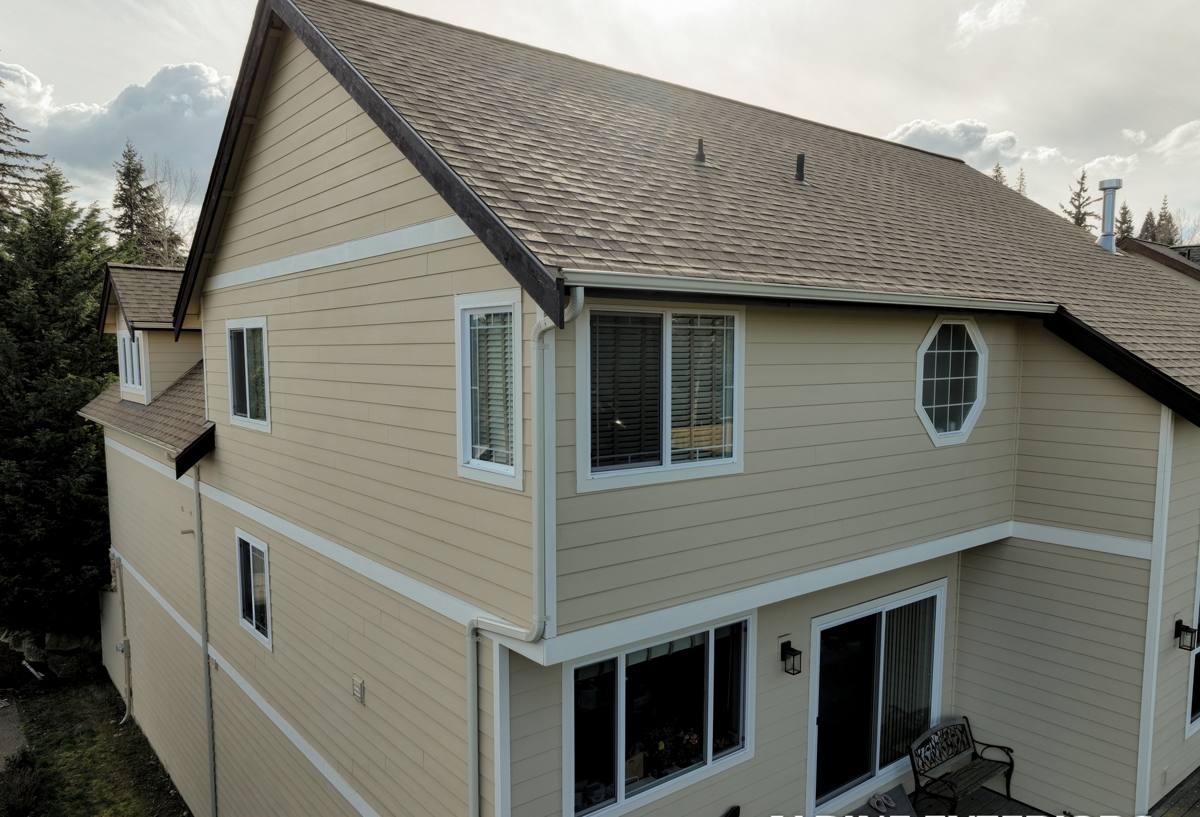
Why Storms Hit Semiahmoo Roofs Harder
Open Wind With Nothing to Break It
Most inland roofs have some combination of trees, neighboring structures, or terrain that takes the edge off wind gusts before they reach the roof deck. A property out on the spit often doesn't have that buffer. Wind coming off open water hits roof edges, ridges, and any already-weak fastening point with more sustained force, which is exactly the condition that causes shingles to lift, crease, or tear loose rather than just get wet.
Salt Air Working on Fasteners and Flashing Year-Round
Salt-laden air moving in from more than one direction accelerates corrosion in exposed nails, flashing metal, and fastener heads well before it's visible from the ground. A fastener that's already lost some of its holding strength to corrosion is far more likely to let go in a wind event than a fully sound one would — which means storm damage on a Semiahmoo roof is often the visible result of corrosion that had already been quietly weakening the roof for a while.
A Moss Season That Never Fully Lets Go
Mild temperatures and near-constant humidity keep moss and mildew active across most of the year in this part of Whatcom County, and Semiahmoo's waterfront position doesn't shorten that window. Moss holds moisture against shingles and roof decking long after a storm has passed, and it can mask early wind or impact damage on shaded, north-facing slopes until the problem has already worked its way past the surface layer.
What Actually Counts as Storm Damage
Storm damage isn't always a dramatic hole in the roof. Most of what we're called out for after a windstorm or a heavy blow off the water falls into a few recognizable categories, and some of it isn't obvious from the ground at all.
- Wind uplift: Shingles that have been lifted, creased, or torn loose at the tabs, often starting at ridges, hips, or roof edges where wind pressure concentrates first.
- Flashing failure: Metal flashing at valleys, chimneys, vents, or wall transitions that's been bent, lifted, or pulled loose enough to let water behind it.
- Impact damage: Bruising, cracking, or punctures from wind-driven debris, tree limbs, or anything else the storm carries onto the roof.
- Wind-driven water intrusion: Rain forced sideways and upward under shingle edges or through compromised laps, even where the shingle itself looks intact.
- Granule loss: Accelerated wear from wind abrasion that thins a shingle's protective surface without necessarily removing it outright.
The tricky part is that several of these can exist on the same roof at once, and only one of them tends to be visible from the driveway. That's the main reason a proper storm damage inspection has to cover the whole roof plane, not just the spot the homeowner already spotted.
What a Correct Storm Repair Involves
Inspection That Goes Beyond the Obvious Spot
We walk the full roof, not just the area where damage was reported, because wind and impact damage rarely stays confined to one tidy location. A gust strong enough to lift shingles on one slope has usually stressed fasteners and flashing elsewhere on the roof too, even if nothing has failed there yet. Catching that now is what keeps a storm repair from turning into a second service call a few months later.
Temporary Protection When It Can't Wait
When a roof has an active leak or exposed decking after a storm, the priority is getting it dry and protected before anything else — tarping or temporary covering that actually holds under continued wind, not a quick patch that fails in the next blow. Permanent repair follows once conditions allow it, but a house should never sit exposed to more weather while that's being scheduled.
Matching Materials on a Partial Repair
Shingle color and profile availability changes over the years a roof is in service, and an exact match isn't always possible on a partial repair, especially if the existing roof has faded with age. We're upfront about that before starting work rather than after, and we talk through the realistic options — a close match, a repair placed where it's least visible, or in some cases a case for full replacement if enough of the roof is affected that patchwork stops making sense.
Flashing and Underlayment Done Right the Second Time
If a storm took out flashing or underlayment in one section, that section gets rebuilt to proper spec, not just resealed with caulk over the original failure point. On an exposed property like this, a flashing detail that failed once under wind-driven rain will fail again in the same way unless the underlying installation issue gets corrected, not just covered.
Repair or Replace? Weighing the Decision
| Situation | Repair Usually Makes Sense | Replacement Worth Considering |
|---|---|---|
| Extent of damage | Isolated to one slope or a small section | Spread across multiple slopes or a large portion of the roof |
| Roof age | Roof is well within its expected service life | Roof was already nearing the end of its lifespan before the storm |
| Underlying condition | Decking and flashing elsewhere are sound | Inspection turns up rot, widespread corrosion, or prior storm damage never addressed |
| Material availability | A reasonably close shingle match is available | Existing shingle line is discontinued and mismatch would be highly visible |
There's rarely a single right answer that applies to every roof — the honest answer depends on what the inspection actually finds. We'll tell you plainly which side of that table your roof falls on rather than defaulting to whichever option is more profitable for us.
Insurance, Documentation, and What to Expect
Most storm damage claims move faster and more smoothly when the damage is documented clearly and specifically, rather than described in general terms. We provide written findings and photos from our own inspection that homeowners can use alongside whatever their insurance adjuster requires, and we're glad to walk an adjuster through what we found on-site if that's useful. We don't handle the claim itself — that's between the homeowner and their insurer — but we won't leave a homeowner guessing about what the roof actually needs while that process plays out.
| Factor | Why It Matters |
|---|---|
| Timing of the inspection | Damage documented soon after a storm is easier to tie directly to that event |
| Scope of the written estimate | An itemized breakdown of materials and labor holds up better under claim review than a vague lump sum |
| Temporary protection performed | Proper tarping can prevent secondary water damage that complicates or expands a claim |
| Photo documentation | Clear before-and-after photos are often the single most useful piece of an adjuster's file |
How Our Process Works
- Same-window inspection: We walk the full roof and document what we find with photos, not just the section that prompted the call.
- Temporary protection if needed: Active leaks or exposed decking get covered and secured before we move on to anything else.
- Written scope: You get a clear, itemized estimate covering materials, flashing work, and labor — useful whether you're paying out of pocket or working with an insurer.
- Repair or replacement, done to spec: Flashing, underlayment, and shingles go in correctly the first time, not patched over a failure point.
- Final walkthrough: We review the completed work with you in person and do a full site and fastener sweep before we call the job finished.
Why Hiring a Crew That Already Works Semiahmoo Matters
A crew that regularly repairs roofs on the spit has already seen how wind off open water finds the weak point in a fastening pattern, how salt air shortens the working life of unprotected flashing, and which slopes hold moisture longest through the wet season. That's the kind of practical knowledge that shows up in dozens of small decisions during a storm repair — decisions a crew unfamiliar with this specific stretch of coastline might not think to make at all. It also matters afterward: a workmanship warranty is only useful if the company behind it is still reachable and still working in the area when a question comes up.
A Practical Checklist Before You Hire for Storm Repair
- Do they inspect the full roof, or only the spot you pointed out?
- Is temporary protection part of their process when a leak is active?
- Does the estimate itemize flashing, underlayment, and shingle work separately?
- Can they provide written findings and photos for insurance purposes?
- Do they carry current WA contractor licensing, liability insurance, and workers' compensation?
- Have they done recent work on Semiahmoo or comparably exposed waterfront properties?
Signs Your Roof Took Storm Damage You Haven't Noticed Yet
Storm damage doesn't always announce itself with an obvious hole or a dramatic leak. Some of the more common signs we're called out for show up weeks or months after the storm that actually caused them.
- Granules collecting in gutters or at downspout outlets after a windy stretch
- Shingle tabs that look slightly lifted or uneven along a ridge or roof edge
- New or growing water stains on interior ceilings following a storm off the water
- Flashing around chimneys, vents, or skylights that looks bent, lifted, or missing sealant
- Moss returning quickly in the same spot after cleaning, which can point to damage trapping extra moisture underneath
If any of this sounds familiar after a recent storm, it's worth having the roof looked at before the next system moves through rather than waiting for a leak to force the decision.
If a recent storm has you wondering whether your Semiahmoo roof took damage, we're glad to come take an honest look and put together a written estimate at no cost and no pressure. Use the form below to request a free storm damage inspection.