 Blaine Siding
 Siding Repair in Everson: A Job That Requires Knowing the Weather, Not Just the Siding
Everson sits inland from Blaine along the Nooksack River corridor, and while it doesn't get the direct salt spray that coastal Whatcom County properties deal with, it shares the same core problem every home in this part of the county fights every winter: a long, wet, low-sun season that gives moisture weeks at a time to work into anything that isn't sealed correctly. Add the moss and algae growth that thrives in that shade and dampness, and siding here ages differently than siding in a drier climate. A repair that would hold up fine in Spokane or Boise can fail within a season here if it doesn't account for how water actually moves through a wall system in this region.
We work siding repair calls throughout the Blaine and greater Whatcom County service area, including Everson, and the pattern is consistent: most of what we're called out for isn't random damage. It's the predictable result of moisture finding a way in and staying there.
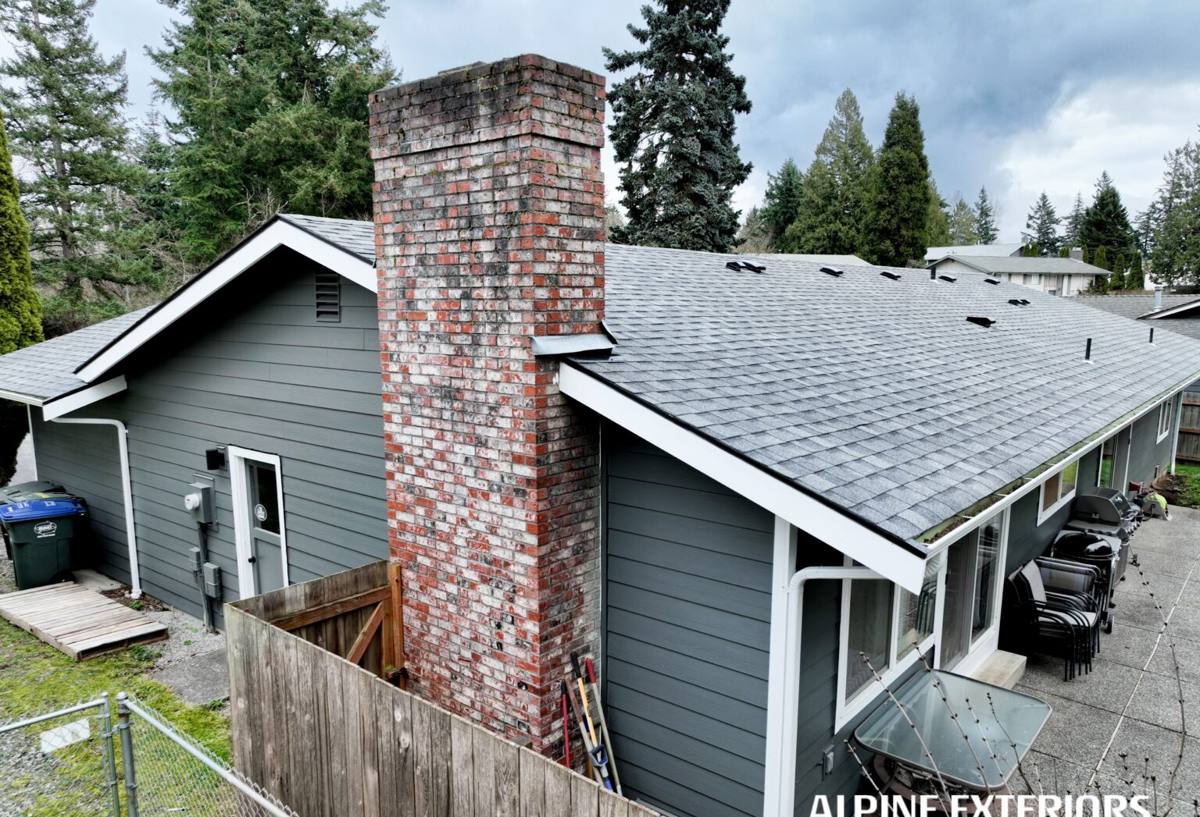
Why Siding Fails Faster in This Part of Whatcom County
Driving Rain, Not Just Rain
Pacific Northwest storms rarely fall straight down. Wind-driven rain pushes water sideways into laps, seams, and fastener penetrations that were never designed to be submerged, only shed. Over years, that repeated horizontal pressure finds every weak point in a siding installation — a caulk joint that was never meant to be a primary water barrier, a butt joint without proper flashing, a nail driven too tight or too loose.
The Moss and Algae Factor
Shaded, moisture-retentive surfaces in this region grow moss and algae faster than almost anywhere else in the country. On siding, that growth does two things: it holds water against the surface far longer than open air would, and its root structure can work into seams and coatings, breaking down caulk and finish over time. Homes with heavy tree cover or north-facing walls in Everson tend to show this first.
Regional Marine Influence
Even away from the immediate coastline, Whatcom County's weather is shaped by marine air moving in off the Salish Sea — mild temperatures, high humidity, and long stretches without a real drying period. That combination is exactly what accelerates rot in wood-based products and traps moisture behind siding that isn't installed with a proper drainage plane behind it.
Signs an Everson Home Needs Siding Repair
Most siding failure is visible before it becomes a structural problem — if you know what to look for.
- Soft or spongy spots when you press on the siding, especially near the bottom courses or around window trim
- Visible cracking, splitting, or buckling in individual boards or panels
- Paint or finish that's peeling, bubbling, or chalking unevenly across a wall
- Persistent moss or dark staining that comes back within weeks of cleaning
- Gaps opening up at seams, corners, or where siding meets trim, window, or door frames
- Warping or waviness visible from an angle, especially after a wet winter
- Interior signs — musty smell, discoloration on interior drywall, or peeling interior paint on an exterior wall
- Insect activity or soft wood at the base of walls near grade
Any one of these on its own might be minor. Several showing up in the same area, or interior signs showing up at all, usually means water has been getting behind the siding for a while — not just sitting on top of it.
What a Correct Siding Repair Actually Involves
A lot of "repairs" in this industry amount to caulking a crack and calling it done. That approach hides a symptom without addressing why the damage happened, and on a home in this climate, the same failure usually comes back within a year or two. A repair worth doing includes a few non-negotiable steps:
1. Find the Actual Water Path
Before anything gets patched, we pull back enough siding to see what's happening behind it. Damage on the surface almost always started somewhere else — a failed flashing detail, a gap in the house wrap, a fastener that punched through the water-resistive barrier.
2. Check the Substrate
If sheathing or framing behind the siding has started to soften or rot, patching the visible siding without addressing what's underneath is a temporary fix at best. This is the step that separates a real repair from a cosmetic one.
3. Restore the Drainage Plane
Siding is not the primary waterproofing layer on a wall — the house wrap and flashing behind it are. Any repair has to reconnect those layers correctly, with proper lapping and sealing, so water that gets past the siding still has a way to drain out instead of pooling.
4. Match or Replace, Honestly
Sometimes a damaged section can be cut out and replaced in kind. Sometimes the surrounding material has aged or degraded enough that a patch will stand out or simply won't hold as well as the rest of the wall. We'll tell you which situation you're in rather than pushing a repair that isn't going to last.
Repair or Replace? What Actually Drives That Decision
| Factor | Favors Repair | Favors Replacement |
|---|---|---|
| Extent of damage | Isolated to one wall or a few boards | Recurring across multiple walls or elevations |
| Substrate condition | Sheathing and framing are dry and sound | Rot has spread into sheathing or framing |
| Siding material | Sound material available to match cleanly | Original material is discontinued, brittle, or failing generally |
| Age of existing siding | Siding is well within its expected service life | Siding is near or past the age where failures compound |
| Underlying cause | A one-time or localized event (impact damage, one bad flashing detail) | A systemic issue — poor original installation, no drainage plane |
We'd rather tell you honestly that a $600 repair will hold for years than sell you a full re-side you don't need — and just as often, we'll tell you when a repair is only going to buy you a season or two before you're back to the same wall.
Why We Only Install James Hardie When Replacement Is the Right Call
When a repair situation turns into a genuine replacement — a wall section, an elevation, or the whole house — we only install James Hardie fiber cement. It's a standard we hold to for a specific reason: we've seen how different siding materials actually perform in Whatcom County's wet, moss-prone climate over years, not just how they look on installation day.
Wood-based and engineered-wood products can perform well when detailed and maintained precisely, but they're more sensitive to the moisture cycle this region puts them through — repeated wetting, slow drying, and the organic growth that comes with it. Vinyl is low-maintenance but can warp under repeated heat exposure and doesn't hold paint or accept repairs the way fiber cement does. Hardie's fiber cement composition is non-combustible, dimensionally stable in wet-dry cycling, and its ColorPlus factory finish is engineered specifically to resist the fading and moisture intrusion that plagues field-applied paint in marine climates. When we're the ones standing behind the work, that's the material we're willing to put our name on.
That standard applies to new installations and full re-sides. For a targeted repair on existing non-Hardie siding, we'll still do the work correctly and tell you straight when patching no longer makes sense — that's usually the point where we'd recommend transitioning that section, or the home, to Hardie instead of continuing to chase failures in an aging material.
Our Process for Everson Siding Repair Calls
- Inspection: We look at the damage, but also at the flashing, trim, and drainage details around it — the parts that determine whether a repair will actually last.
- Honest diagnosis: You get a clear explanation of what's causing the damage, not just what's visible.
- Written scope: A specific plan — what gets opened up, what gets repaired or replaced, and what it involves — before any work starts.
- Correct repair: Water management restored first, siding restored second. We don't skip the layer nobody sees.
- Cleanup and walkthrough: You see the finished work and understand exactly what was done and why.
Why a Crew That Already Works Everson Matters
Repair work depends on judgment calls that come from having seen the same failure pattern on other homes nearby, not just from a checklist. A crew that's worked wet-climate siding repairs across Whatcom County knows which failure patterns show up on north-facing walls with heavy shade, how far moss damage typically extends past what's visible, and which older installation methods in this region tend to fail first. That local pattern recognition is the difference between a repair that addresses the actual cause and one that just covers the symptom until the next wet winter.
It also means straightforward logistics — material and crew availability without the delays that come with contractors driving in from outside the region, and a company that's still local and reachable if a repair needs a follow-up look.
Get a Straight Answer on Your Siding
If you're seeing soft spots, recurring moss, cracked boards, or anything else that doesn't look right on your Everson home's siding, we'll take a look and give you an honest read on what it needs — repair, partial replacement, or nothing urgent at all. Use the form below to request a free, no-pressure estimate.