 Blaine Siding
 Point Roberts Puts Ordinary Siding to the Test
Point Roberts sits on its own small peninsula, with water on three sides and almost no shelter from the weather moving in off the Strait of Georgia. That geography means salt-laden air reaches nearly every home here, not just the ones directly on the water. Combine that with the driving winter rain that's normal for this part of Whatcom County, and a moss season that can stretch for months in the shaded, damp spots around a house, and you get a climate that ages weak siding fast — sometimes years ahead of what the same product would show inland.
We've replaced siding on homes across the Blaine area long enough to see which materials hold up out here and which ones start failing quietly, behind a coat of paint, long before anyone notices from the curb. This page is about what a correct siding replacement looks like for a Point Roberts home, and why the details matter more here than almost anywhere else in the county.
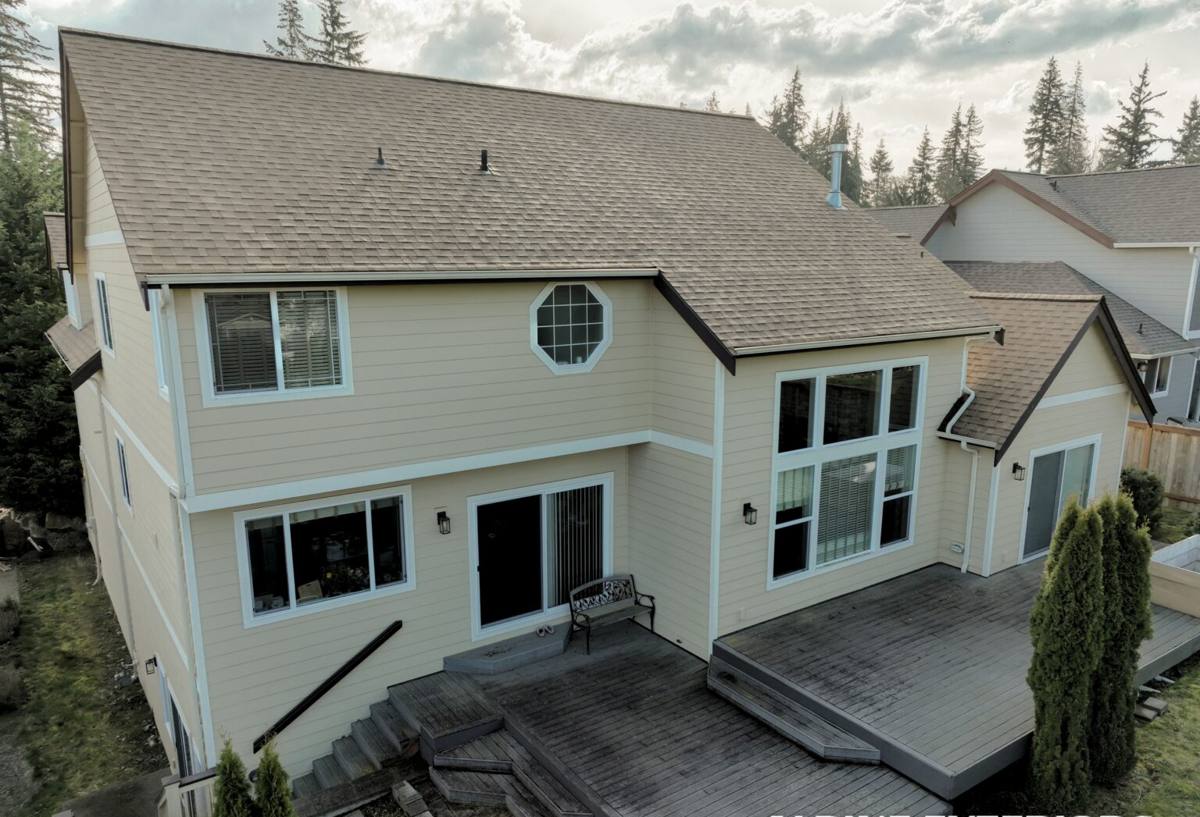
What Salt Air, Rain, and Moss Actually Do to Siding
Salt Air and Fasteners
Airborne salt doesn't just sit on the surface of a wall — it works into seams, fastener heads, and any exposed cut edge. Over time it accelerates corrosion in fasteners and flashing that aren't rated for coastal exposure, and it breaks down paint films faster than the same product would wear in a drier, inland location. Siding that isn't factory-finished for this kind of exposure often needs repainting on a much shorter cycle than the homeowner was told to expect.
Wind-Driven Rain and Water Intrusion
Rain that's pushed sideways by wind behaves differently than rain that falls straight down. It finds its way under laps, around trim, and through any gap in the water-resistive barrier that a straight-down rain would never reach. On an exposed peninsula like this one, that means flashing details and lap coverage that might be "good enough" elsewhere aren't good enough here.
Moss, Algae, and Trapped Moisture
Shade, humidity, and mild temperatures are exactly what moss and algae need to establish themselves on a wall. Beyond the cosmetic issue, moss and algae hold moisture against the siding surface for long stretches, which is hard on any material that isn't dimensionally stable or that absorbs water at the surface. Wood-based products are particularly vulnerable to this cycle of trapped moisture and slow degradation.
What a Correct Siding Replacement Actually Involves
A Full Tear-Off, Not a Cover-Over
Installing new siding over old siding hides problems instead of solving them. A proper replacement starts with a full tear-off so the sheathing underneath can be inspected. On a coastal, high-moisture site like Point Roberts, that inspection step matters — it's the only way to catch hidden water damage before it's sealed behind a new wall for another twenty years.
Weather-Resistive Barrier and Flashing Details
Every window, door, and penetration needs flashing that's detailed to shed wind-driven rain, not just vertical rain. The house wrap or weather-resistive barrier underneath the siding has to be lapped correctly, taped at seams, and tied into the flashing so water has a continuous path back out, never a path in.
A Drainage Gap Behind the Siding
A small gap or drainage mat between the siding and the weather-resistive barrier lets any moisture that does get past the surface drain and dry out instead of sitting against the wall assembly. In a climate with this much sustained dampness, that gap is what keeps minor moisture from turning into rot.
A Fastening Schedule Built for Wind Exposure
Open, waterfront-adjacent sites see more sustained wind than sheltered inland lots. Fastener type, spacing, and embedment need to match that exposure — this is a manufacturer-specified detail, not a guess, and it's one of the first things that gets shortcut on a rushed job.
Why We Install Only James Hardie Fiber Cement
We stopped installing vinyl, LP SmartSide, cedar, and primed spruce a while back, and we don't install Cemplank or Allura either. That's not a knock on any single product line — it's a standard we set after weighing how each of those materials actually performs against salt air, sustained moisture, and a long moss season, and deciding the trade-offs weren't ones we were willing to put our name behind.
Vinyl expands and contracts with temperature swings and can become brittle over time, which shows up as buckling or cracked panels on exposed walls. Wood-based products, including cedar and primed spruce, need consistent upkeep to resist moisture and moss in a climate this damp, and the maintenance burden falls on the homeowner year after year. James Hardie fiber cement is non-combustible, dimensionally stable, and doesn't feed moss and algae the way bare wood fibers can.
Hardie's ColorPlus factory finish is baked on under controlled conditions, which gives it better fade and moisture resistance than a field-applied paint job, and it comes with a stronger finish warranty than most site-painted alternatives. Hardie also makes climate-engineered HZ product lines built specifically for wetter regions like ours, with formulations tuned to resist moisture-related damage. It's a system, not just a board, and it's the one we've standardized on for every home we side.
The Point Roberts Access Factor
Point Roberts is a U.S. exclave — the only way to reach it by land is through Canada, crossing the border twice each direction. That's a fact of life for anyone who lives, works, or builds there, and it's also something a contractor unfamiliar with the area often doesn't plan for.
Material deliveries, crew scheduling, and even something as simple as an extra trim run all need to account for that crossing. A crew that already routes through it regularly stages materials ahead of time, builds the crossing into the day's schedule, and doesn't lose a job to a delay that a Blaine-based crew wouldn't even notice. A crew coming from farther away, with no regular routine on this stretch of the border, is more likely to under-budget the time it takes to get a job done right — which shows up as rushed details on your wall.
Our Process, Start to Finish
- Inspection and estimate — we walk the exterior, check for existing moisture or rot, and give you a written scope, not a verbal guess.
- Material ordering — Hardie panels, trim, and flashing components are ordered and staged ahead of the crossing so the crew isn't waiting on materials mid-job.
- Full tear-off — old siding comes off completely so the sheathing can be inspected and any damaged sections repaired before anything new goes up.
- Weather barrier and flashing — a new weather-resistive barrier, correctly lapped flashing, and a drainage gap go in before a single piece of siding is installed.
- Hardie installation — siding, trim, and fastening follow James Hardie's published specifications for this climate zone, not a generic install pattern.
- Final walkthrough — we go over the finished job with you before we consider it done.
Cost Factors for a Point Roberts Siding Replacement
Every home is different, but the same handful of factors drive most of the variation in scope and cost for this area. This isn't a price list — it's what actually moves the number up or down.
| Factor | Why It Matters Here |
|---|---|
| Home size and wall complexity | More square footage and more corners, gables, and trim details mean more labor and material |
| Condition of existing sheathing | Hidden water damage found during tear-off may need repair before new siding goes on |
| Wind and water exposure | Open, waterfront-adjacent walls often need more flashing detail and fastening attention |
| Trim and window count | Every window, door, and penetration needs individual flashing work |
| Access and logistics | Material staging and border-crossing scheduling factor into project timelines |
Signs Your Point Roberts Home Needs Replacement, Not Just Repair
A patch or repaint can solve a small, isolated problem. These signs usually mean the underlying siding system has run its course.
- Soft or spongy spots when you press on the siding, especially near the bottom courses
- Paint that peels or bubbles again within a year or two of repainting
- Moss or algae that regrows quickly after cleaning, rather than staying off for a season
- Visible warping, buckling, or cupping in individual boards or panels
- Staining or dark streaking concentrated at seams, corners, or below windows
- Rot or soft wood visible at butt joints or where trim meets siding
- A noticeable rise in heating costs that points to a failing wall assembly
Keeping New Siding Looking Good Through Moss Season
Even the right material benefits from a little upkeep. A gentle rinse once or twice a year, before moss gets a foothold, keeps growth from establishing in the first place. Keeping gutters clear prevents overflow from running down and staining the wall below, and trimming back vegetation that shades and dampens a wall gives it more airflow and sun exposure to dry out between rain events. Because Hardie's ColorPlus finish is factory-applied and built to resist fading and moisture, it needs far less of this kind of intervention than a field-painted wood surface would over the same years.
Why Hiring a Crew That Already Works Point Roberts Matters
A siding replacement is only as good as the details nobody sees once the wall is closed up — the flashing behind the trim, the drainage gap behind the panel, the fastening schedule that accounts for wind. Those are the details that either hold up to salt air, driving rain, and moss season, or quietly fail a few years in. Hiring a crew that already understands this specific stretch of Whatcom County, including the realities of getting materials and equipment onto the peninsula, means fewer surprises and a job built for the conditions your home actually faces.
If you're weighing a siding replacement for a Point Roberts home, we're happy to take a look and walk you through what we'd recommend — no pressure, no obligation. Use the form below to request a free estimate.