 Blaine Siding
 Building a Deck That Actually Holds Up in Bellingham
Bellingham sits close enough to the water and far enough into the Pacific Northwest's wet-season pattern that a deck here works harder than a deck almost anywhere else in the country. Salt-laden air off the Sound, long stretches of driving rain, and a moss season that can run from fall through spring all attack a deck at once — the wood, the fasteners, the footings, and the finish. A deck built to a generic national spec, or built fast to hit a low bid, tends to show problems within a few years: soft boards, rust streaks around screw heads, green film that never fully goes away, and railings that start to wiggle. A deck built for this specific climate, with the right materials and the right details in the substructure, will still be solid and safe well past the point where a corner-cut deck has become a liability.
This page covers what actually goes into a deck built for Bellingham conditions — material choices, framing and fastening decisions, drainage, and the maintenance a homeowner should expect to do. It's meant to help you ask better questions of any contractor you're considering, including us.
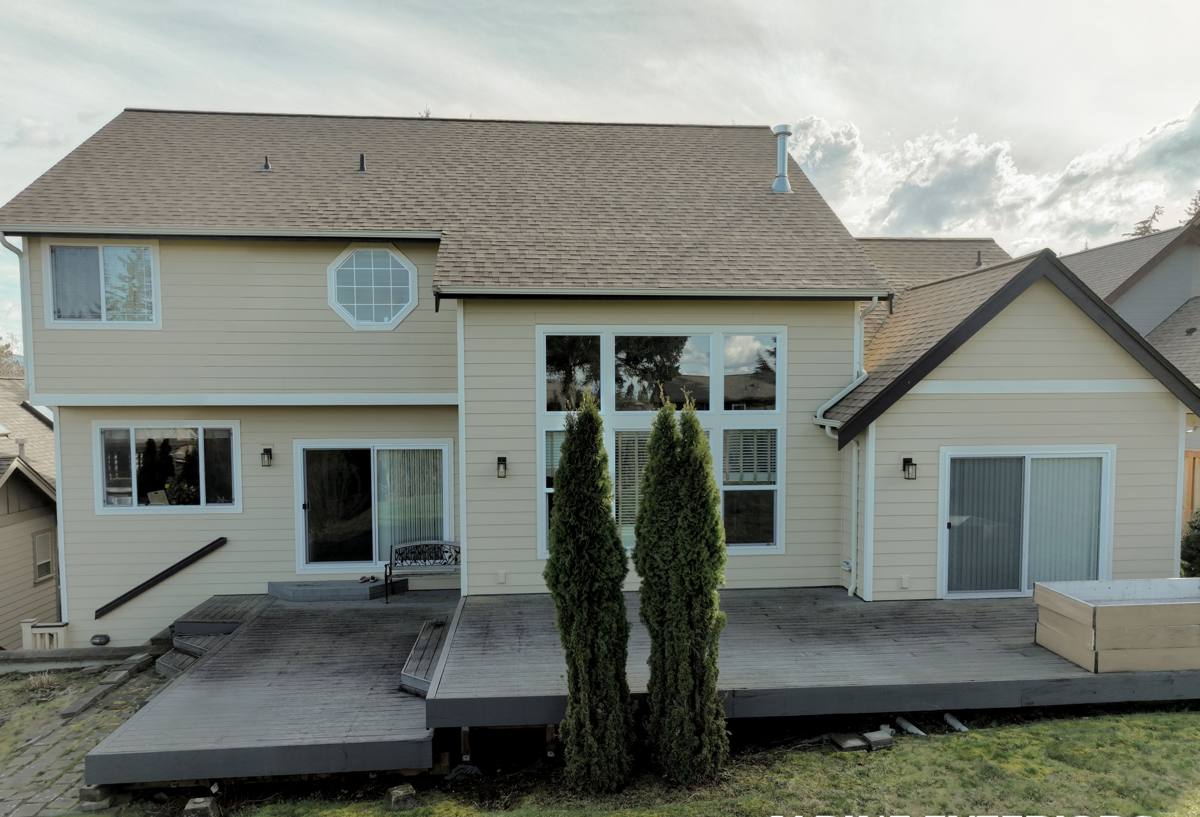
What Whatcom County's Climate Does to a Deck
Three things drive almost every deck problem we see in this area.
Moisture that doesn't let up
Whatcom County gets a lot of rain, and a lot of it falls as slow, steady, all-day soaking rather than short heavy storms. That means deck surfaces, framing, and especially the ledger board where the deck meets the house stay wet for long stretches at a time. Wood that can't shed water and dry out between rain events starts to rot from the inside, often well before it looks bad on the surface.
Salt air and corrosion
Proximity to Bellingham Bay and the broader Puget Sound means airborne salt reaches exterior hardware even a few miles inland. Standard fasteners and connectors that would be fine in a dry inland climate can start corroding within a couple of seasons here. Corrosion at a joist hanger or a ledger bolt isn't cosmetic — it's a structural problem.
Moss, algae, and shade
Many Bellingham lots have mature tree cover, which is great for shade and privacy but means decks stay damp longer and get less direct sun to dry them out. Moss and algae take hold on horizontal surfaces, and beyond looking bad, they hold moisture against the decking and make the surface slick and dangerous underfoot, especially on stairs.
Choosing Decking Material for This Climate
There's no single "best" decking material — the right choice depends on budget, how much maintenance you want to do, and how much sun or shade the deck gets. Here's how the common options actually perform under Bellingham conditions.
| Material | How it handles rain & moss | Maintenance | Typical lifespan here |
|---|---|---|---|
| Pressure-treated wood | Needs a real gap between boards and good airflow underneath, or it holds water and stains | Annual cleaning and periodic sealing to keep moss and checking under control | 15–20 years with upkeep |
| Cedar | Naturally more rot-resistant, but still needs to dry between rain events | Periodic cleaning and refinishing to hold color and resist graying | 15–20 years with upkeep |
| Composite decking | Doesn't rot, but can still grow surface moss/algae if it stays damp and shaded | Occasional washing; no staining or sealing needed | 25–30+ years, backed by manufacturer warranty |
| PVC/capped polymer | Fully sheds water, most resistant to staining and moss buildup | Lowest maintenance of the group; occasional washing | 25–30+ years, backed by manufacturer warranty |
For heavily shaded, moss-prone lots — common in parts of Bellingham with mature tree canopy — we generally steer homeowners toward composite or PVC decking, not because wood is a bad product, but because the maintenance burden of keeping a shaded wood deck clean and sealed year after year is a real, ongoing cost that a lot of people underestimate when they're comparing sticker price alone. For a deck that gets good sun exposure and where the homeowner doesn't mind an annual cleaning and refinishing routine, quality cedar or treated wood is still a solid, less expensive choice.
Substructure and Framing: Where Decks Actually Fail
The decking boards are what you see, but the substructure is what determines whether the deck is safe. Almost every deck failure we're called out to inspect in this region traces back to the framing, not the surface boards.
Footings and post bases
In our wet clay- and silt-heavy soils, footings need to be sized and set below frost depth and local grade requirements, with post bases that keep the post end off standing water. A post set directly in or near standing water will rot from the bottom up regardless of what species or treatment it is.
Joist protection
Every cut end and every joist top should be protected — cut ends re-sealed after cutting, and joist tops covered with a flashing tape barrier before decking goes down. This single detail is one of the most commonly skipped steps on lower-cost deck jobs, and it's one of the biggest reasons framing rots out from underneath a deck that still looks fine on top.
Airflow underneath
A deck built low to the ground with poor ventilation underneath will stay damp for days after a storm. Proper clearance and, where the design allows, venting details help the structure actually dry out between rain events instead of staying saturated all winter.
Ledger Attachment and Waterproofing
The ledger board — where the deck attaches to the house — is the single most safety-critical connection on most decks, and it's also the most exposed to water intrusion into the house structure itself. A correctly built ledger connection includes proper flashing that directs water away from the house sheathing, lag bolts or through-bolts rated for the load (not just deck screws), and a small gap or flashing detail that keeps water from wicking behind the ledger board. Done wrong, a ledger connection can lead to rot inside the wall of the house itself, not just deck failure — this is a detail worth asking any contractor to explain specifically, not just take on faith.
Railings, Fasteners, and Hardware for a Marine Climate
Hardware choice matters more here than in most parts of the country. Standard galvanized fasteners can start showing rust streaks within a couple of years this close to salt air. We build with stainless steel or high-grade coated fasteners and connectors rated for coastal exposure, matched to whatever decking material is used, since some composite and PVC products require specific fastener types to keep their warranty valid. Railings get the same attention — posts anchored into framing (not just decking), connections that won't loosen as wood framing shrinks and swells with the season, and hardware that will still be tight and rust-free years down the line.
Our Deck Building Process
Every deck is different, but the process we follow stays consistent:
- On-site assessment — we look at sun exposure, drainage, tree cover, and how the deck will attach to the house before recommending materials.
- Design and material selection — sized and laid out for the space, with a material recommendation based on the site's actual moisture and shade conditions, not a one-size-fits-all default.
- Permitting — we handle the permit application and inspections required by the local jurisdiction for the project.
- Footings and framing — footings set to code depth, joists protected with flashing tape, ledger properly flashed and bolted.
- Decking, railings, and stairs — installed per manufacturer spec, with coastal-rated fasteners throughout.
- Final walkthrough — we go over the finished deck with you, including what maintenance it will and won't need.
Permits and Code Considerations in Whatcom County
Most new decks and many deck replacements require a building permit, and inspections typically cover footings before they're covered and framing before decking goes on. Requirements can vary depending on whether a property is inside Bellingham city limits or in unincorporated Whatcom County, and by deck height, size, and proximity to property lines. Skipping permitting on a deck isn't just a paperwork risk — it can create real problems later when you go to sell the house or file an insurance claim. We pull the required permits as part of the job rather than leaving that step to the homeowner.
Maintenance Checklist for Bellingham Decks
Whatever material your deck is built from, a little seasonal attention goes a long way in this climate:
- Sweep leaves and debris off the deck regularly in fall — trapped leaves hold moisture and accelerate moss growth
- Wash the deck surface at least once a year to remove moss and algae film before it builds up
- Check railings and stair connections annually for any looseness
- Inspect fastener heads for early rust staining and address it before it spreads
- Keep gutters and downspouts near the deck clear so water isn't dumping directly onto or under it
- For wood decks, plan on resealing or refinishing every 1–3 years depending on sun exposure
- Trim back overhanging branches where practical to reduce shade and speed drying time
Why Hire a Crew That Already Works Bellingham
A contractor who builds decks in a dry inland climate can do competent work and still get details wrong here — not from lack of skill, but because the failure modes are different. Fastener corrosion, ledger flashing, moss-prone shaded framing, and footing depth in our soils are all things you learn by building in this specific area, season after season. A crew that already works Bellingham and the surrounding Whatcom County area knows which details actually matter here, has already seen what goes wrong when they're skipped, and builds accordingly from the start rather than learning it on your project.
If you're planning a new deck or need to replace one that's showing its age, we're happy to come take a look and talk through what makes sense for your site and budget. Fill out the form below for a free, no-pressure estimate.