 Blaine Siding
 Why Nooksack-Area Homes Are Hard on Siding
Homes in the Nooksack area near Blaine sit in one of the more demanding exterior environments in Whatcom County. You've got salt-laden air drifting in off the Salish Sea, driving rain that comes sideways more often than straight down, and a moss season that stretches from fall through spring in the shaded, damp conditions typical of this part of the county. None of these things are dramatic on their own. What they do is grind away at siding slowly, over years, until a homeowner is suddenly dealing with soft trim, peeling paint, or siding that's holding moisture it should have shed a decade earlier.
Salt air is corrosive to exposed metal fasteners and trim, and it accelerates the breakdown of coatings that aren't built to handle it. Driving rain finds every gap, seam, and poorly caulked joint and pushes water behind the siding rather than off of it. And moss doesn't just sit on a roof — it colonizes north-facing and shaded siding runs, holding moisture against the wall assembly and feeding rot in anything that isn't genuinely moisture-resistant. Put those three together and you have a climate that punishes shortcuts. It rewards a siding system engineered for exactly this kind of exposure, installed by people who understand the wall assembly underneath it.
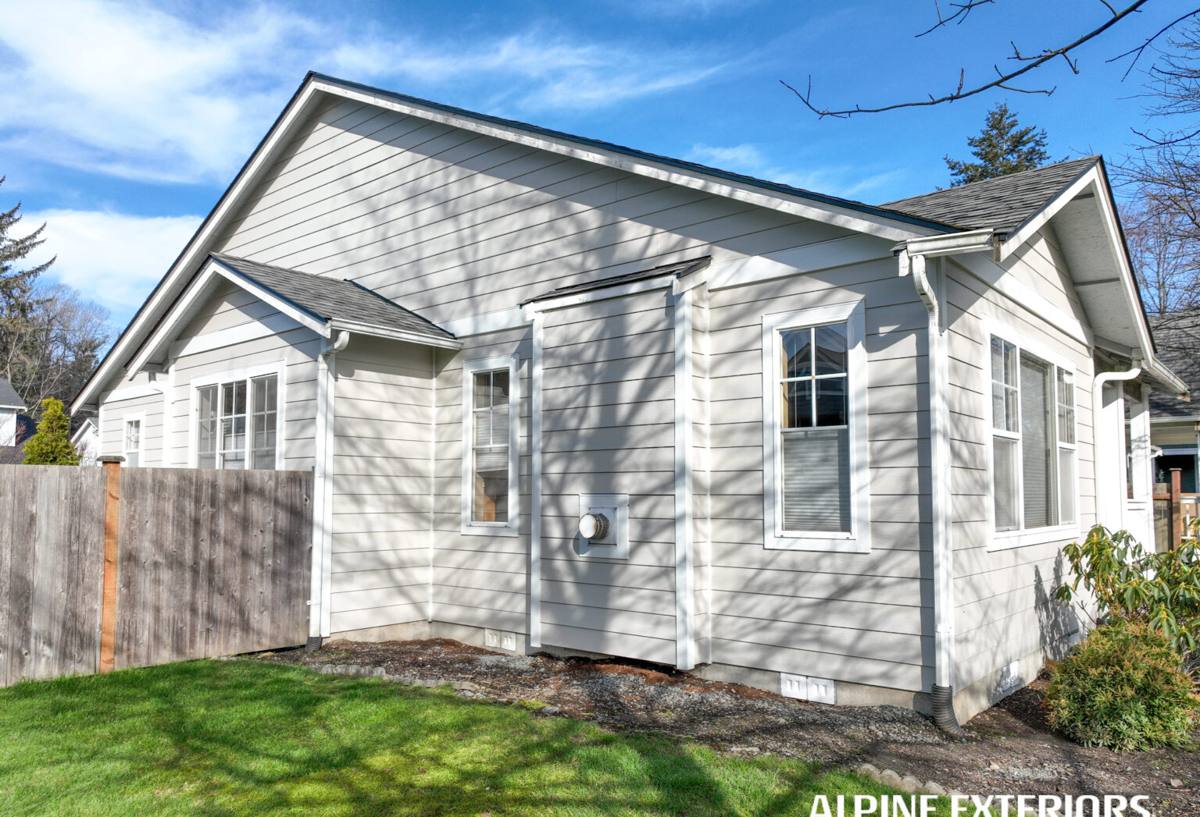
Why We Only Install James Hardie
We standardized on James Hardie fiber cement for every home we side, including homes in the Nooksack area, and we don't install vinyl, LP SmartSide, Cemplank, Allura, primed spruce, or cedar. That's not a marketing position — it's a decision built around what actually holds up in this climate over the long run.
Fiber cement is non-combustible, dimensionally stable, and doesn't rely on a surface coating alone to keep water out — the material itself is engineered to resist moisture intrusion and won't swell, delaminate, or rot the way wood-based and wood-alternative products can when they take on repeated wetting. James Hardie backs its siding with a factory-applied finish and a warranty structure that's transferable to a future homeowner, which matters if you ever sell. Other products on the market get some things right — vinyl is inexpensive, cedar looks great fresh off the truck, LP SmartSide is easier to cut — but each comes with a real trade-off in a marine, high-moisture climate: vinyl can warp and fade and gives you no real fire resistance; cedar demands ongoing maintenance most homeowners underestimate; engineered wood products depend heavily on flawless installation and sealing to avoid moisture problems at the edges. We'd rather install one product exceptionally well than juggle several and hope each one gets installed correctly.
The Product Line Built for This Climate
James Hardie makes climate-specific product formulations, and for a coastal, high-moisture area like Blaine and the surrounding Nooksack area, that matters. Their HZ5 formulation is engineered for regions with more freeze-thaw cycling and moisture exposure, which fits the Pacific Northwest better than a formulation designed for a drier, milder climate. We spec the correct HZ line for this region rather than treating all Hardie product as interchangeable, because the underlying fiber cement composition is tuned differently depending on where a home sits.
What "Correct" Installation Actually Involves
Fiber cement siding is only as good as the installation behind it. Hardie's own data and warranty terms are explicit about this — most siding failures aren't material failures, they're installation failures. In a climate that pushes water at a wall from every angle, the details most homeowners never see are the ones that determine whether siding lasts 30-plus years or starts failing at year eight.
- Correct starter strip and clearance at the foundation so the bottom edge of the siding never sits in standing water or direct soil contact
- Proper weather-resistant barrier installed and lapped correctly underneath the siding, not just stapled up as an afterthought
- Flashing integrated at every window, door, and roofline intersection — the single most common source of hidden water intrusion when skipped or done wrong
- Correct fastener type, spacing, and placement, since over- or under-driven nails and the wrong fastener material both compromise the panel over time
- Proper gapping at butt joints and trim, with the right sealant used in the right places — not everywhere, and not nowhere
- Field-cut edges primed and sealed before installation, since factory ColorPlus finish only protects what's actually coated
Every one of these steps takes a few extra minutes on a job site. Skipped consistently across a whole house, they add up to hours saved by the crew and years shaved off the siding's service life. This is why we treat installation technique as seriously as the product choice itself.
Our Process for a Nooksack-Area Home
Assessment and Tear-Off
We start by walking the exterior and identifying what's actually happening underneath the existing siding — soft sheathing, prior water intrusion, inadequate flashing — rather than just measuring for new panels. In a moisture-heavy climate like this one, what's under the old siding often tells us more than what we can see from the outside. Any compromised sheathing gets addressed before anything new goes up; covering a wet or rotted substrate with new siding just hides the problem for a while.
Weather Barrier and Flashing
We install a continuous weather-resistant barrier and integrate flashing at every penetration and transition point — windows, doors, roof lines, and any wall-to-wall intersections. This is the layer that does the real water management work; the siding itself is the second line of defense, not the first.
Installation to Manufacturer Spec
Panels, fasteners, and gapping are installed to James Hardie's published installation guidelines for this climate zone, not to a generic standard. That includes correct nailing patterns, proper clearances, and sealant only where Hardie's own specifications call for it.
Final Walkthrough
We do a detailed walkthrough before calling the job finished, checking caulk lines, trim details, and touch-up work so nothing gets left half-done in a spot that's hard to notice from the ground.
What Drives the Cost of a Siding Job
Every home is different, and we won't quote a number without seeing the house, but these are the factors that most affect what a James Hardie project runs in this area.
| Factor | Why It Matters |
|---|---|
| Condition of existing sheathing | Rot or moisture damage found during tear-off requires repair before new siding goes on |
| Home size and wall complexity | More corners, dormers, and trim details mean more labor and material cuts |
| Product line and profile | HardiePlank lap siding, HardieShingle, and HardiePanel carry different material and labor costs |
| ColorPlus vs. field-painted | Factory-finished ColorPlus costs more upfront but eliminates a full repaint down the line |
| Trim and accessory scope | Fascia, soffit, and window trim replacement often gets bundled with a siding job for a clean finish |
| Access and site conditions | Multi-story sections, tight lot lines, or difficult staging areas add labor time |
Living With Fiber Cement Siding Here Long-Term
One of the real advantages of James Hardie in this climate is how little ongoing maintenance it asks for compared to wood-based alternatives. It won't rot, and it's not a food source for the kind of organic growth that colonizes cedar and other wood products. That said, "low maintenance" isn't "no maintenance" — moss and mildew can still develop on the surface of any siding in a shaded, damp yard, including Hardie. A periodic gentle rinse (never a high-pressure wash aimed directly at seams or trim) keeps growth from taking hold, and it's worth a quick visual check of caulk lines and trim joints once a year, since caulk is the one component that does wear out and need occasional renewal well before the siding itself does.
Why a Crew That Already Works This Area Matters
Installation technique needs to change based on climate, and a crew that's worked houses throughout Whatcom County and the Blaine area already knows where water problems tend to show up on homes exposed to this kind of weather — which wall orientations take the worst of the driving rain, which roof-to-wall intersections need extra attention, and where moss tends to establish first. That's the kind of judgment that comes from doing the work here repeatedly, not from a general contracting background applied to a job in an unfamiliar climate. It also means faster response if something needs a look after the job is done, without the delay of coordinating a crew that has to travel in from outside the area.
If you're weighing a siding replacement or repair for a home in the Nooksack area near Blaine, we're glad to come take a look and give you a straightforward, no-pressure estimate — what we'd recommend, what it would involve, and what it would cost, with no obligation attached.