 Blaine Siding
 Asphalt Shingle Roofing Built for Nooksack's Weather
Nooksack sits in a part of Whatcom County where the weather doesn't do a roof any favors. Long stretches of steady rain, damp air moving in off the water and settling into low-lying valleys, and short winter days that never quite dry a roof out between storms all add up to conditions that push asphalt shingles harder than they're pushed in drier parts of the state. A roof that would coast along for decades in eastern Washington can start showing granule loss, moss colonies, and soft spots years earlier here if it wasn't installed with this climate in mind.
We install and repair asphalt shingle roofs across Whatcom County, including Nooksack, and we build every job around the same question: what does this roof need to survive years of driving rain, salt-tinged coastal air, and a moss season that can run most of the year? That's a different set of priorities than a shingle roof going up somewhere hot and dry, and it changes decisions about underlayment, ventilation, flashing, and even which shingle line makes sense.
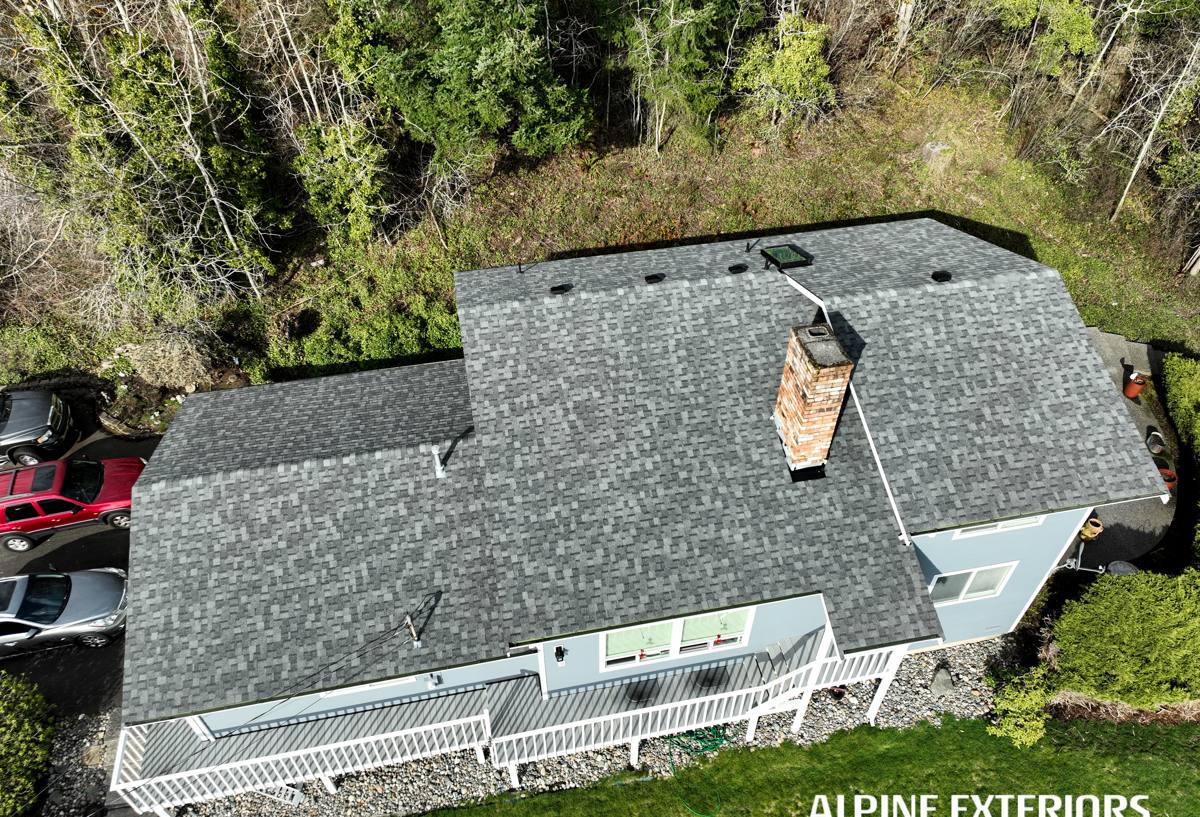
Why Local Homes Wear Out Asphalt Shingles Faster
Three things do most of the damage to shingle roofs in this part of Whatcom County, and they usually work together rather than separately.
Persistent moisture and moss
Shade from mature trees, north-facing roof planes, and long wet winters give moss and algae exactly what they need to take hold. Once moss establishes itself on a shingle roof, it holds water against the surface, lifts shingle edges, and works its way under tabs and flashing over time. A roof that looks fine from the ground can already have moss doing quiet damage underneath.
Wind-driven rain
Storms coming off the water don't just drop rain straight down — they push it sideways, into laps, valleys, and any gap in flashing that a calmer climate could get away with. Roofs here need tighter seals and more attention to detail at every penetration and transition, because wind-driven rain finds weak points that vertical rain never would.
Salt-influenced air
Whatcom County's proximity to the water means the air carries more moisture and mild salt content than you'd find further inland. Over years, that accelerates the breakdown of lower-grade shingle materials, fasteners, and metal flashing. It's not dramatic damage in any single season, but it adds up, which is why material choice matters more here than in a drier climate.
What a Correct Asphalt Shingle Roof Needs in This Climate
Installing shingles correctly here means more than nailing them down in the right pattern. The parts you don't see matter as much as the shingles themselves.
Ventilation and moisture control
A roof deck that can't breathe traps moisture underneath the shingles, which shortens their life from below while moss and algae work on them from above. Balanced intake and exhaust ventilation keeps the attic and roof deck drier year-round, which matters more in a climate that rarely gives a roof a long dry stretch to recover.
Underlayment and ice-and-water protection
We use synthetic underlayment across the full roof and self-adhering ice-and-water membrane at eaves, valleys, and around penetrations — the spots where wind-driven rain and ponding are most likely to find a way in. This is standard practice for us, not an upgrade, because it's what the local weather actually calls for.
Flashing and detail work
Chimneys, skylights, vent pipes, and valleys are where the vast majority of roof leaks start, almost never in the open field of shingles. Correctly formed and properly lapped flashing at every one of these points is what keeps driving rain out, and it's the part of a roofing job that separates a careful crew from a fast one.
Signs Your Nooksack Roof Needs Attention
Most shingle roof problems here start small and stay hidden for a while. A few things are worth checking regularly, especially after a windy winter:
- Dark streaking or green-black patches, especially on north-facing or shaded roof planes
- Granules collecting in gutters or at the base of downspouts
- Shingles that look cupped, curled at the edges, or slightly lifted
- Soft or spongy spots when the roof deck is walked
- Daylight visible through the roof deck from inside the attic
- Water stains on interior ceilings, especially near chimneys or skylights
- Moss buildup thick enough to hold visible water after rain has stopped
None of these mean a roof needs full replacement automatically — but they're worth a professional look before the next wet season rather than after.
Choosing the Right Asphalt Shingle for This Area
Not every shingle product is built the same, and in a climate like this, the differences show up faster than they would elsewhere. Here's how the common tiers compare for a Whatcom County roof:
| Shingle Type | Typical Lifespan Here | Best Fit For |
|---|---|---|
| 3-tab shingles | 12–18 years | Budget-driven projects, secondary structures |
| Architectural (dimensional) shingles | 20–30 years | Most primary homes; better wind and moisture resistance |
| Impact-resistant / algae-resistant lines | 25–30+ years | Shaded lots, north-facing roofs, moss-prone properties |
We work with several major manufacturers — GAF, Owens Corning, and CertainTeed among them — and match the product line to the roof's exposure, slope, and the homeowner's budget rather than defaulting to one product for every house. Algae-resistant granule technology is worth the modest upgrade cost on most roofs in this area given how much moss pressure they face.
Our Installation Process
Every job follows the same sequence, whether it's a small repair or a full tear-off:
- On-site inspection and honest assessment of what the roof actually needs — repair, partial replacement, or full replacement
- Written estimate with material options and a clear scope, no pressure to upsize the job
- Tear-off and roof deck inspection, replacing any damaged sheathing before new material goes down
- Ice-and-water membrane at eaves, valleys, and penetrations, synthetic underlayment across the field
- Shingle installation to manufacturer specifications, with attention to nail placement and exposure for wind resistance
- Flashing, vent, and penetration detailing done by hand, not shortcut with sealant alone
- Final walkthrough and cleanup, including magnetic sweep for stray fasteners
Cost Factors for Asphalt Shingle Roofing in Nooksack
Every roof is priced individually, but a few factors consistently move the number up or down:
| Factor | Effect on Cost |
|---|---|
| Roof size and number of planes | More area and complexity means more labor and material |
| Roof pitch and access | Steep or hard-to-access roofs take longer and require more safety setup |
| Existing deck condition | Rotted or soft sheathing adds repair cost once uncovered |
| Shingle tier chosen | 3-tab is the lowest cost; architectural and algae-resistant lines cost more upfront but last longer here |
| Number of layers to remove | Tear-off of multiple old layers adds labor and disposal cost |
Broadly speaking, a straightforward architectural shingle replacement on an average home runs from the low thousands to the mid-teens depending on size and complexity — but the only way to get a real number is a look at the actual roof.
Repair or Full Replacement?
Not every problem calls for a new roof. A roof with isolated flashing failures, a small area of storm damage, or a handful of damaged shingles on an otherwise sound roof is usually a good repair candidate. A roof approaching or past its expected lifespan, with widespread granule loss, multiple leak points, or a deck showing moisture damage in more than one area, is usually past the point where repair makes financial sense. We'll tell you plainly which category a roof falls into rather than defaulting to the bigger job.
Why Hire a Crew That Already Works Nooksack and the Surrounding Area
A roofer who works Whatcom County regularly already knows how this climate treats a roof — where moss tends to take hold first, how much wind-driven rain a valley here actually sees, and which details matter more locally than they would in a roofing manual written for a different region. That local knowledge shows up in small decisions throughout a job: where extra ice-and-water membrane is worth it, how much ventilation an attic here actually needs, and which shingle tier is worth the extra cost given what the roof will face. It also means a crew that's around after the job is done, not one that installed a roof and left the area.
Get a Free Estimate
If your roof in Nooksack is showing moss, granule loss, or you just want an honest read on how much life it has left, we're happy to take a look. The estimate is free, there's no pressure attached to it, and you'll get a straight answer about whether the roof needs repair, replacement, or just a bit more time. Fill out the form below to get started.