 Blaine Siding
 Roofing in the Shadow of the Peace Arch
Homes in the Peace Arch area of Blaine sit about as close to the water and the border as you can get in Whatcom County. That location is part of what makes the neighborhood desirable, and it's also exactly what wears a roof out faster than it would twenty or thirty miles inland. Salt-laden air off the water, near-constant marine humidity, and driving rain that comes in sideways during winter storms all work on shingles, flashing, and fasteners year-round. Add a moss season that can run eight months or longer in a shaded, damp lot, and you have a roof that ages differently here than it would in a drier part of the state.
We do roof repair work specifically in this area, not as a side trip from a bigger service zone. That matters because the failure patterns we see on Peace Arch roofs — moss-lifted shingles, corroded flashing at chimneys and dormers, soffit rot from trapped moisture — repeat house after house. Knowing what to expect before we're on the ladder saves time and saves homeowners money on diagnosis.
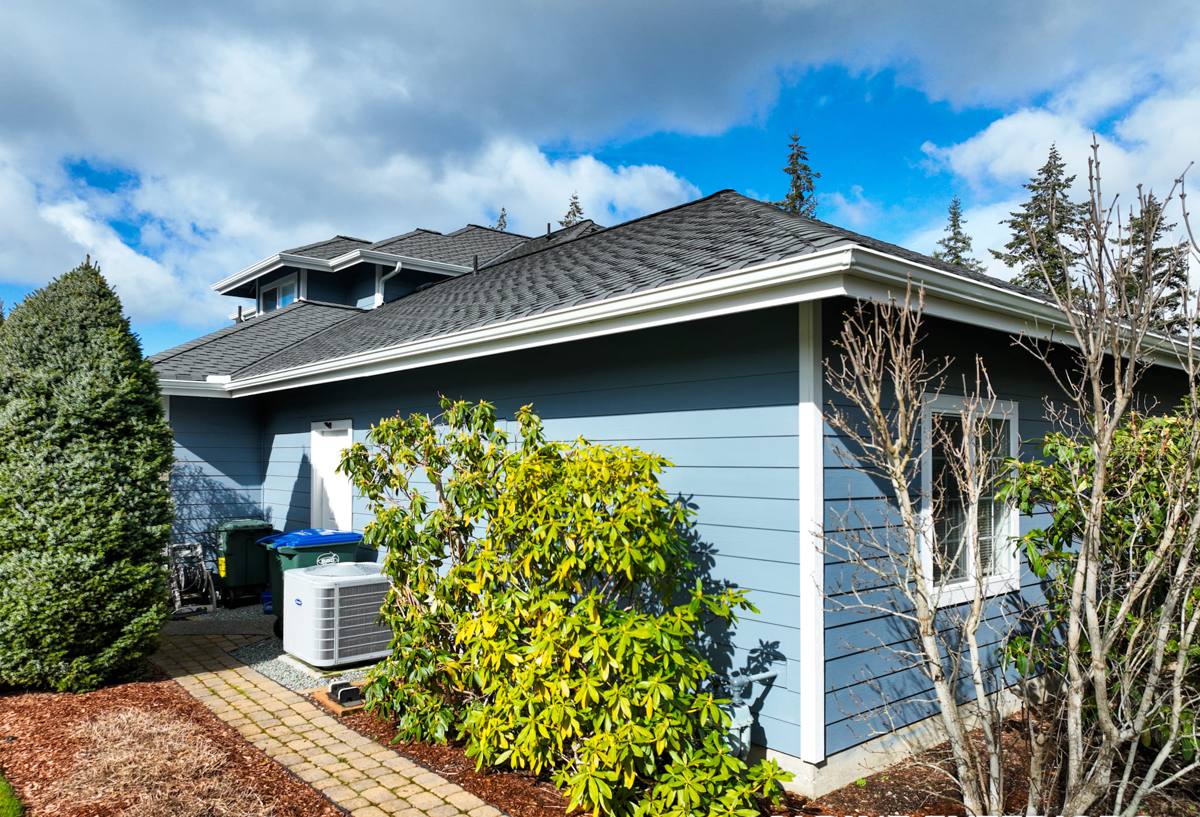
What Blaine's Climate Actually Does to a Roof
It helps to understand the specific mechanisms at work, not just "it rains a lot."
Salt Air and Metal Fatigue
Coastal salt air accelerates corrosion on exposed metal — nail heads, flashing, gutter fasteners, and any exposed screws on ridge caps or vents. A fastener that might last fifteen years inland can start rusting and backing out in half that time near the water. Rust stains bleeding down a roof slope are usually the first visible sign.
Driving Rain and Wind-Driven Water
Storms coming off the water don't just fall straight down — wind pushes rain sideways and up under shingle edges, at ridge caps, and around any roof penetration. Standard shingle overlap is designed for vertical rainfall. Wind-driven rain finds the gaps that gravity alone wouldn't reach, which is why proper underlayment and flashing detail matter more here than in calmer inland areas.
Moss, Algae, and Shade
Whatcom County's wet season, combined with tree cover common on Peace Arch lots, creates ideal conditions for moss and algae growth on north-facing and shaded roof slopes. Moss isn't just a cosmetic problem — its root structure lifts shingle edges, holds moisture against the roof deck, and accelerates granule loss. Left unaddressed for a few seasons, moss-related damage moves from a repair job to a full slope replacement.
Signs a Peace Arch Roof Needs Repair Now
Most roof failures we're called out for didn't happen overnight. They built up over one or two wet seasons. Homeowners in this area should watch for:
- Granules collecting in gutters or at downspout outlets
- Dark streaking or green-black growth on shaded slopes
- Curling, cupping, or lifted shingle edges, especially at the roof's leading edges
- Rust staining below flashing, vents, or metal ridge caps
- Soft or spongy decking felt underfoot in the attic near the eaves
- Water stains on interior ceilings, particularly after a windy rainstorm rather than a calm one
- Daylight visible through the roof deck from inside the attic
That last symptom — a stain that shows up only during wind-driven storms, not steady rain — is a strong clue the problem is wind-forced water at a flashing detail rather than a simple worn shingle. It's one of the more common repair calls we get from this part of Blaine.
What a Correct Repair Actually Involves
A roof repair done right is more than swapping a few shingles. On a coastal roof, the sequence matters:
1. Find the Real Source, Not Just the Symptom
Water travels. A stain on a bedroom ceiling might trace back to a flashing failure eight feet away. We trace leaks from the interior symptom back to the actual entry point before opening anything up, so the repair addresses the cause instead of patching where the water happened to show up.
2. Clear and Assess Before Repairing
On a moss-affected roof, we remove growth and debris from the repair area first. Repairing over moss just traps moisture under the new work and shortens its life. This also lets us see the actual condition of the shingles and decking underneath rather than guessing.
3. Replace Damaged Decking Where Needed
If water has been sitting under lifted shingles for a season or more, the plywood or OSB decking underneath can be soft or delaminated. Patching shingles over compromised decking is a short-term fix that fails again quickly. We check decking condition at every repair site and replace it where it's actually gone soft, not as a default upsell.
4. Rebuild Flashing Properly
Chimney flashing, valley flashing, and step flashing along dormers and sidewalls are the most common failure points on this type of roof. A correct repair uses proper step-and-counter flashing with adequate overlap and a compatible sealant — not just a bead of caulk over an old seam, which fails again within a season or two in this climate.
5. Match Materials and Tie In Cleanly
New shingles need to tie into the existing roof at the right offset and nailing pattern, with underlayment lapped correctly so water sheds over every seam. A patch that looks fine from the ground but wasn't tied in correctly will leak again at the first real windstorm.
Repair or Replace? How We Help You Decide
Not every damaged roof needs full replacement, and not every roof that looks rough is actually a repair candidate. We walk through the same factors on every Peace Arch inspection:
| Factor | Leans Toward Repair | Leans Toward Replacement |
|---|---|---|
| Roof age | Under roughly 15 years, or within the material's expected lifespan | At or past the manufacturer's expected service life |
| Extent of moss/algae damage | Limited to one or two slopes, caught early | Widespread across most of the roof, granule loss heavy |
| Number of leak points | One isolated flashing or penetration failure | Multiple unrelated leaks in different areas |
| Decking condition | Solid, dry decking outside the repair area | Soft or delaminated decking in multiple spots |
| Underlayment condition | Intact and still doing its job | Brittle, torn, or failing broadly under the shingles |
We'll tell you honestly which side of that table your roof falls on. If a repair genuinely solves the problem, that's what we'll recommend — a roof doesn't need to be replaced just because it's inconvenient to fix a section of it.
Our Process for Peace Arch Repair Calls
Because we already work this part of Blaine regularly, the process tends to move faster than a first-time visit from an out-of-area crew:
- Inspection and diagnosis — We assess the roof from both the exterior and, where accessible, the attic, to confirm the actual leak path or damage cause.
- Written scope and estimate — You get a clear description of what's being repaired, the materials involved, and the cost, before any work starts.
- Repair work — Moss and debris removal, decking replacement if needed, flashing rebuild, and shingle tie-in, done to match the surrounding roof.
- Cleanup and walkthrough — Job site cleared of debris and old material, and we walk you through what was done and what to watch for going forward.
Materials We Use — and Why
For repairs in a marine climate, we favor materials chosen for how they hold up here specifically, not just what's cheapest to install:
- Algae-resistant shingles for repair sections, which use copper-infused granules to slow regrowth on shaded slopes
- Corrosion-resistant flashing and fasteners — standard galvanized components corrode faster than they should this close to salt air, so we favor better-rated metal at critical joints
- Self-adhered ice-and-water membrane at valleys, eaves, and flashing details, which seals around fastener penetrations far better than felt alone in wind-driven rain
We don't push premium materials on every job. For a straightforward shingle repair on a newer roof, standard components matched to the existing roof are often the right call. Where we do recommend an upgrade — usually at flashing points or in heavy-moss zones — it's because that specific detail is a known weak point on coastal roofs, not a blanket sales pitch.
What to Ask Before Hiring Anyone to Repair Your Roof
Roof repair is one of the easier trades to do badly and have it look fine for a year before it fails. A few questions separate a solid contractor from a risky one:
- Are you licensed and bonded to do roofing work in Washington State?
- Do you carry liability insurance, and can you provide proof?
- Will the estimate be in writing, with the scope of work spelled out?
- Do you check attic or decking condition before quoting, or just look at the roof from the outside?
- How do you handle moss and debris removal as part of the repair, not just the shingle swap?
- What warranty applies to the labor, separate from the material warranty?
- Do you regularly work in this area, or is this a one-off trip?
Any contractor who hesitates on the licensing and insurance questions is worth walking away from — that's not a place to compromise on a home's largest protective surface.
Why a Local Crew Matters for Peace Arch Homes
A crew that already works this neighborhood has seen the specific failure patterns of Blaine's coastal exposure repeatedly — which flashing details fail first, which slopes hold moss the longest, how quickly wind-driven rain finds a weak seam. That's practical knowledge that speeds up diagnosis and reduces the guesswork on your repair. It also means we're not learning Whatcom County's climate on your roof for the first time, and we're a reasonable drive away if a repair needs a follow-up check after the next storm.
If you're seeing moss buildup, a stain that only shows up in windy storms, or you just want a second opinion before committing to a full roof replacement, we're happy to take a look. Fill out the form below for a free, no-pressure estimate — we'll give you a straight answer on what your roof actually needs.